Manual pulse checks in children show moderate accuracy and take a long time
Pulse check accuracy in pediatrics during resuscitation: a systematic review
Systematic reviewHarm found
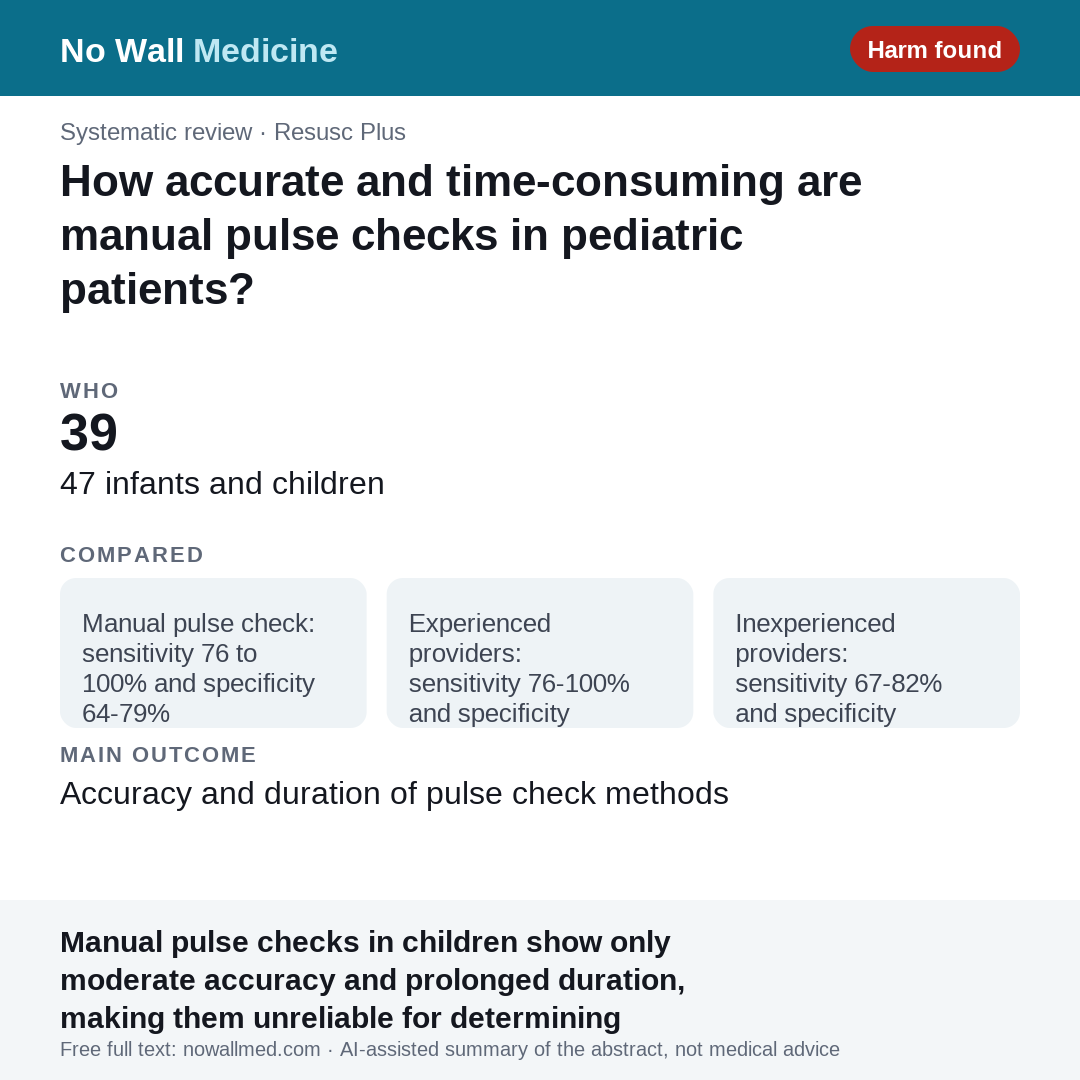
How accurate and time-consuming are manual pulse checks in pediatric patients?
Who
39
47 infants and children
Compared
Manual pulse check: sensitivity 76 to 100% and specificity 64-79%
Experienced providers: sensitivity 76-100% and specificity 62-82%
Inexperienced providers: sensitivity 67-82% and specificity 44-95%
Main outcome
Accuracy and duration of pulse check methods
Bottom line: Manual pulse checks in children show only moderate accuracy and prolonged duration, making them unreliable for determining cardiac arrest.
Resusc Plus · 2025-04-17Download image
Clinical question: How accurate and time-consuming are manual pulse checks in pediatric patients?
Why it matters: Current guidelines suggest starting cardiopulmonary resuscitation based on signs of life, but manual pulse checks are considered unreliable and time-consuming.
Key points
- Researchers reviewed three studies involving 39 pediatric patients and 376 pulse checks performed by 183 nurses and 181 physicians.
- Manual pulse check sensitivity ranged from 76% to 100% and specificity ranged from 64% to 79%.
- The mean duration of pulse checks was 20 s with an accuracy of 85%.
Headline and key points written with AI from the paper’s abstract, with every number checked against it. Read the paper before relying on them.
Was this summary helpful?
Cite this article
Katzenschlager S, Acworth J, Tiwari LK, Kleinmann M, Myburgh M, Castillo JD. Pulse check accuracy in pediatrics during resuscitation: a systematic review. Resusc Plus. 2025. doi:10.1016/j.resplu.2025.100959
Spotted a mistake? Suggest a correction
Top studies every Monday
The week’s key trials and guidelines in your specialties, plus any topics you follow. By email, free.
Get the weekly digest