Pulsed Field vs Conventional Thermal Ablation for Paroxysmal Atrial Fibrillation: Recurrent Atrial Arrhythmia Burden
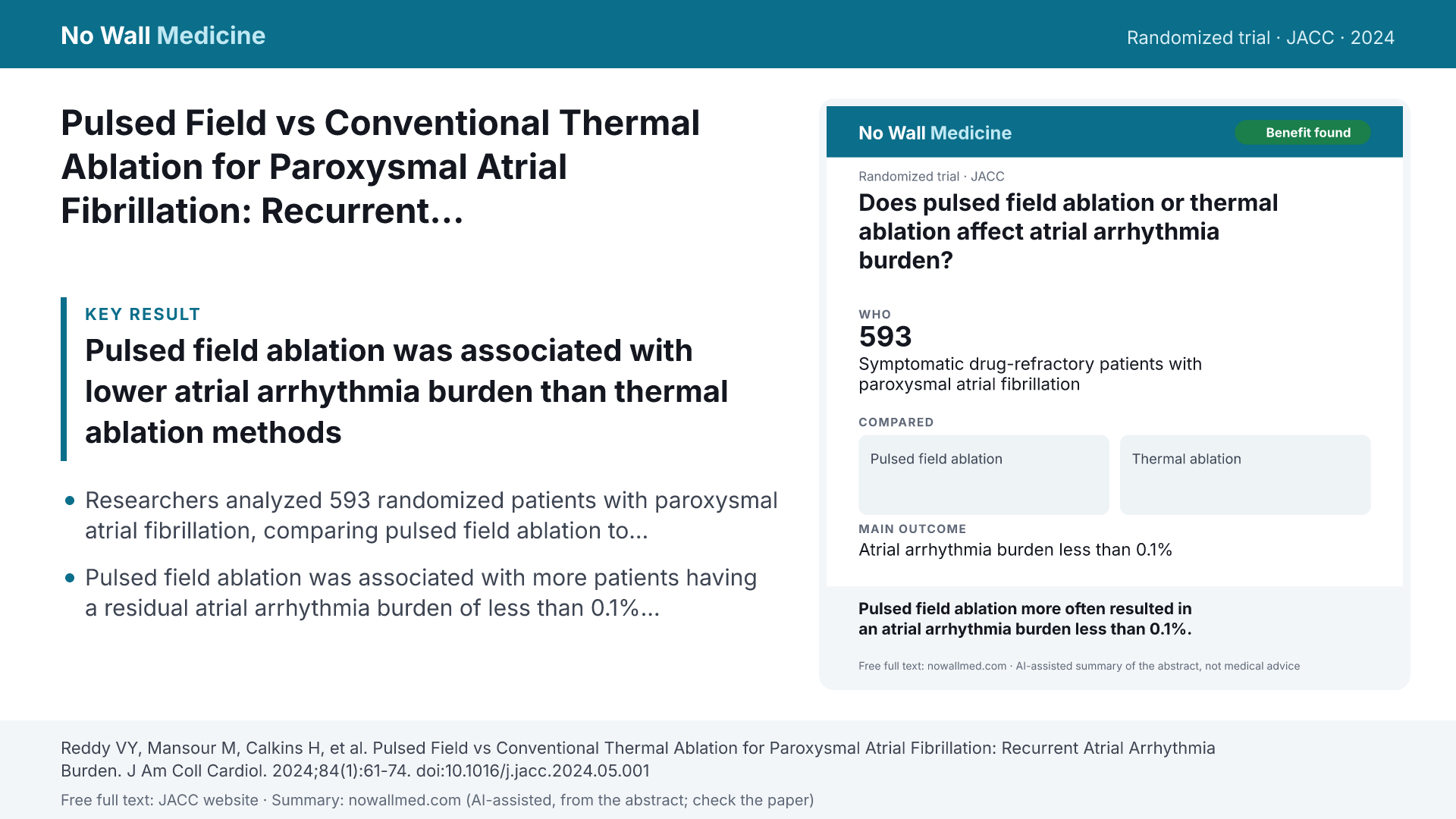
Key result: Pulsed field ablation was associated with lower atrial arrhythmia burden than thermal ablation methods
Randomized trialBenefit found
Does pulsed field ablation or thermal ablation affect atrial arrhythmia burden?
Who
593
Symptomatic drug-refractory patients with paroxysmal atrial fibrillation
Compared
Pulsed field ablation
Thermal ablation
Main outcome
Atrial arrhythmia burden less than 0.1%
Result: odds ratio 1.5 (95% CI 1.0-2.3)
Bottom line: Pulsed field ablation more often resulted in an atrial arrhythmia burden less than 0.1%.
JACC · 2024-05-18
Key points
- Researchers analyzed 593 randomized patients with paroxysmal atrial fibrillation, comparing pulsed field ablation to thermal ablation using radiofrequency or cryoballoon methods.
- Pulsed field ablation was associated with more patients having a residual atrial arrhythmia burden of less than 0.1% compared to thermal ablation (OR: 1.5; 95% CI: 1.0-2.3; P = 0.04).
- An atrial arrhythmia burden exceeding 0.1% was associated with reduced quality of life and increased clinical interventions like redo ablation, cardioversion, and hospitalization.
Discussion prompts
- Would these patients look like yours? Who was left out?
- Is the main outcome one that matters to patients?
- Is the difference large enough to change what you do?
Cite: Reddy VY, Mansour M, Calkins H, et al. Pulsed Field vs Conventional Thermal Ablation for Paroxysmal Atrial Fibrillation: Recurrent Atrial Arrhythmia Burden. J Am Coll Cardiol. 2024;84(1):61-74. doi:10.1016/j.jacc.2024.05.001
Free full text: JACC website · Summary and visual abstract: nowallmed.com/a/pulsed-field-vs-conventional-thermal-ablation-for-paroxysmal-atrial-1lko4t0/ (AI-assisted from the abstract; check the paper before relying on it).