Four-drug regimens show better outcomes and higher infection rates in newly diagnosed multiple myeloma
Quadruplet regimens for patients with newly diagnosed multiple myeloma: a systematic review and meta-analysis
Systematic review and meta-analysis of 7 randomized controlled trialsBenefit found
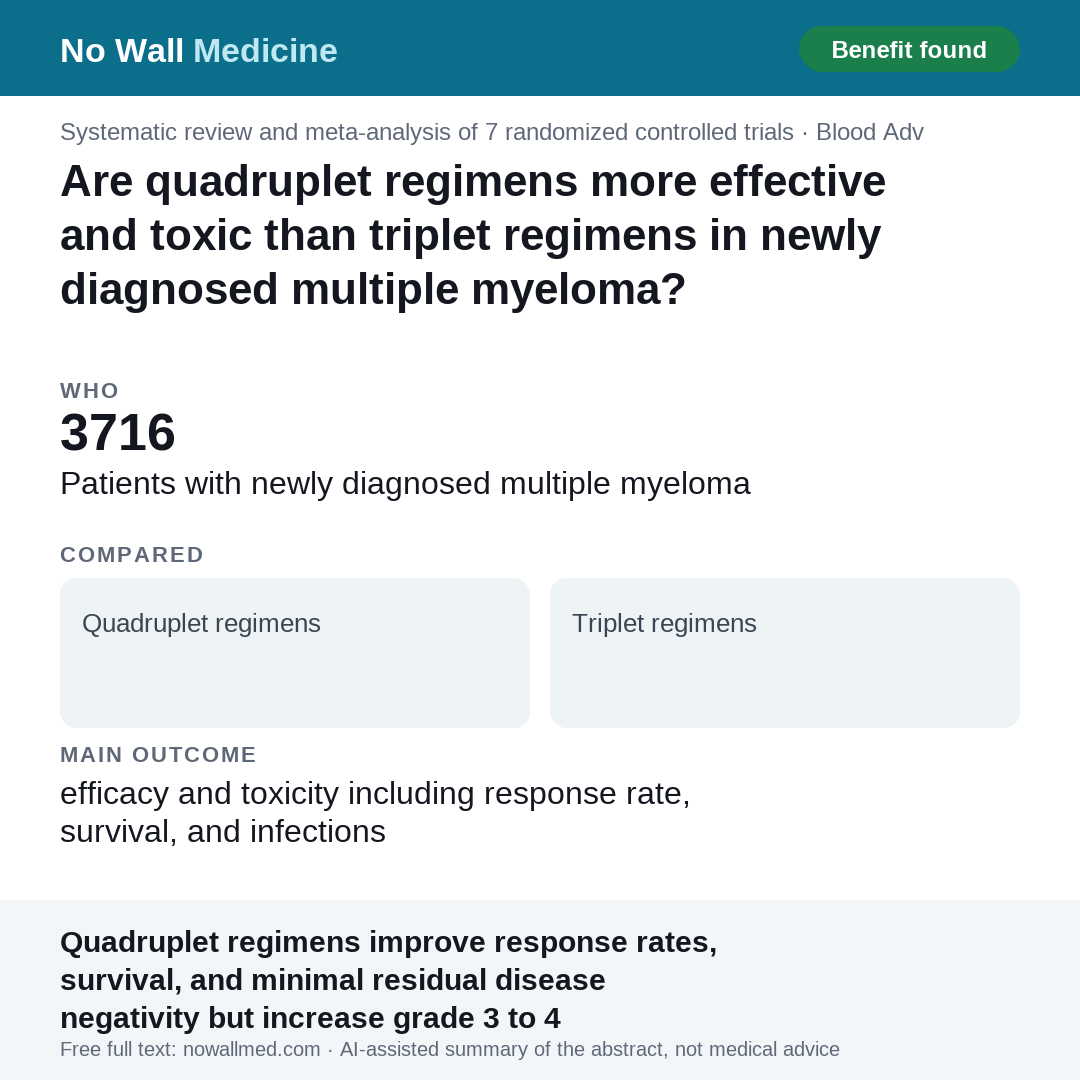
Are quadruplet regimens more effective and toxic than triplet regimens in newly diagnosed multiple myeloma?
Who
3716
Patients with newly diagnosed multiple myeloma
Compared
Quadruplet regimens
Triplet regimens
Main outcome
efficacy and toxicity including response rate, survival, and infections
Result: hazard ratio 0.55 (95% CI 0.46-0.66) for progression-free survival
Bottom line: Quadruplet regimens improve response rates, survival, and minimal residual disease negativity but increase grade 3 to 4 infections.
Blood Adv · 2024-09-30Download image
Clinical question: Are quadruplet regimens more effective and toxic than triplet regimens in newly diagnosed multiple myeloma?
Why it matters: The efficacy and toxicity of adding an anti-CD38 monoclonal antibody to standard proteasome inhibitor and immunomodulatory drug regimens in newly diagnosed multiple myeloma were not fully synthesized.
Key points
- Researchers analyzed 7 randomized controlled trials involving 3716 patients to compare three-drug regimens against four-drug regimens for newly diagnosed multiple myeloma.
- Four-drug regimens were associated with higher overall response rates (RR, 1.03; 95% CI, 1.01-1.05) and better progression-free survival (HR, 0.55; 95% CI, 0.46-0.66).
- The four-drug approach was linked to higher rates of minimal residual disease negativity and a slight increase in grade 3 to 4 infections (RR, 1.22; 95% CI, 1.07-1.39).
Headline and key points written with AI from the paper’s abstract, with every number checked against it. Read the paper before relying on them.
Was this summary helpful?
Abstract
Quadruplet regimens (anti-CD38 monoclonal antibodies [mAbs] with proteasome inhibitor [PI] and immunomodulatory drugs [IMiDs]) are increasingly being investigated in newly diagnosed multiple myeloma (NDMM). The objective of our study was to conduct a systematic review and meta-analysis to measure the efficacy and toxicity of quadruplet regimens used in NDMM. Embase, MEDLINE, Web of Science, Cochrane Library, clinical trial registries, and meeting libraries from inception to 24 January 2024, in addition to American Society of Clinical Oncology conference abstracts 2024, were searched using terms reflecting multiple myeloma and components of the quadruplet regimen. Included studies were randomized controlled trials (RCTs) that compared backbone regimens consisting of a PI and IMiD vs the same regimen plus an anti-CD38 mAb in NDMM. We identified 7 RCTs including 3716 patients. Compared with triplets, quadruplets increase the overall response rate (ORR; relative risk [RR], 1.03; 95% confidence interval [CI], 1.01-1.05) and progression-free survival (PFS; hazard ratio [HR], 0.55; 95% CI, 0.46-0.66). Quadruplets increase the rates of minimal residual disease (MRD) negativity at 10-5 (RR, 1.39; 95% CI, 1.23-1.58) and 10-6 (RR, 1.62; 95% CI, 1.36-1.94). Quadruplets improve overall survival (OS; HR, 0.65; 95% CI, 0.53-0.79). There was a slight increase in the rates of grade 3 to 4 infections (RR, 1.22; 95% CI, 1.07-1.39) noted with quadruplets compared with triplets. Overall, in this meta-analysis, quadruplets were associated with improved efficacy including ORR, MRD negativity, PFS, and OS, with a slight increase in infection rates. Quadruplet regimens represent a new standard of care, particularly in transplant-eligible NDMM.
Abstract reproduced under the article’s CC BY NC ND licence.
Subject terms
Cite this article
Ebraheem MS, Chakraborty R, Rochwerg B, Visram A, Mohyuddin GR, Venner CP. Quadruplet regimens for patients with newly diagnosed multiple myeloma: a systematic review and meta-analysis. Blood Adv. 2024. doi:10.1182/bloodadvances.2024014139
Spotted a mistake? Suggest a correction
Top studies every Monday
The week’s key trials and guidelines in your specialties, plus any topics you follow. By email, free.
Get the weekly digest