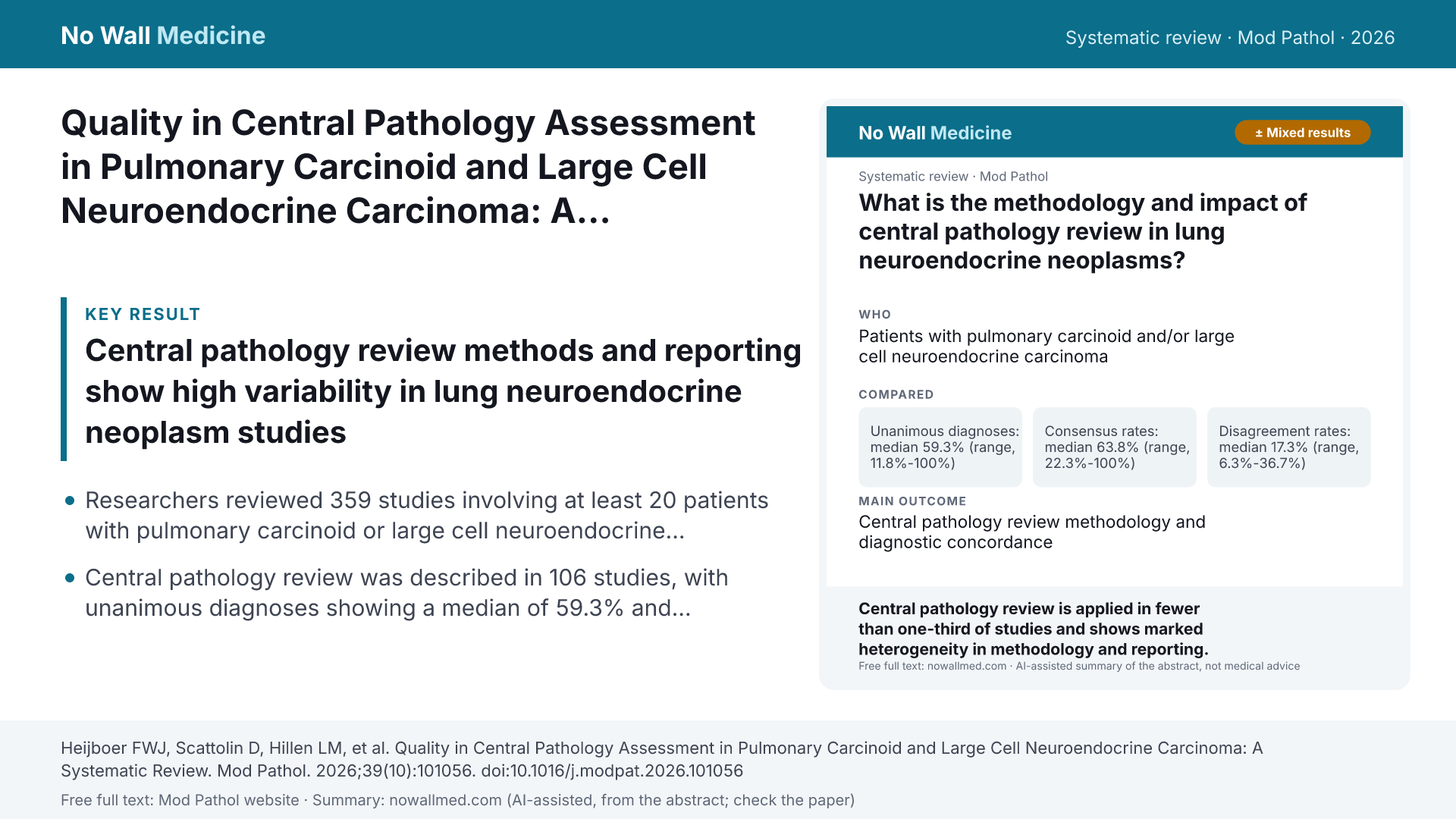
Central pathology review methods and reporting show high variability in lung neuroendocrine neoplasm studies
Quality in Central Pathology Assessment in Pulmonary Carcinoid and Large Cell Neuroendocrine Carcinoma: A Systematic Review
Systematic reviewMixed results
What is the methodology and impact of central pathology review in lung neuroendocrine neoplasms?
Who
Patients with pulmonary carcinoid and/or large cell neuroendocrine carcinoma
Compared
Unanimous diagnoses: median 59.3% (range, 11.8%-100%)
Consensus rates: median 63.8% (range, 22.3%-100%)
Disagreement rates: median 17.3% (range, 6.3%-36.7%)
Main outcome
Central pathology review methodology and diagnostic concordance
Bottom line: Central pathology review is applied in fewer than one-third of studies and shows marked heterogeneity in methodology and reporting.
Mod Pathol · 2026-08-05Download image

Clinical question: What is the methodology and impact of central pathology review in lung neuroendocrine neoplasms?
Why it matters: The methodology and impact of using central pathology review to improve diagnostic accuracy for lung neuroendocrine neoplasms remain poorly characterized.
Key points
- Researchers reviewed 359 studies involving at least 20 patients with pulmonary carcinoid or large cell neuroendocrine carcinoma to examine central pathology review practices.
- Central pathology review was described in 106 studies, with unanimous diagnoses showing a median of 59.3% and consensus rates showing a median of 63.8%.
- Disagreement rates between pathologists had a median of 17.3%, while interobserver variability, a measure of how much experts agree, ranged from 0.21 to 0.98.
Limitation the authors note: The review noted substantial heterogeneity in how central pathology review is implemented, reported, and assessed across different studies.
Headline and key points written with AI from the paper’s abstract, with every number checked against it. Read the paper before relying on them.
Was this summary helpful?
Subject terms
Headline, design, result, key points, caveat and citation as plain text.
Cite this article
Heijboer FWJ, Scattolin D, Hillen LM, et al. Quality in Central Pathology Assessment in Pulmonary Carcinoid and Large Cell Neuroendocrine Carcinoma: A Systematic Review. Mod Pathol. 2026;39(10):101056. doi:10.1016/j.modpat.2026.101056
Spotted a mistake? Suggest a correction