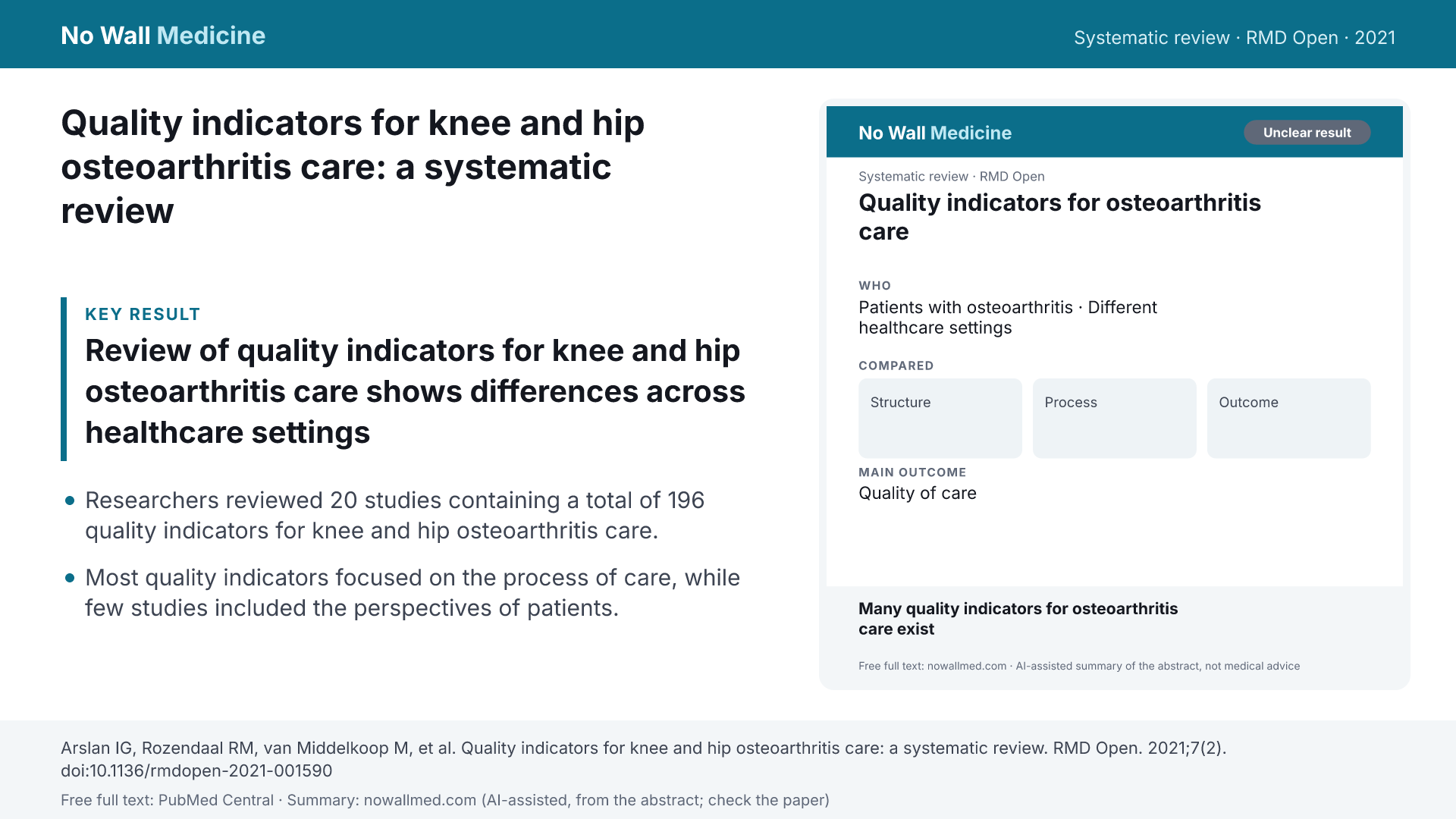
Review of quality indicators for knee and hip osteoarthritis care shows differences across healthcare settings
Quality indicators for knee and hip osteoarthritis care: a systematic review
Systematic reviewUnclear result
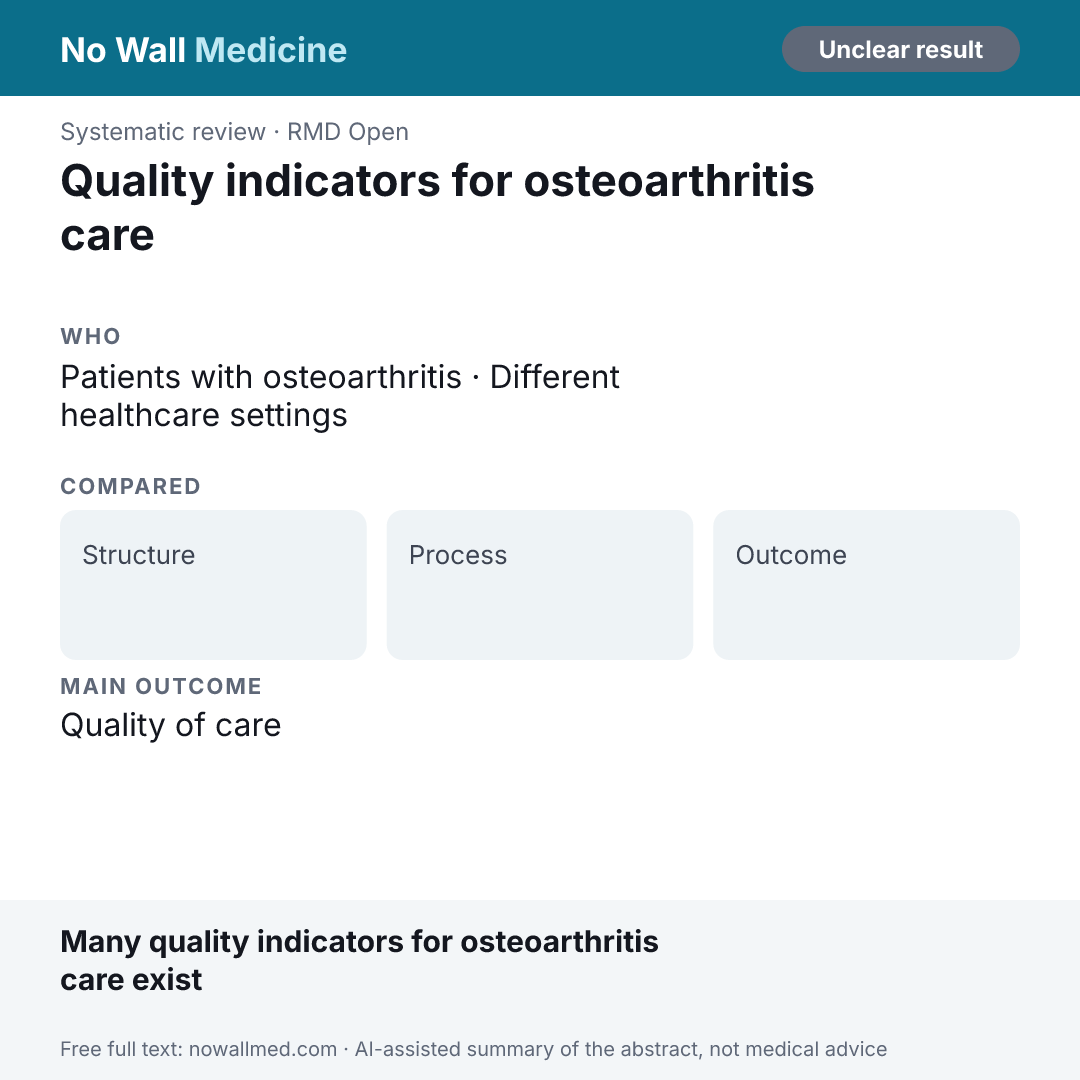
Quality indicators for osteoarthritis care
Who
Patients with osteoarthritis · Different healthcare settings
Compared
Structure
Process
Outcome
Main outcome
Quality of care
Bottom line: Many quality indicators for osteoarthritis care exist
RMD Open · 2021-05-27 · Save PNG
Key points
- Researchers reviewed 20 studies containing a total of 196 quality indicators for knee and hip osteoarthritis care.
- Most quality indicators focused on the process of care, while few studies included the perspectives of patients.
- Differences were found between healthcare settings regarding weight counseling, exercise therapy, laboratory test referrals, and 'do not do' indicators.
Headline and key points written with AI from the paper’s abstract, with every number checked against it. Read the paper before relying on them.
Was this summary helpful?
Abstract
To provide an overview of quality indicators (QIs) for knee and hip osteoarthritis (KHOA) care and to highlight differences in healthcare settings. A database search was conducted in MEDLINE (PubMed), EMBASE, CINAHL, Web of Science, Cochrane CENTRAL and Google Scholar, OpenGrey and Prospective Trial Register, up to March 2020. Studies developing or adapting existing QI(s) for patients with osteoarthritis were eligible for inclusion. Included studies were categorised into healthcare settings. QIs from included studies were categorised into structure, process and outcome of care. Within these categories, QIs were grouped into themes (eg, physical therapy). A narrative synthesis was used to describe differences and similarities between healthcare settings. We included 20 studies with a total of 196 QIs mostly related to the process of care in different healthcare settings. Few studies included patients' perspectives. Rigorous methods for evidence synthesis to develop QIs were rarely used. Narrative analysis showed differences in QIs between healthcare settings with regard to exercise therapy, weight counselling, referral to laboratory tests and 'do not do' QIs. Differences within the same healthcare setting were identified on radiographic assessment. The heterogeneity in QIs emphasise the necessity to carefully select QIs for KHOA depending on the healthcare setting. This review provides an overview of QIs outlined to their healthcare settings to support healthcare providers and policy makers in selecting the contextually appropriate QIs to validly monitor the quality of KHOA care. We strongly recommend to review QIs against the most recent guidelines before implementing them into practice.
Abstract reproduced under the article’s CC BY licence.
Subject terms
Headline, design, result, key points, caveat and citation as plain text.
Cite this article
Arslan IG, Rozendaal RM, van Middelkoop M, et al. Quality indicators for knee and hip osteoarthritis care: a systematic review. RMD Open. 2021. doi:10.1136/rmdopen-2021-001590
Spotted a mistake? Suggest a correction