Integrated care programs showed mixed results for spending and outcomes among dual-eligible Medicare-Medicaid beneficiaries
Quality, Spending, Utilization, and Outcomes Among Dual-Eligible Medicare-Medicaid Beneficiaries in Integrated Care Programs: A Systematic Review
Systematic reviewMixed results
How do integrated care programs affect spending, quality, utilization, and outcomes for dual-eligible beneficiaries?
Who
Dual-eligible Medicare-Medicaid beneficiaries · United States
Compared
Integrated care programs
Nonintegrated arrangements
Main outcome
Spending, quality, utilization, and patient outcomes
Bottom line: Integrated care programs showed variable effects on spending, utilization, and outcomes, with some reductions in nursing home stays.
Limitation: Limited ability to control for bias from unmeasured differences between enrollees.
JAMA Health Forum · 2024-07-05Download image
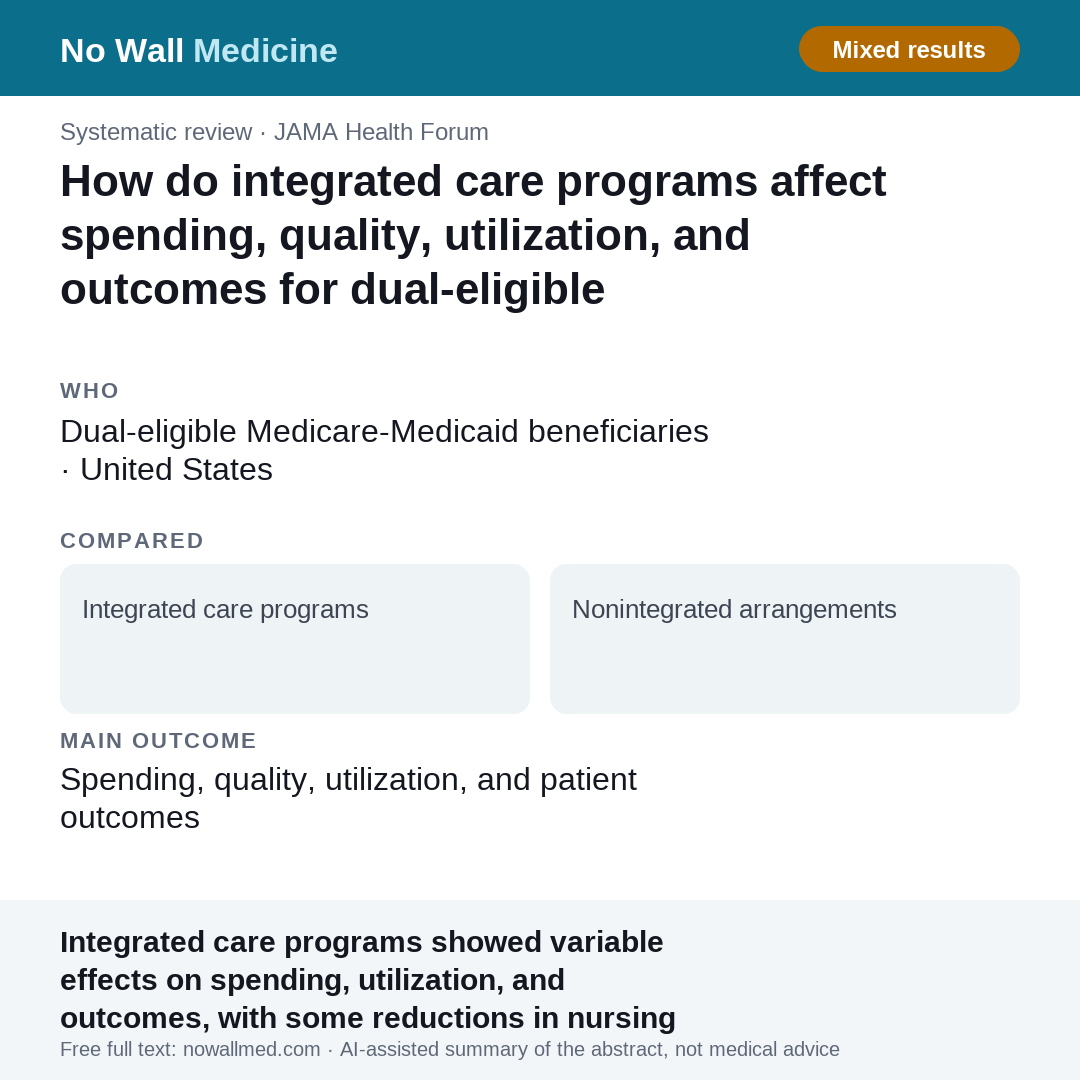
Clinical question: How do integrated care programs affect spending, quality, utilization, and outcomes for dual-eligible beneficiaries?
Why it matters: It is unknown how integrated care plans that manage both Medicare and Medicaid benefits affect healthcare spending, quality, and patient outcomes for dual-eligible beneficiaries.
Key points
- Researchers reviewed 26 evaluations of integrated care programs including Programs of All-Inclusive Care for the Elderly, Medicare-Medicaid Plans, and Fully Integrated Dual Eligible Special Needs Plans.
- Integrated care was associated with fewer long-term nursing home stays in some PACE and Fully Integrated Dual Eligible Special Needs Plan studies, but Medicare-Medicaid Plans were associated with higher Medicare spending in 8 of 10 studies.
- Results regarding hospitalizations, care coordination, and patient satisfaction were mixed, inconclusive, or insufficient to evaluate specific subgroups.
Limitation the authors note: Studies had a limited ability to control for bias from unmeasured differences between enrollees of integrated care programs compared with nonintegrated models.
Headline and key points written with AI from the paper’s abstract, with every number checked against it. Read the paper before relying on them.
Was this summary helpful?
Subject terms
Cite this article
Roberts ET, Duggan C, Stein R, Jonnadula S, Johnston KJ, Figueroa JF. Quality, Spending, Utilization, and Outcomes Among Dual-Eligible Medicare-Medicaid Beneficiaries in Integrated Care Programs: A Systematic Review. JAMA Health Forum. 2024. doi:10.1001/jamahealthforum.2024.2187
Spotted a mistake? Suggest a correction
Top studies every Monday
The week’s key trials and guidelines in your specialties, plus any topics you follow. By email, free.
Get the weekly digest