QFR-guided PCI had lower 3-year MACE rate in multivessel disease patients
Quantitative Flow Ratio- vs Angiography-Guided Percutaneous Coronary Intervention: A Secondary Analysis of the FAVOR III China Trial
Randomized clinical trialBenefit found
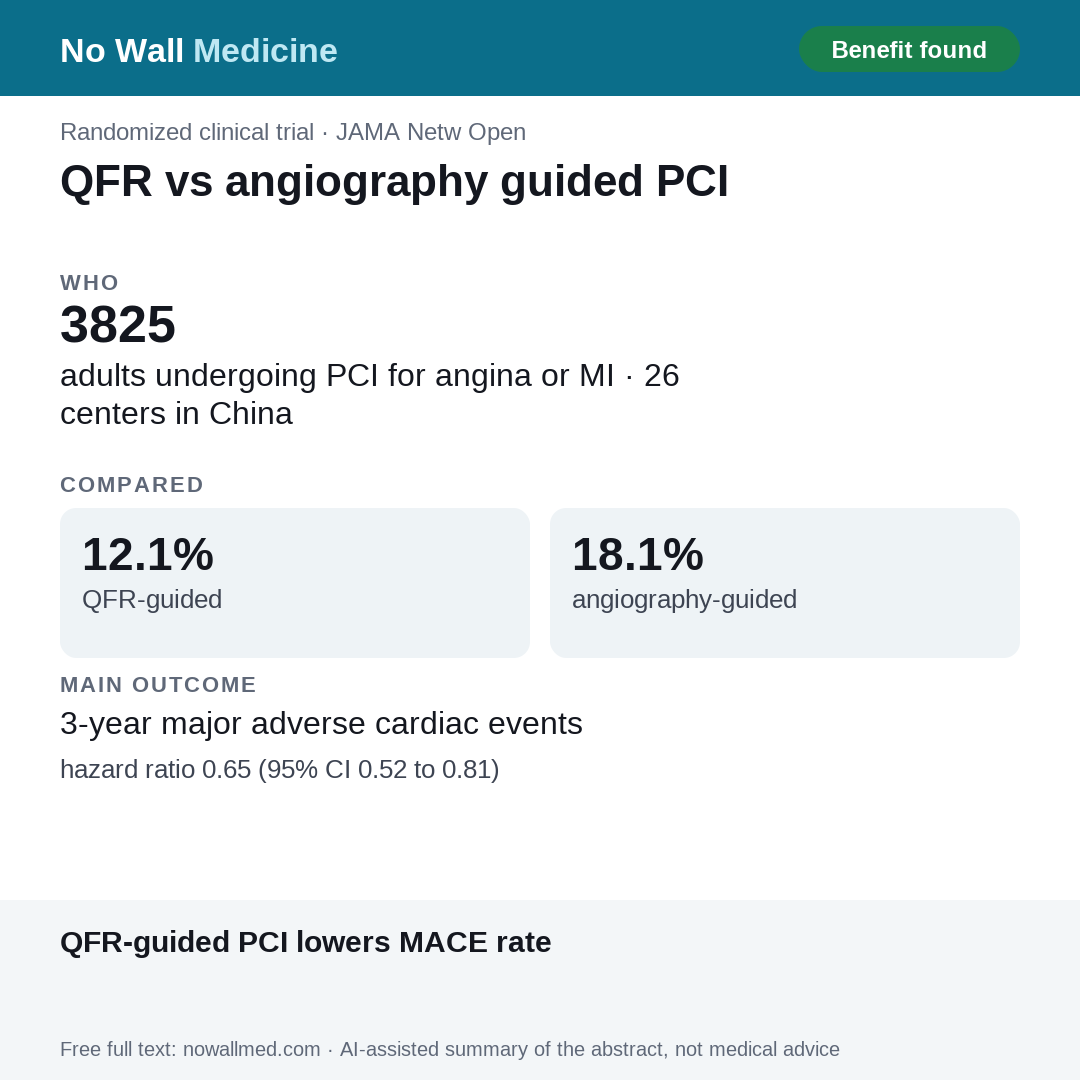
QFR vs angiography guided PCI
Who
3825
adults undergoing PCI for angina or MI · 26 centers in China
Compared
12.1%QFR-guided (124/1023)
18.1%angiography-guided (188/1043)
Main outcome
3-year major adverse cardiac events
Result: hazard ratio 0.65 (95% CI 0.52 to 0.81)
Bottom line: QFR-guided PCI lowers MACE rate
JAMA Netw Open · 2026-10-01Download image
Key points
- 3825 patients undergoing heart vessel opening procedure were studied, 54% had multivessel disease.
- QFR-guided procedure had 12.1% major adverse cardiac events rate, angiography-guided had 18.1% rate.
- QFR-guided procedure was associated with lower MACE rate in multivessel disease patients, with hazard ratio 0.65.
Headline and key points written with AI from the paper’s abstract, with every number checked against it. Read the paper before relying on them.
Topics
Spotted a mistake? Suggest a correction
More in Cardiology
Clonal hematopoiesis mutations linked to higher atrial fibrillation risk in cancer populations
Association of Clonal Hematopoiesis Mutations With Incident Atrial Fibrillation: A Systematic Review and Meta-Analysis
Deep learning model detects aortic stenosis from finger-cuff pressure waveforms accurately
Aortic Valve Stenosis Screening Using Deep Learning on Noninvasive Arterial Pressure Waveforms
Spontaneous coronary artery dissection affects younger women more often than expected
Spontaneous coronary artery dissection: implications for women's health, clinical care, and future research
Early lipid-lowering strategies may reduce atherosclerotic cardiovascular disease risk
Lipid-Lowering Strategies in the Era of Early Atherosclerosis Detection: 2026 ACC Scientific Statement: A Report of the American College of Cardiology