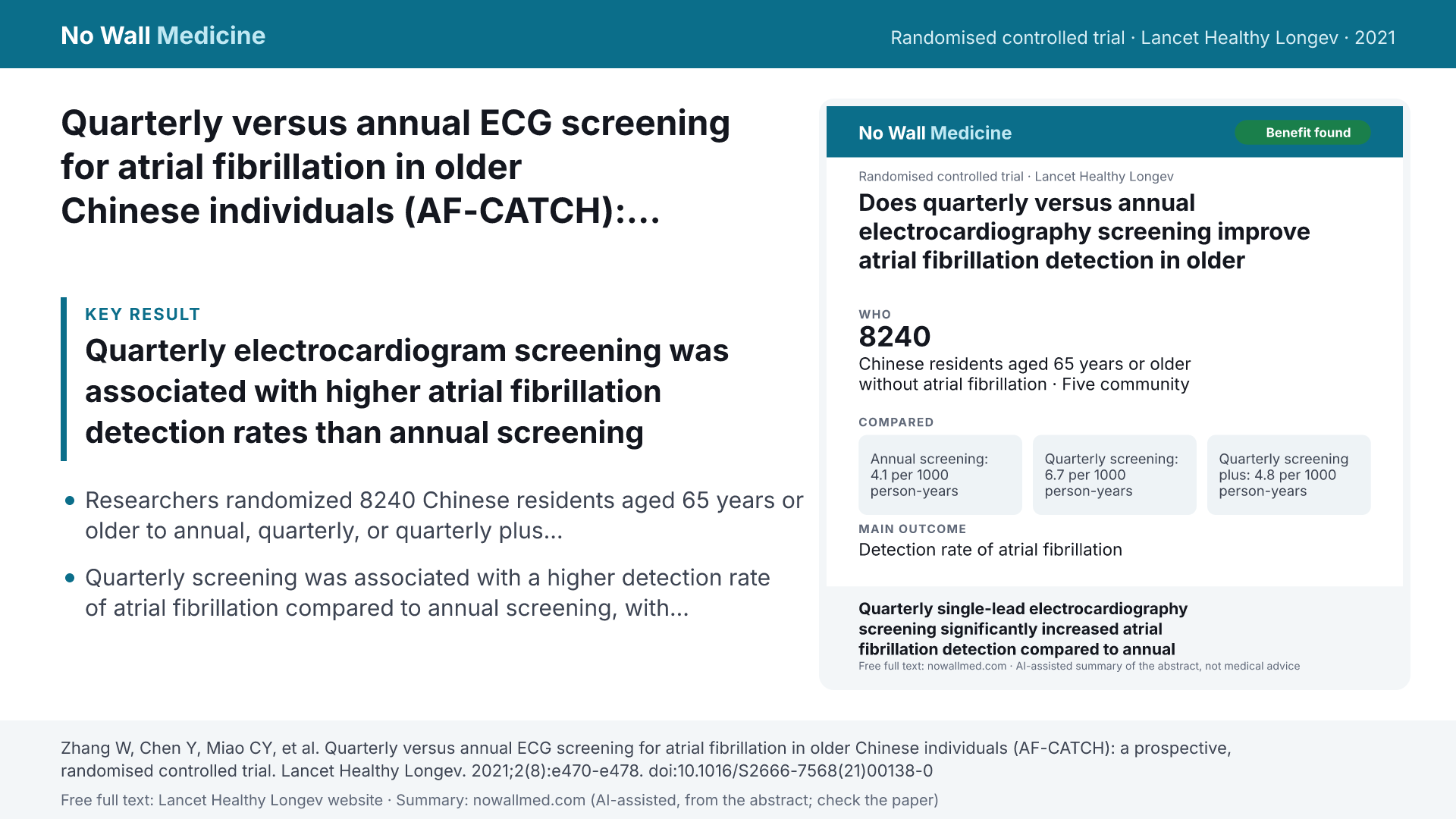
Quarterly electrocardiogram screening was associated with higher atrial fibrillation detection rates than annual screening
Quarterly versus annual ECG screening for atrial fibrillation in older Chinese individuals (AF-CATCH): a prospective, randomised controlled trial
Randomised controlled trialBenefit found
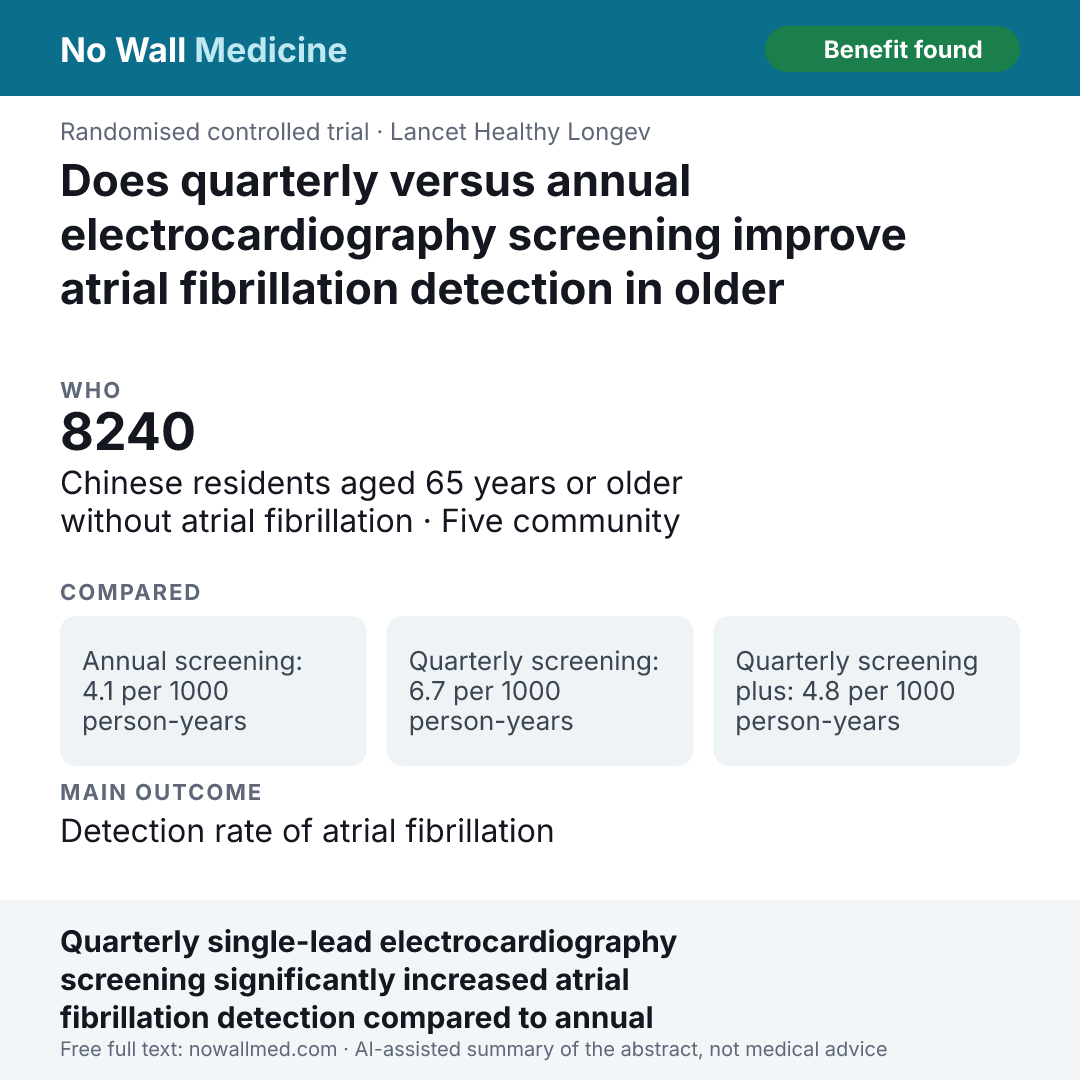
Does quarterly versus annual electrocardiography screening improve atrial fibrillation detection in older Chinese individuals?
Who
8240
Chinese residents aged 65 years or older without atrial fibrillation · Five community health centres in Shanghai, China
Compared
Annual screening: 4.1 per 1000 person-years
Quarterly screening: 6.7 per 1000 person-years
Quarterly screening plus: 4.8 per 1000 person-years
Main outcome
Detection rate of atrial fibrillation
Result: hazard ratio 1.71 (95% CI 1.06-2.76)
Bottom line: Quarterly single-lead electrocardiography screening significantly increased atrial fibrillation detection compared to annual screening in older Chinese residents.
Funded by: Bayer Healthcare Company
Lancet Healthy Longev · 2021-07-23 · Save PNG
Clinical question: Does quarterly versus annual electrocardiography screening improve atrial fibrillation detection in older Chinese individuals?
Key points
- Researchers randomized 8240 Chinese residents aged 65 years or older to annual, quarterly, or quarterly plus electrocardiogram screening over a median of 2.1 years.
- Quarterly screening was associated with a higher detection rate of atrial fibrillation compared to annual screening, with a hazard ratio of 1.71.
- The quarterly screening plus group, which included weekly screenings for the first month, showed no significant difference in detection compared to the quarterly group.
Headline and key points written with AI from the paper’s abstract, with every number checked against it. Read the paper before relying on them.
Was this summary helpful?
Abstract
Background
Screening for atrial fibrillation before onset of symptoms and the subsequent initiation of oral anticoagulants could prevent stroke and death. The most cost-effective strategy to screen for atrial fibrillation in a population at high risk aged 65 years and older is unknown. Therefore, we aimed to investigate whether more frequent electrocardiography (ECG) recordings would significantly improve the detection of atrial fibrillation compared with annual ECG screenings. Methods
We did a randomised controlled trial that compared different screening frequencies of 30 s single-lead ECG (AliveCor Heart Monitor) in the detection of atrial fibrillation in Chinese residents (≥65 years) in five community health centres in Shanghai, China. Only participants without history of atrial fibrillation and without atrial fibrillation rhythm at baseline were eligible for inclusion in the trial. Random assignment was done with the use of a random number table and stratified for study site. Participants were randomly assigned in a 1:1 ratio to annual or quarterly screening groups. The quarterly screening group was further randomly assigned in a 3:1 ratio to subgroups of quarterly screening and quarterly screening plus (which involved ECG screening once per week for the first month of follow-up, then quarterly for the remainder of follow-up). The primary outcome was the detection rate of atrial fibrillation. The intention-to-treat analysis was done for all randomly assigned patients who had at least one ECG recording during follow-up. This trial was registered at ClinicalTrials.gov, NCT02990741, and terminated on Oct 31, 2020. Findings
Between April 17, 2017, and June 26, 2018, 8240 participants were randomly assigned to annual screening (n=4120), quarterly screening (n=3090), and quarterly screening plus (n=1030), with a mean number of ECG recordings of 1·6 (SD 0·5) for annual screening, 3·5 (1·5) for quarterly screening, and 5·2 (2·9) for quarterly screening plus during a median of 2·1 years follow-up (13 284 person-years). 73 incident cases of atrial fibrillation occurred: 26 in the annual screening group (4·1 per 1000 person-years) and 47 in the quarterly screening group (6·7 per 1000 person-years. Quarterly screening was associated with a significant increase in the detection rate of atrial fibrillation, compared with annual screening (hazard ratio [HR] 1·71; 95% CI 1·06-2·76; p=0·029). 40 incident cases were detected in quarterly screening (7·2 per 1000 person-years; HR compared to annual screening, 1·83; 95% CI 1·12-3·00; p=0·017) and seven in the quarterly screening plus group (4·8 per 1000 person-years; HR compared with annual screening, 1·24; 0·54-2·86; p=0·61). No significant difference was noted between quarterly screening and the quarterly screening plus group (HR of quarterly screening plus compared with quarterly screening, 0·68; 0·30-1·52; p=0·35). Interpretation
Quarterly 30 s single-lead ECG screening was associated with a significantly higher detection rate of incident atrial fibrillation compared with annual screening, but additional once per week screenings in the first month did not yield an added predictive value. Quarterly screening might be considered in a general population at a high risk of atrial fibrillation, such as those aged 65 years and older. Funding
Bayer Healthcare Company.
Abstract reproduced under the article’s CC BY NC ND licence.
Subject terms
Headline, design, result, key points, caveat and citation as plain text.
Cite this article
Zhang W, Chen Y, Miao CY, et al. Quarterly versus annual ECG screening for atrial fibrillation in older Chinese individuals (AF-CATCH): a prospective, randomised controlled trial. Lancet Healthy Longev. 2021;2(8):e470-e478. doi:10.1016/S2666-7568(21)00138-0
Spotted a mistake? Suggest a correction