Race and Ethnicity Representation in Phase 2/3 Oncology Clinical Trial Publications: A Systematic Review
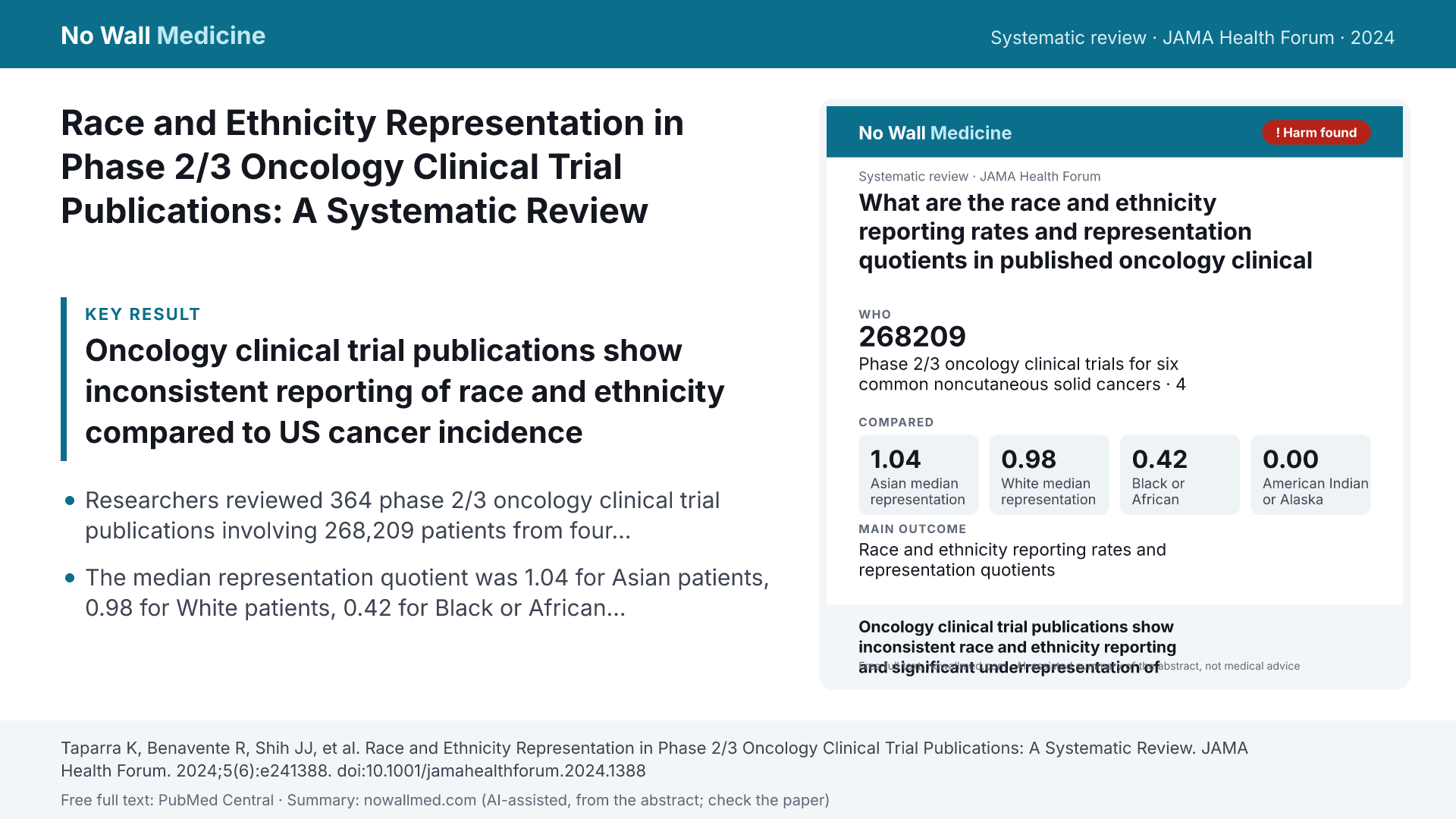
Key result: Oncology clinical trial publications show inconsistent reporting of race and ethnicity compared to US cancer incidence
Systematic reviewHarm found
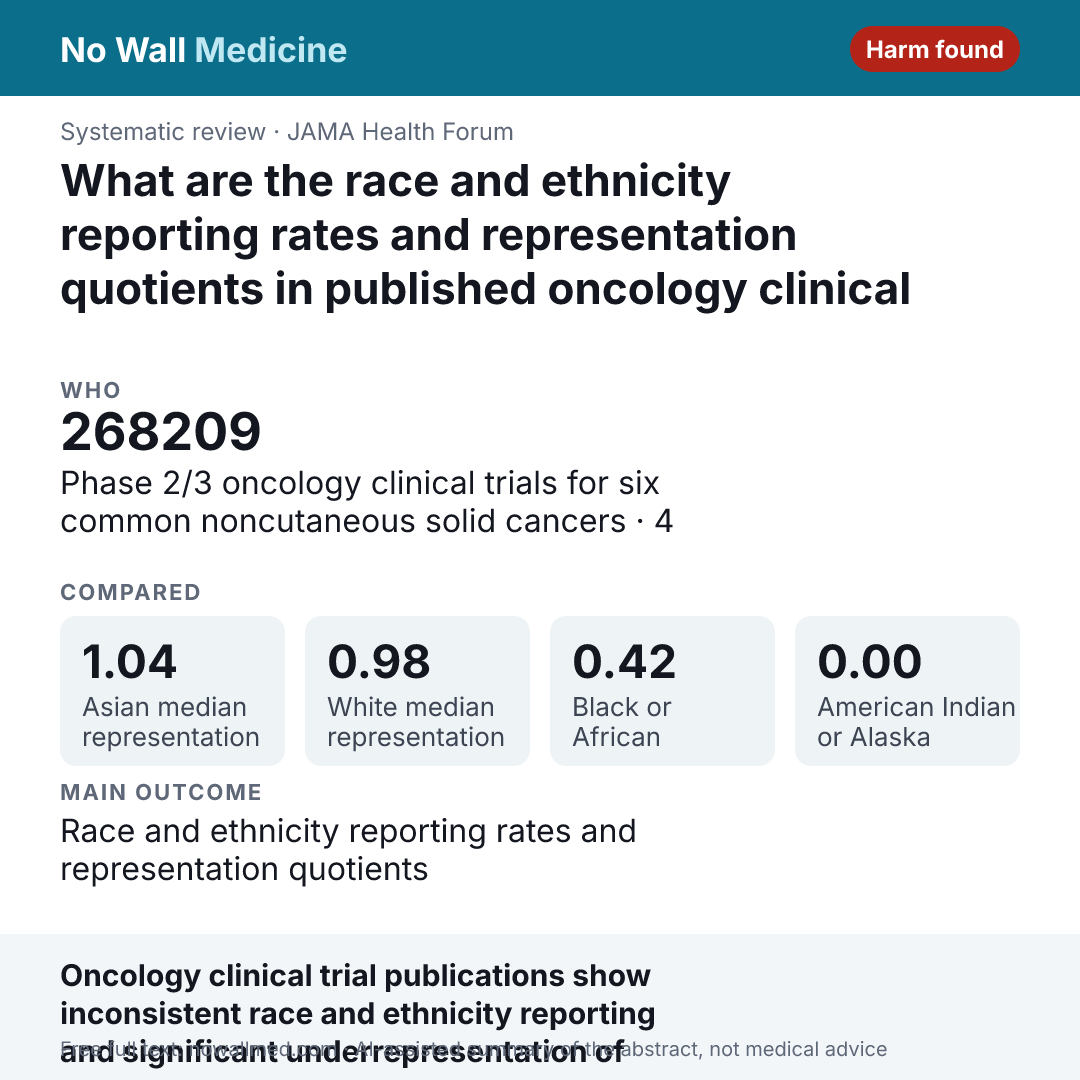
What are the race and ethnicity reporting rates and representation quotients in published oncology clinical trials?
Who
268209
Phase 2/3 oncology clinical trials for six common noncutaneous solid cancers · 4 high-impact journals
Compared
1.04Asian median representation quotient (IQR, 0.09-4.77)
0.98White median representation quotient (IQR, 0.86-1.06)
0.42Black or African American median representation quotient (IQR, 0.12-0.75)
0.00American Indian or Alaska Native median representation quotient (IQR, 0.00-0.00)
Main outcome
Race and ethnicity reporting rates and representation quotients
Bottom line: Oncology clinical trial publications show inconsistent race and ethnicity reporting and significant underrepresentation of several racial groups.
JAMA Health Forum · 2024-06-07 · Save PNG
Key points
- Researchers reviewed 364 phase 2/3 oncology clinical trial publications involving 268,209 patients from four high-impact medical journals.
- The median representation quotient was 1.04 for Asian patients, 0.98 for White patients, 0.42 for Black or African American patients, and 0.00 for American Indian or Alaska Native and Native Hawaiian or Other Pacific Islander patients.
- Race and ethnicity reporting was significantly lower in journal publications than in ClinicalTrials.gov for American Indian or Alaska Native (14% vs 45%) and Native Hawaiian or Other Pacific Islander (8% vs 43%) groups.
Why it matters: Reporting of race and ethnicity in medical journals is inconsistent despite mandates to collect and report these standards to achieve health equity.
Discussion prompts
- Would these patients look like yours? Who was left out?
- Is the main outcome one that matters to patients?
- Is the difference large enough to change what you do?
Cite: Taparra K, Benavente R, Shih JJ, et al. Race and Ethnicity Representation in Phase 2/3 Oncology Clinical Trial Publications: A Systematic Review. JAMA Health Forum. 2024;5(6):e241388. doi:10.1001/jamahealthforum.2024.1388
Free full text: PubMed Central · Summary and visual abstract: nowallmed.com/a/race-and-ethnicity-representation-in-phase-2-3-oncology-clinical-1pgm62d/ (AI-assisted from the abstract; check the paper before relying on it).