Racial and Ethnic Reporting and Representation in US Alzheimer Clinical Trials: A Systematic Review
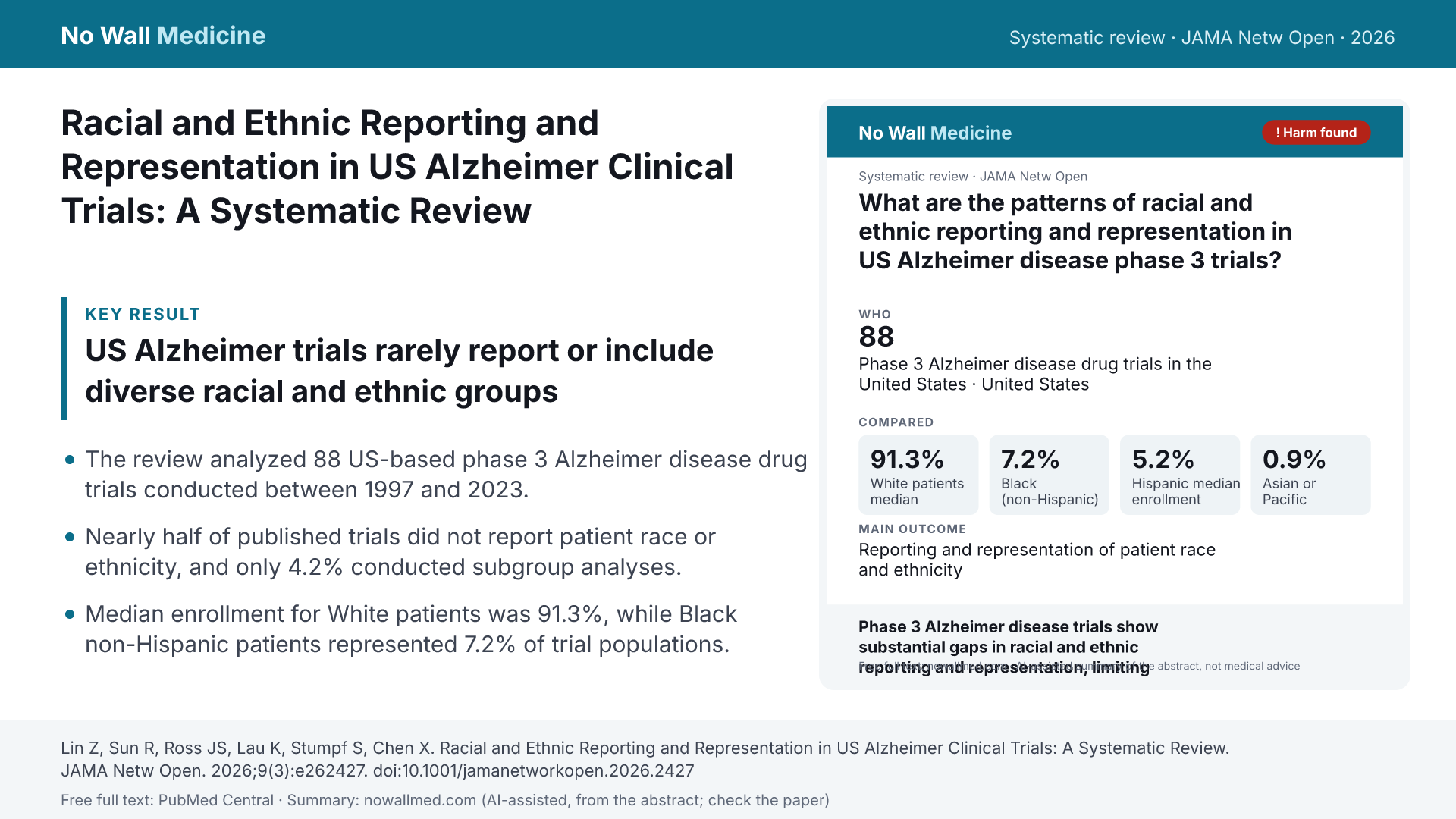
Key result: US Alzheimer trials rarely report or include diverse racial and ethnic groups
Systematic reviewHarm found
What are the patterns of racial and ethnic reporting and representation in US Alzheimer disease phase 3 trials?
Who
88
Phase 3 Alzheimer disease drug trials in the United States · United States
Compared
91.3%White patients median enrollment (87.3%-93.6%)
7.2%Black (non-Hispanic) median enrollment (3.7%-9.1%)
5.2%Hispanic median enrollment (3.1%-6.6%)
0.9%Asian or Pacific Islander median enrollment (0.6%-1.6%)
Main outcome
Reporting and representation of patient race and ethnicity
Bottom line: Phase 3 Alzheimer disease trials show substantial gaps in racial and ethnic reporting and representation, limiting generalizability.
JAMA Netw Open · 2026-03-02
Key points
- The review analyzed 88 US-based phase 3 Alzheimer disease drug trials conducted between 1997 and 2023.
- Nearly half of published trials did not report patient race or ethnicity, and only 4.2% conducted subgroup analyses.
- Median enrollment for White patients was 91.3%, while Black non-Hispanic patients represented 7.2% of trial populations.
Why it matters: Alzheimer disease disproportionately affects underrepresented populations, but it is unclear if trial findings generalize to these groups.
Discussion prompts
- Would these patients look like yours? Who was left out?
- Is the main outcome one that matters to patients?
- Is the difference large enough to change what you do?
Cite: Lin Z, Sun R, Ross JS, Lau K, Stumpf S, Chen X. Racial and Ethnic Reporting and Representation in US Alzheimer Clinical Trials: A Systematic Review. JAMA Netw Open. 2026;9(3):e262427. doi:10.1001/jamanetworkopen.2026.2427
Free full text: PubMed Central · Summary and visual abstract: nowallmed.com/a/racial-and-ethnic-reporting-and-representation-in-us-alzheimer-dkl2jr/ (AI-assisted from the abstract; check the paper before relying on it).