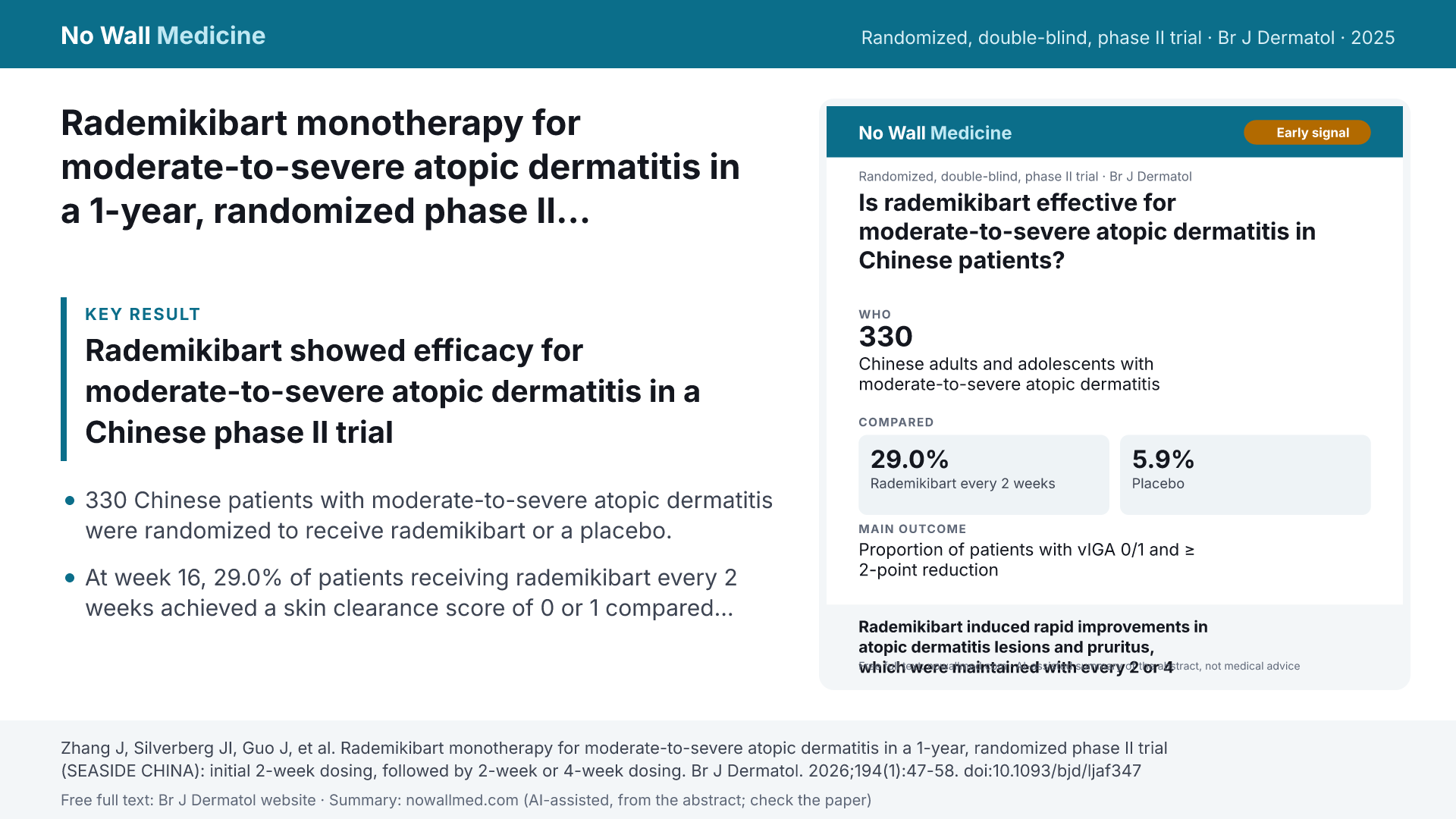
Rademikibart showed efficacy for moderate-to-severe atopic dermatitis in a Chinese phase II trial
Rademikibart monotherapy for moderate-to-severe atopic dermatitis in a 1-year, randomized phase II trial (SEASIDE CHINA): initial 2-week dosing, followed by 2-week or 4-week dosing
Randomized, double-blind, phase II trialEarly signal
Is rademikibart effective for moderate-to-severe atopic dermatitis in Chinese patients?
Who
330
Chinese adults and adolescents with moderate-to-severe atopic dermatitis
Compared
29.0%Rademikibart every 2 weeks
5.9%Placebo
Main outcome
Proportion of patients with vIGA 0/1 and ≥ 2-point reduction
Bottom line: Rademikibart induced rapid improvements in atopic dermatitis lesions and pruritus, which were maintained with every 2 or 4 weeks dosing.
Br J Dermatol · 2025-09-02 · Save PNG

Clinical question: Is rademikibart effective for moderate-to-severe atopic dermatitis in Chinese patients?
Why it matters: The efficacy and safety of rademikibart, a monoclonal antibody targeting the interleukin-4 receptor subunit alpha, needed to be evaluated in Chinese adults and adolescents.
Key points
- 330 Chinese patients with moderate-to-severe atopic dermatitis were randomized to receive rademikibart or a placebo.
- At week 16, 29.0% of patients receiving rademikibart every 2 weeks achieved a skin clearance score of 0 or 1 compared to 5.9% for placebo.
- Patients receiving rademikibart every 4 weeks through week 52 showed similar skin clearance and itch reduction results to those receiving it every 2 weeks.
Headline and key points written with AI from the paper’s abstract, with every number checked against it. Read the paper before relying on them.
Was this summary helpful?
Subject terms
Headline, design, result, key points, caveat and citation as plain text.
Cite this article
Zhang J, Silverberg JI, Guo J, et al. Rademikibart monotherapy for moderate-to-severe atopic dermatitis in a 1-year, randomized phase II trial (SEASIDE CHINA): initial 2-week dosing, followed by 2-week or 4-week dosing. Br J Dermatol. 2026;194(1):47-58. doi:10.1093/bjd/ljaf347
Spotted a mistake? Suggest a correction