Systematic review of 535 radiology artificial intelligence studies shows performance decreases during external validation
Radiology artificial intelligence: a systematic review and evaluation of methods (RAISE)
Systematic reviewMixed results
What are the methods and performance of deep learning in clinical radiology?
Who
535
Studies of artificial intelligence in radiology published 2015 to 2019
Compared
Internal performance median: Dice of 0.89, AUC of 0.903, Accuracy of 89.4
External validation performance: performance on average decreased by 6%
Main outcome
Performance of deep learning methods in radiology
Bottom line: Deep learning shows expert-level results, but performance often decreases during external validation and studies are mostly retrospective.
Limitation: Literature is dominated by retrospective cohort studies with limited external validation and high potential for bias.
Eur Radiol · 2022-04-14Download image
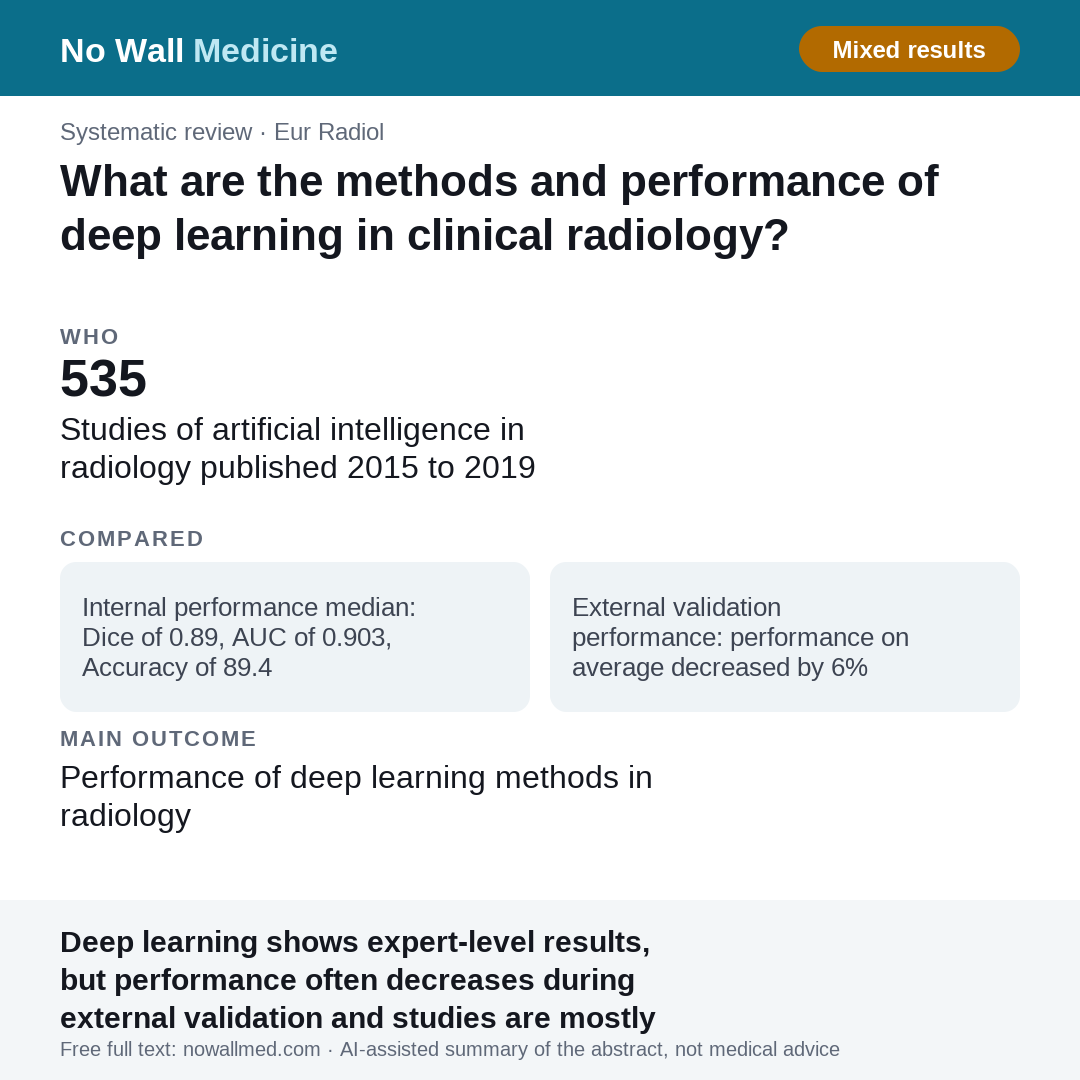
Clinical question: What are the methods and performance of deep learning in clinical radiology?
Why it matters: Systematic reviews of the entire field of artificial intelligence in clinical radiology were lacking due to varying study designs and quality.
Key points
- Researchers reviewed 535 articles published between 2015 and 2019 that used deep learning, a type of artificial intelligence, in clinical radiology.
- In 77 studies that allowed for direct comparison, performance decreased by an average of 6% during external validation.
- The median performance metrics across studies were a Dice score of 0.89, an Area Under the Curve of 0.903, and an accuracy of 89.4%.
Limitation the authors note: The literature is dominated by retrospective cohort studies with limited external validation and a high potential for bias.
Headline and key points written with AI from the paper’s abstract, with every number checked against it. Read the paper before relying on them.
Was this summary helpful?
Subject terms
Cite this article
Kelly BS, Judge C, Bollard SM, Clifford SM, Healy GM, Aziz A. Radiology artificial intelligence: a systematic review and evaluation of methods (RAISE). Eur Radiol. 2022. doi:10.1007/s00330-022-08784-6
Spotted a mistake? Suggest a correction
Top studies every Monday
The week’s key trials and guidelines in your specialties, plus any topics you follow. By email, free.
Get the weekly digest