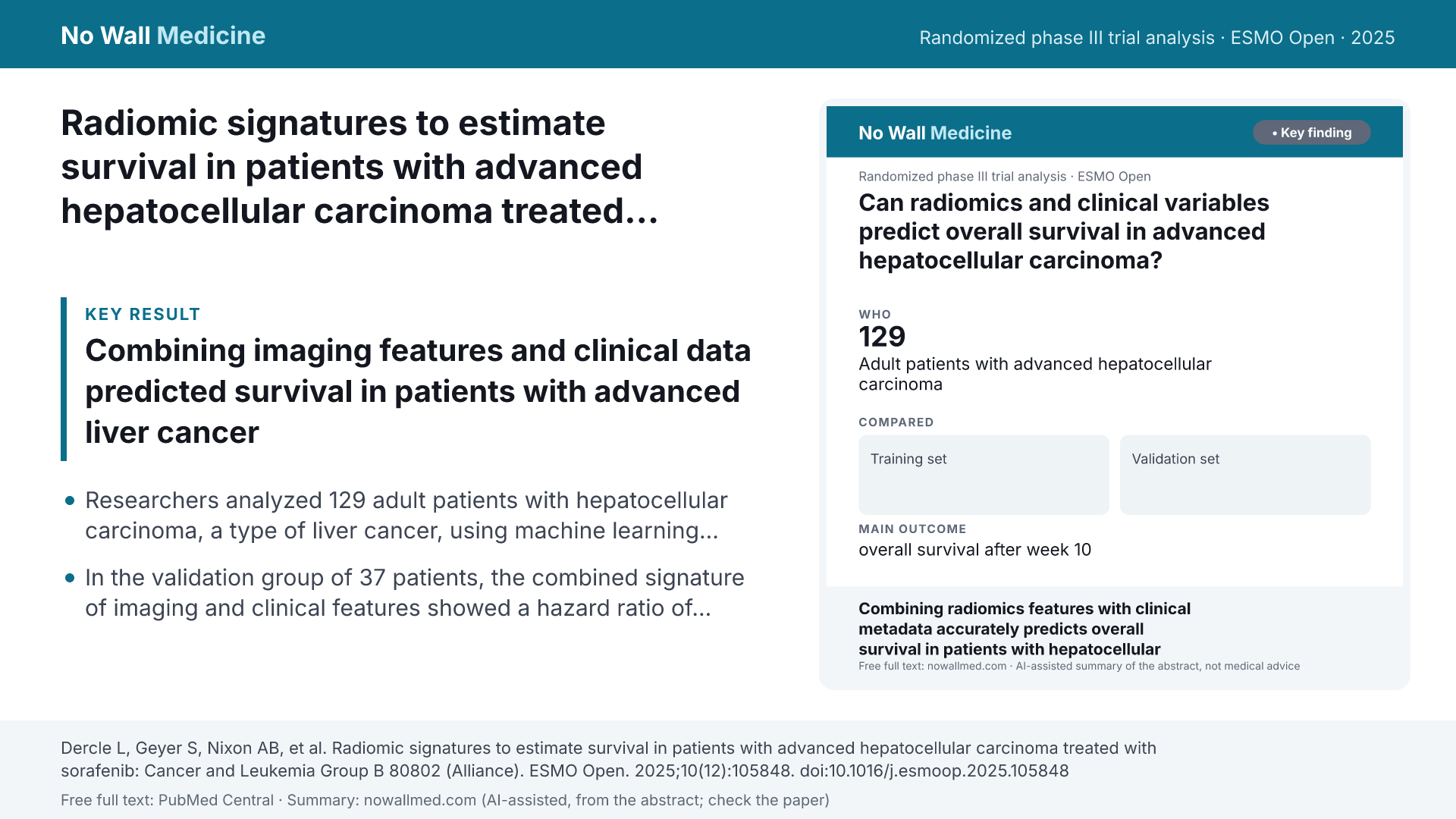
Combining imaging features and clinical data predicted survival in patients with advanced liver cancer
Radiomic signatures to estimate survival in patients with advanced hepatocellular carcinoma treated with sorafenib: Cancer and Leukemia Group B 80802 (Alliance)
Randomized phase III trial analysisKey finding
Can radiomics and clinical variables predict overall survival in advanced hepatocellular carcinoma?
Who
129
Adult patients with advanced hepatocellular carcinoma
Compared
Training set
Validation set
Main outcome
overall survival after week 10
Result: hazard ratio 2398 (95% confidence interval 121-47 371)
Bottom line: Combining radiomics features with clinical metadata accurately predicts overall survival in patients with hepatocellular carcinoma receiving sorafenib.
ESMO Open · 2025-12-02 · Save PNG
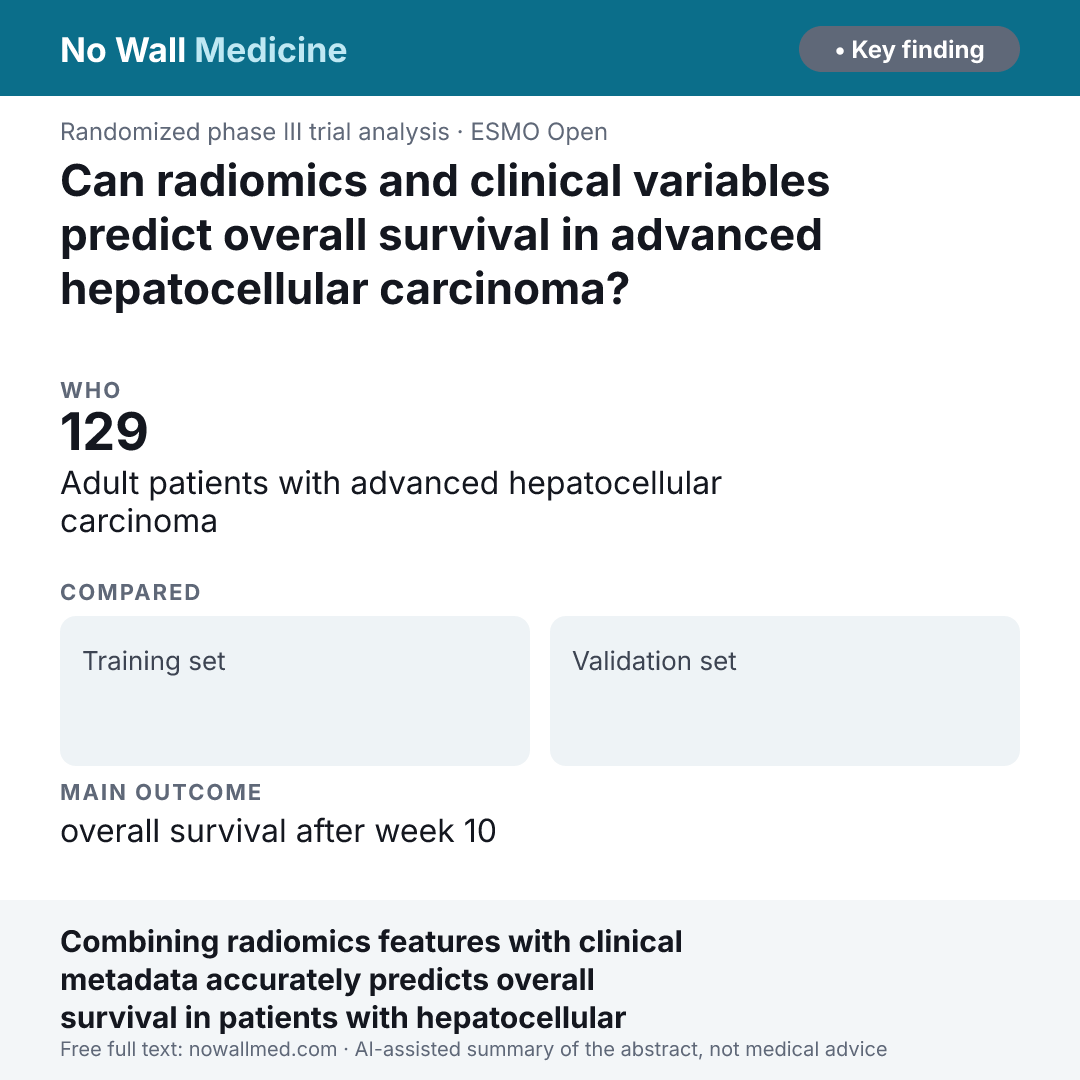
Clinical question: Can radiomics and clinical variables predict overall survival in advanced hepatocellular carcinoma?
Why it matters: Current methods for evaluating treatment response in liver cancer rely on tumor size and density, which do not always correlate well with survival.
Key points
- Researchers analyzed 129 adult patients with hepatocellular carcinoma, a type of liver cancer, using machine learning to evaluate computed tomography images and clinical data.
- In the validation group of 37 patients, the combined signature of imaging and clinical features showed a hazard ratio of 2398 (95% confidence interval 121-47 371).
- The most important variables for prediction included baseline albumin, alpha-fetoprotein, Child-Pugh score, and specific imaging features from baseline and week 10.
Headline and key points written with AI from the paper’s abstract, with every number checked against it. Read the paper before relying on them.
Was this summary helpful?
Subject terms
Headline, design, result, key points, caveat and citation as plain text.
Cite this article
Dercle L, Geyer S, Nixon AB, et al. Radiomic signatures to estimate survival in patients with advanced hepatocellular carcinoma treated with sorafenib: Cancer and Leukemia Group B 80802 (Alliance). ESMO Open. 2025;10(12):105848. doi:10.1016/j.esmoop.2025.105848
Spotted a mistake? Suggest a correction