Radiomics models show strong performance in identifying high-risk carotid artery plaques in systematic review
Radiomics performance to identify high-risk carotid artery plaques: a systematic review
Systematic reviewBenefit found
How well do radiomics-based models identify high-risk carotid artery plaques?
Who
6108
Patients with carotid atherosclerotic disease
Compared
Radiomics models: Internal validation area under the curve as high as 0.984
Combined models: Often exceeding 0.90
Main outcome
Area under the curve for identifying high-risk plaques
Bottom line: Radiomics and combined models show strong predictive performance for identifying high-risk carotid plaques compared to traditional assessments.
Limitation: Only four studies included external validation cohorts and there is low compliance with international standardization guidelines.
Eur Radiol Exp · 2026-11-03Download image
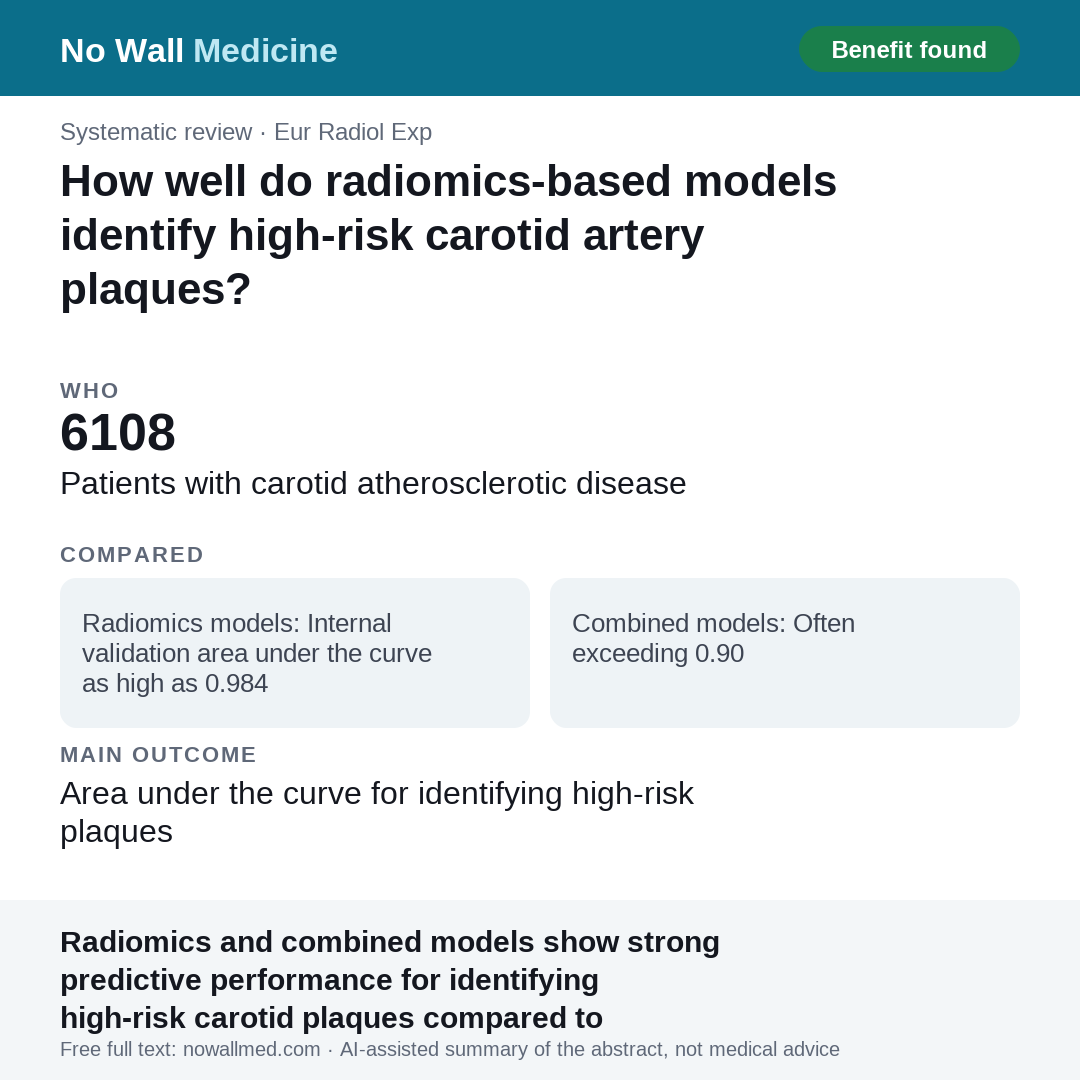
Clinical question: How well do radiomics-based models identify high-risk carotid artery plaques?
Why it matters: Traditional risk assessment relies on the severity of narrowing in the carotid artery, which does not adequately reflect how vulnerable a plaque is.
Key points
- Researchers reviewed 28 studies involving 6,108 patients, 72.4% of whom were male, to evaluate radiomics-based models for carotid plaque assessment.
- Internal validation area under the curve (a measure of predictive accuracy) reached 0.984, while combined models often exceeded 0.90.
- Only four studies included external validation cohorts to test the models on different patient groups.
Headline and key points written with AI from the paper’s abstract, with every number checked against it. Read the paper before relying on them.
Topics
Cite this article
D'lima J, Rheault F, Beaudoin AM. Radiomics performance to identify high-risk carotid artery plaques: a systematic review. Eur Radiol Exp. 2026. doi:10.1186/s41747-026-00843-7
Spotted a mistake? Suggest a correction