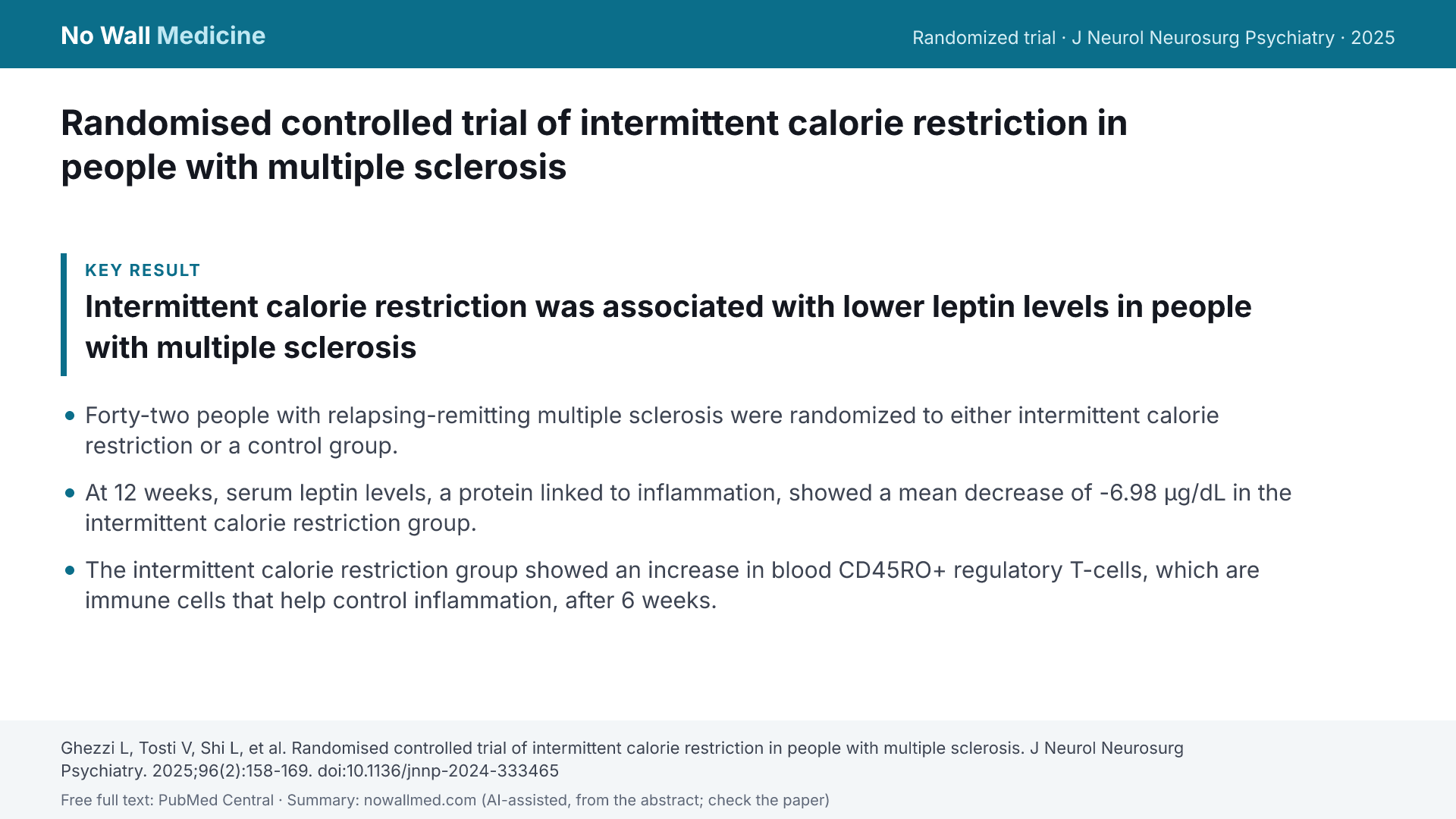
Intermittent calorie restriction was associated with lower leptin levels in people with multiple sclerosis
Randomised controlled trial of intermittent calorie restriction in people with multiple sclerosis
Why it matters: It was unknown how intermittent calorie restriction affects metabolic, immunological, and clinical outcomes in humans with multiple sclerosis.
Key points
- Forty-two people with relapsing-remitting multiple sclerosis were randomized to either intermittent calorie restriction or a control group.
- At 12 weeks, serum leptin levels, a protein linked to inflammation, showed a mean decrease of -6.98 µg/dL in the intermittent calorie restriction group.
- The intermittent calorie restriction group showed an increase in blood CD45RO+ regulatory T-cells, which are immune cells that help control inflammation, after 6 weeks.
Headline and key points written with AI from the paper’s abstract, with every number checked against it. Read the paper before relying on them.
Was this summary helpful?
Abstract
Background
Calorie restriction (CR) ameliorates preclinical models of multiple sclerosis (MS) via multiple mechanisms. These include decreased leptin, a proinflammatory adipokine, but mechanistic studies in humans are lacking. Tests of daily and intermittent CR (iCR) in people with MS (pwMS) showed improvements in fatigue and well-being measures. This trial studied the effects of 12-week iCR on metabolic, immunological, and clinical outcomes in pwMS. Method
Relapsing-remitting MS participants were randomised to iCR or a control group. Study visits were conducted at baseline, 6 and 12 weeks. The primary outcome was reduction in serum leptin levels at 12 weeks. Feasibility and safety were assessed by diet adherence and adverse events (AEs). Secondary outcomes included changes in anthropometric and body composition measures, metabolic and immunologic profiling, and clinical measures. Mixed effects linear regression models were used to evaluate outcome differences between and within groups over time. Results
Forty-two pwMS were randomised, 34 completed the study (17/group). Leptin serum levels at 12 weeks were significantly lower in the iCR versus the control group (mean decrease -6.98 µg/dL, 95% CI: -28.02 to 14.06; p=0.03). Adherence to iCR was 99.5% and 97.2% at 6 and 12 weeks, respectively, and no serious AEs were reported. An increase in blood CD45RO+ regulatory T-cell numbers was seen after 6 weeks of iCR. Exploratory cognitive testing demonstrated a significant improvement in the Symbol Digit Modality Test Score in the iCR group at 12 weeks. Conclusions
iCR has the potential to benefit metabolic and immunologic profiles and is safe and feasible in pwMS. Trial registration number
NCT03539094 .
Abstract reproduced under the article’s CC BY NC licence.
Subject terms
Cite this article
Ghezzi L, Tosti V, Shi L, Cantoni C, Mikesell R, Lancia S. Randomised controlled trial of intermittent calorie restriction in people with multiple sclerosis. J Neurol Neurosurg Psychiatry. 2025. doi:10.1136/jnnp-2024-333465
Spotted a mistake? Suggest a correction
Top studies every Monday
The week’s key trials and guidelines in your specialties, plus any topics you follow. By email, free.
Get the weekly digest