Randomised controlled trial of oxygen therapy and high-flow nasal therapy in African children with pneumonia
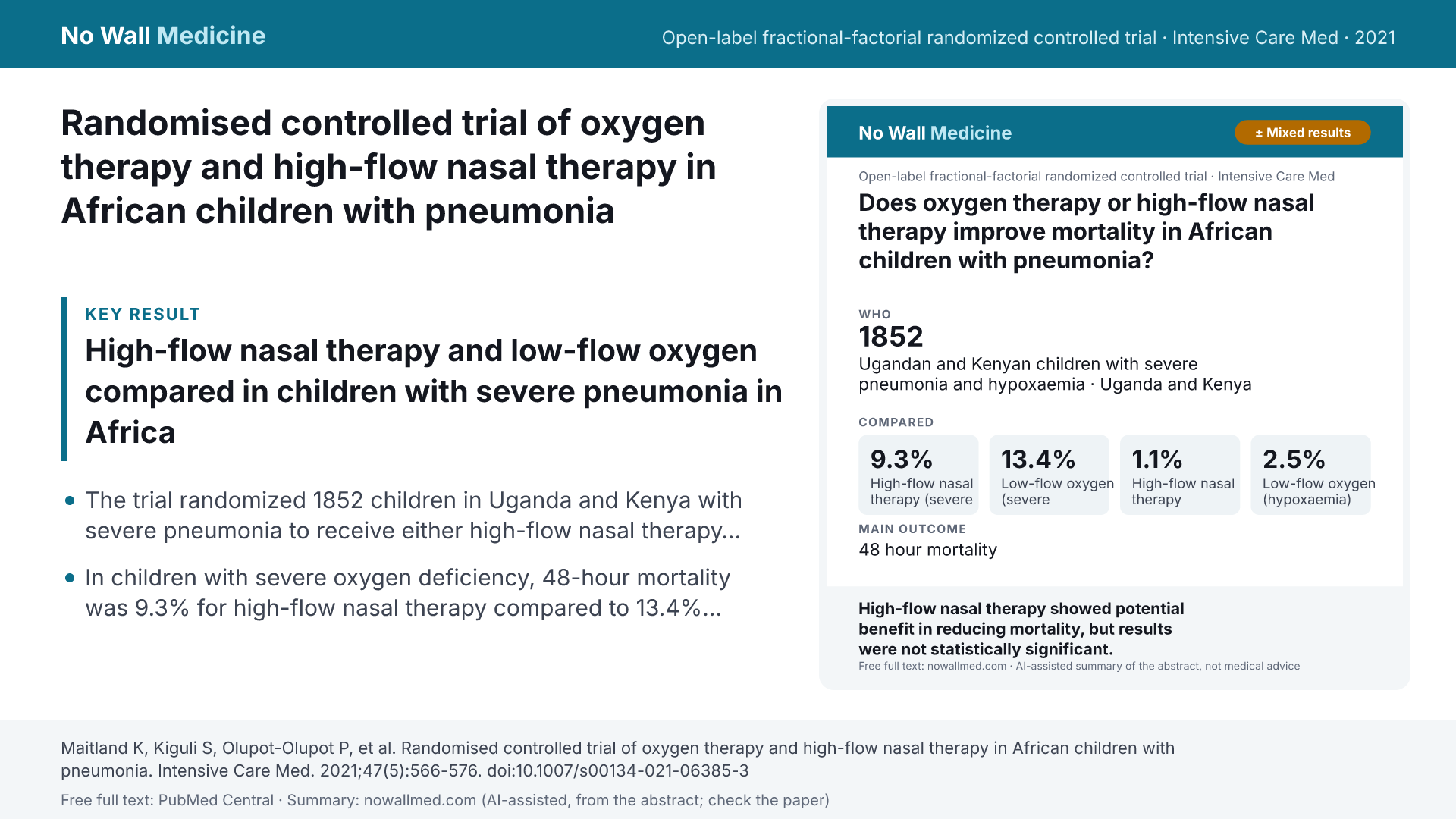
Key result: High-flow nasal therapy and low-flow oxygen compared in children with severe pneumonia in Africa
Open-label fractional-factorial randomized controlled trialMixed results
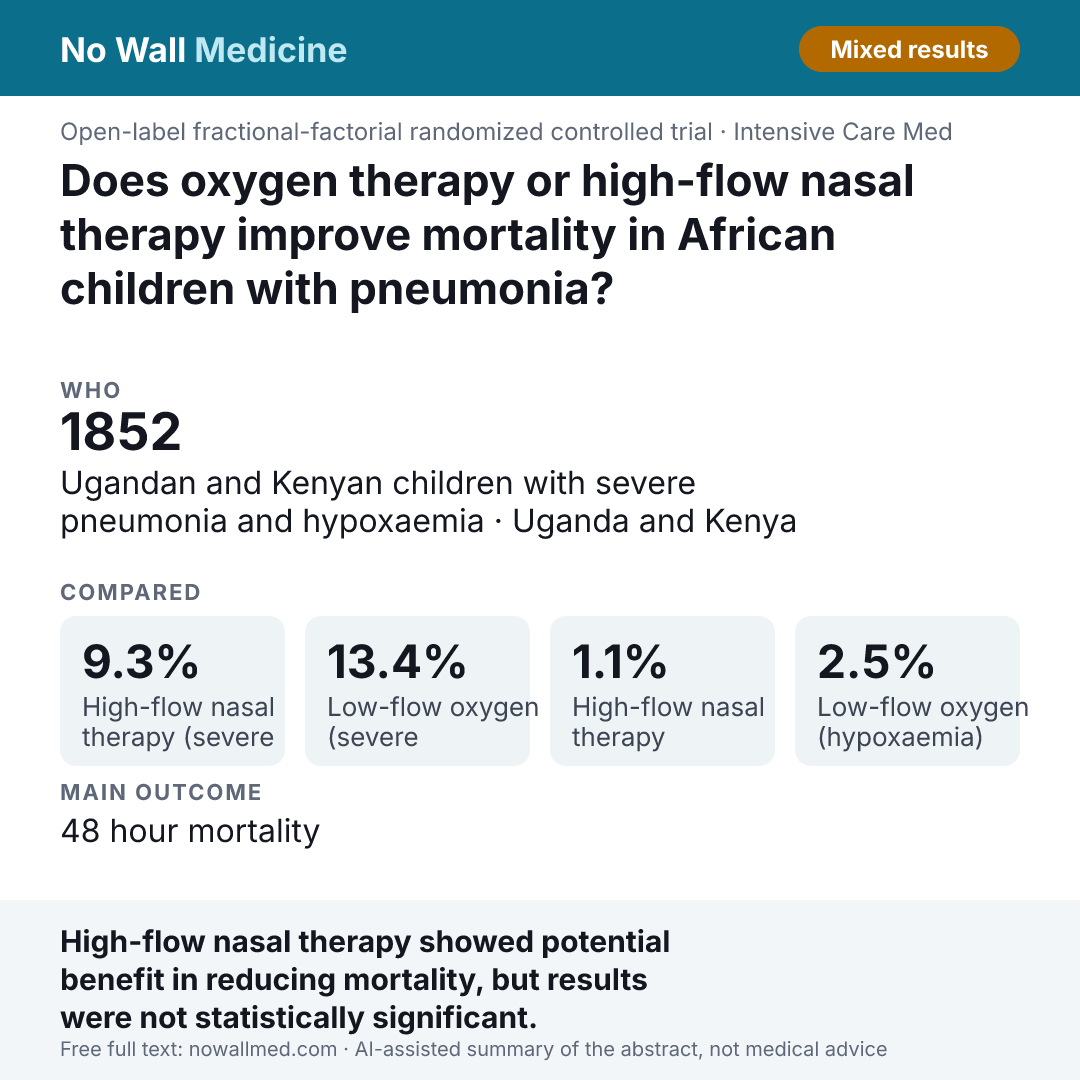
Does oxygen therapy or high-flow nasal therapy improve mortality in African children with pneumonia?
Who
1852
Ugandan and Kenyan children with severe pneumonia and hypoxaemia · Uganda and Kenya
Compared
9.3%High-flow nasal therapy (severe hypoxaemia)
13.4%Low-flow oxygen (severe hypoxaemia)
1.1%High-flow nasal therapy (hypoxaemia)
2.5%Low-flow oxygen (hypoxaemia)
Main outcome
48 hour mortality
Result: adjusted odds ratio HFNT vs LFO 0.60 (0.33-1.06)
Bottom line: High-flow nasal therapy showed potential benefit in reducing mortality, but results were not statistically significant.
Intensive Care Med · 2021-05-05 · Save PNG
Key points
- The trial randomized 1852 children in Uganda and Kenya with severe pneumonia to receive either high-flow nasal therapy or low-flow oxygen.
- In children with severe oxygen deficiency, 48-hour mortality was 9.3% for high-flow nasal therapy compared to 13.4% for low-flow oxygen.
- In children with moderate oxygen deficiency, 48-hour mortality was 1.1% for high-flow nasal therapy, 2.5% for low-flow oxygen, and 1.4% for permissive hypoxaemia.
Discussion prompts
- Would these patients look like yours? Who was left out?
- Is the main outcome one that matters to patients?
- Is the difference large enough to change what you do?
Cite: Maitland K, Kiguli S, Olupot-Olupot P, et al. Randomised controlled trial of oxygen therapy and high-flow nasal therapy in African children with pneumonia. Intensive Care Med. 2021;47(5):566-576. doi:10.1007/s00134-021-06385-3
Free full text: PubMed Central · Summary and visual abstract: nowallmed.com/a/randomised-controlled-trial-of-oxygen-therapy-and-high-flow-nasal-10ww1ih/ (AI-assisted from the abstract; check the paper before relying on it).