Closed bronchoscopy sampling system was safer and more efficient than standard sampling containers
Randomised controlled trial to assess the safety and efficiency of a self-contained sampling device/disposable bronchoscope system versus usual sampling procedure (RASECAL)
Multicentre randomised controlled trialBenefit found
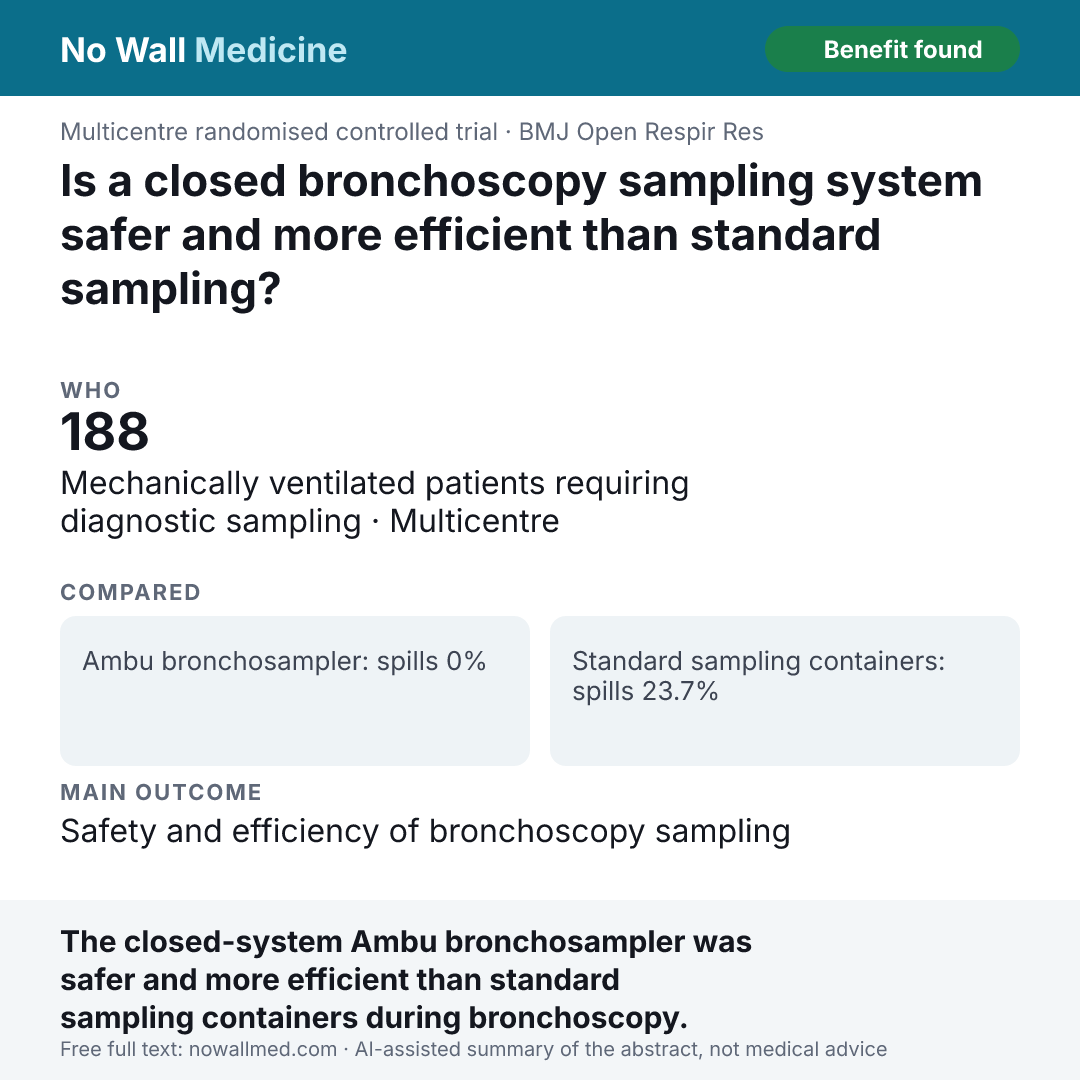
Is a closed bronchoscopy sampling system safer and more efficient than standard sampling?
Who
188
Mechanically ventilated patients requiring diagnostic sampling · Multicentre
Compared
Ambu bronchosampler: spills 0%
Standard sampling containers: spills 23.7%
Main outcome
Safety and efficiency of bronchoscopy sampling
Bottom line: The closed-system Ambu bronchosampler was safer and more efficient than standard sampling containers during bronchoscopy.
BMJ Open Respir Res · 2026-08-31 · Save PNG
Clinical question: Is a closed bronchoscopy sampling system safer and more efficient than standard sampling?
Why it matters: Standard bronchial washing can be inefficient or unsafe due to aerosolisation, poor yield, and loss of sample during the procedure.
Key points
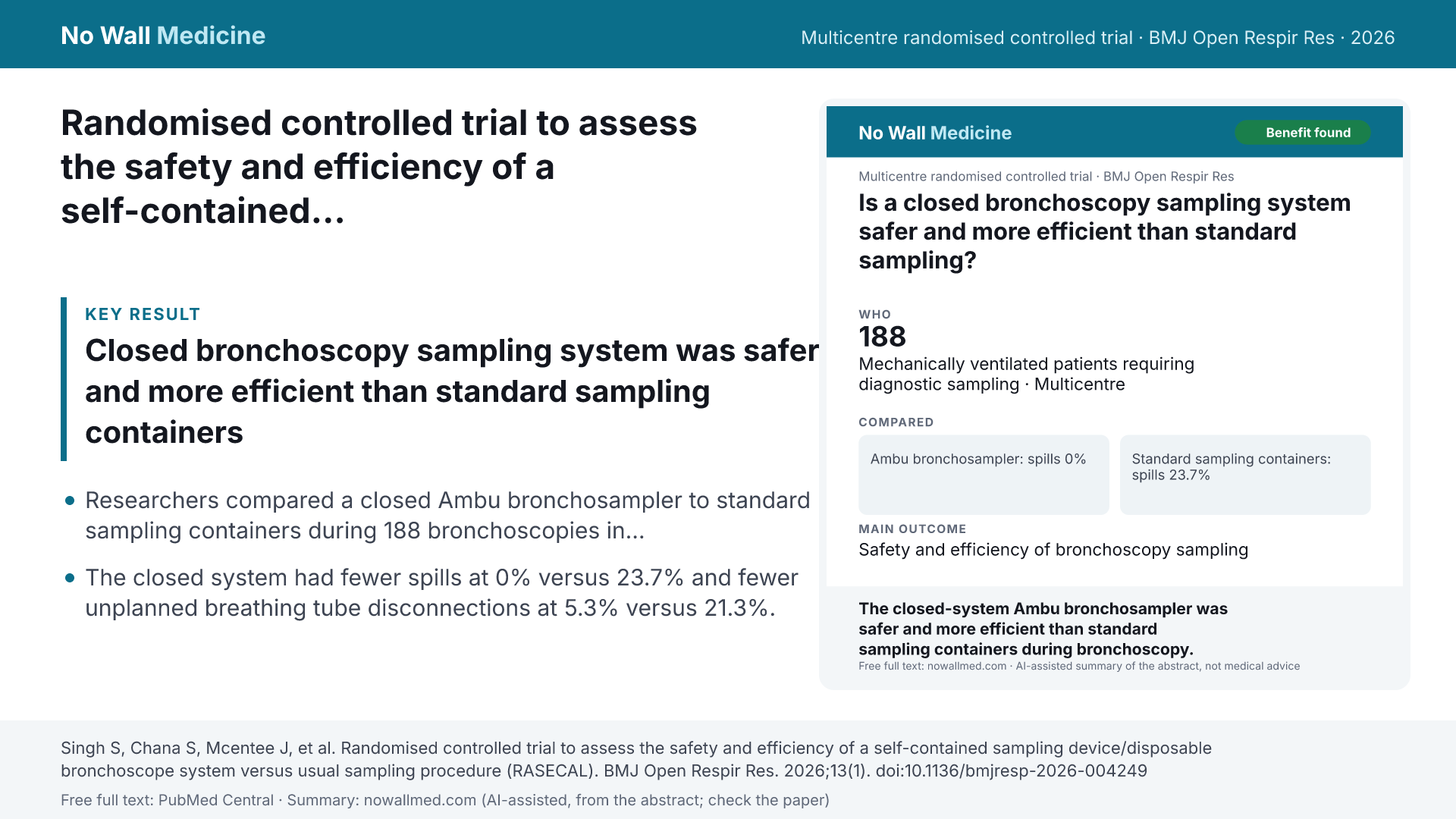
- Researchers compared a closed Ambu bronchosampler to standard sampling containers during 188 bronchoscopies in mechanically ventilated patients.
- The closed system had fewer spills at 0% versus 23.7% and fewer unplanned breathing tube disconnections at 5.3% versus 21.3%.
- The closed system showed higher efficiency in setup, connectivity, and sample loss prevention, though the percentage of volume retrieved was unchanged.
Headline and key points written with AI from the paper’s abstract, with every number checked against it. Read the paper before relying on them.
Was this summary helpful?
Abstract
Background
Bronchial washing can be inefficient or unsafe due to aerosolisation, poor yield and loss of sample. The setup and connectivity of sampling containers is often challenging. Furthermore, the process of bronchoscopy in the intensive care unit is inadequately reported.We tested whether a novel closed bronchoscopy sampling system is safer and more efficient than the standard sampling technique. We recorded variation in bronchoscopy practice in mechanically ventilated patients. Methods
A multicentre randomised controlled trial saw 188 bronchoscopies performed in mechanically ventilated patients requiring diagnostic sampling. The closed-system Ambu bronchosampler (ABS) was compared to standard sampling containers (SSC) with single-use bronchoscopes (Ambu A4) for primary outcomes of safety (spill, unplanned disconnection) and efficiency (ease of connectivity, setup, loss of sample and % volume retrieved), secondary efficiency outcomes and the tertiary outcomes of the bronchoscopy process. Results
ABS was safer than SSC; spills 0% versus 23.7% (0/94 vs 22/93), p<0.001; unplanned tube disconnections 5.3% vs 21.3% (5/95 vs 20/93), p<0.001; unplanned container disconnections 2.1% vs 7.5% (2/95 vs 7/93), p=0.08. Efficiency was significantly higher in ABS than SSC (acceptable/(very) easy) setup 98.9% vs 82.8% (94/95 vs 77/93), connectivity 100% vs 54.7% (88/88 vs 47/86), upright 98.9% vs 10.8% (94/95 vs 10/93) and sample loss 11.6% vs 48.4% (11/95 vs 45/93), all p<0.001. Volume retrieved percentage unchanged (33.0% vs 35.4%, p>0.2).Bronchoscopy for infection in 80.9%, therapeutic lavage in 51% and infrequently otherwise. Prior imaging in 93.2%, preprocedural checklists/timeouts in 83.5% and post-procedure chest X-rays in 78.2%.Mandatory ventilation was most common peribronchoscopy. Neuromuscular blockade in 73.8% and recruitment manoeuvres in 34.7%. The bronchoscope was not removed intraprocedurally in 80.2% of cases. Positive microbiology was found in 45.7% of samples. Adverse events were rare (<5%). Conclusions
Closed-system bronchoscopic sampling was safer (less spill and unplanned disconnections) and more efficient (setup, connectivity and loss prevention) than standard containers. Closed-system diagnostic sampling devices should be the standard during bronchoscopy. Trial registration number
ClinicalTrials.gov NCT05964075.
Abstract reproduced under the article’s CC BY NC licence.
Subject terms
Headline, design, result, key points, caveat and citation as plain text.
Cite this article
Singh S, Chana S, Mcentee J, et al. Randomised controlled trial to assess the safety and efficiency of a self-contained sampling device/disposable bronchoscope system versus usual sampling procedure (RASECAL). BMJ Open Respir Res. 2026;13(1). doi:10.1136/bmjresp-2026-004249
Spotted a mistake? Suggest a correction