Randomised Controlled Trials Assessing the Clinical Value of Urodynamic Studies: A Systematic Review and Meta-analysis
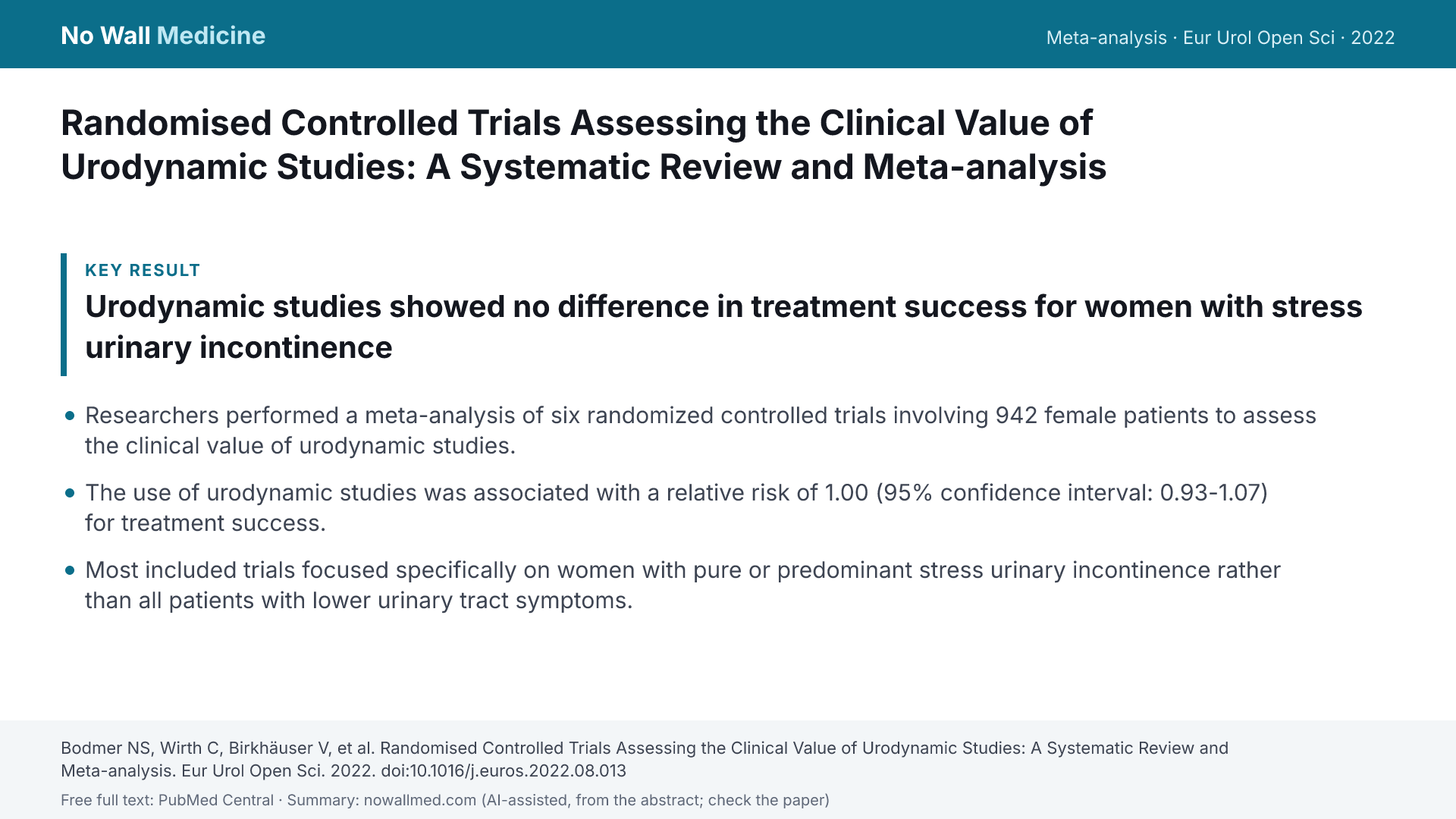
Key result: Urodynamic studies showed no difference in treatment success for women with stress urinary incontinence
Key points
- Researchers performed a meta-analysis of six randomized controlled trials involving 942 female patients to assess the clinical value of urodynamic studies.
- The use of urodynamic studies was associated with a relative risk of 1.00 (95% confidence interval: 0.93-1.07) for treatment success.
- Most included trials focused specifically on women with pure or predominant stress urinary incontinence rather than all patients with lower urinary tract symptoms.
Why it matters: The impact of urodynamic studies on patient outcomes for managing lower urinary tract symptoms remains a subject of academic debate.
Limitation the authors note: The findings from the small group of women with uncomplicated stress urinary incontinence cannot be extrapolated to the overall patient population with lower urinary tract symptoms.
Discussion prompts
- Would these patients look like yours? Who was left out?
- Is the main outcome one that matters to patients?
- Is the difference large enough to change what you do?
Cite: Bodmer NS, Wirth C, Birkhäuser V, et al. Randomised Controlled Trials Assessing the Clinical Value of Urodynamic Studies: A Systematic Review and Meta-analysis. Eur Urol Open Sci. 2022. doi:10.1016/j.euros.2022.08.013
Free full text: PubMed Central · Summary and visual abstract: nowallmed.com/a/randomised-controlled-trials-assessing-the-clinical-value-of-sz2mf9/ (AI-assisted from the abstract; check the paper before relying on it).