Personalised smoking cessation support did not increase quit rates during lung cancer screening
Randomised trial of delivering co-located, personalised stop-smoking support within lung cancer screening: the YESS study
Randomised controlled trialNo clear difference
Does personalised stop-smoking support delivered alongside lung cancer screening increase smoking abstinence?
Who
1003
Individuals who currently smoked attending for lung cancer screening
Compared
Personalised stop-smoking support: 33.6% at 3 months
Standard best practice: 30.0% at 3 months
Main outcome
7-day point prevalent abstinence rates
Result: odds ratio 1.17 (95% CI 0.90 to 1.54)
Bottom line: Adding a personalised stop-smoking intervention did not increase smoking quit rates compared to standard best practice.
Thorax · 2026-08-14Download image
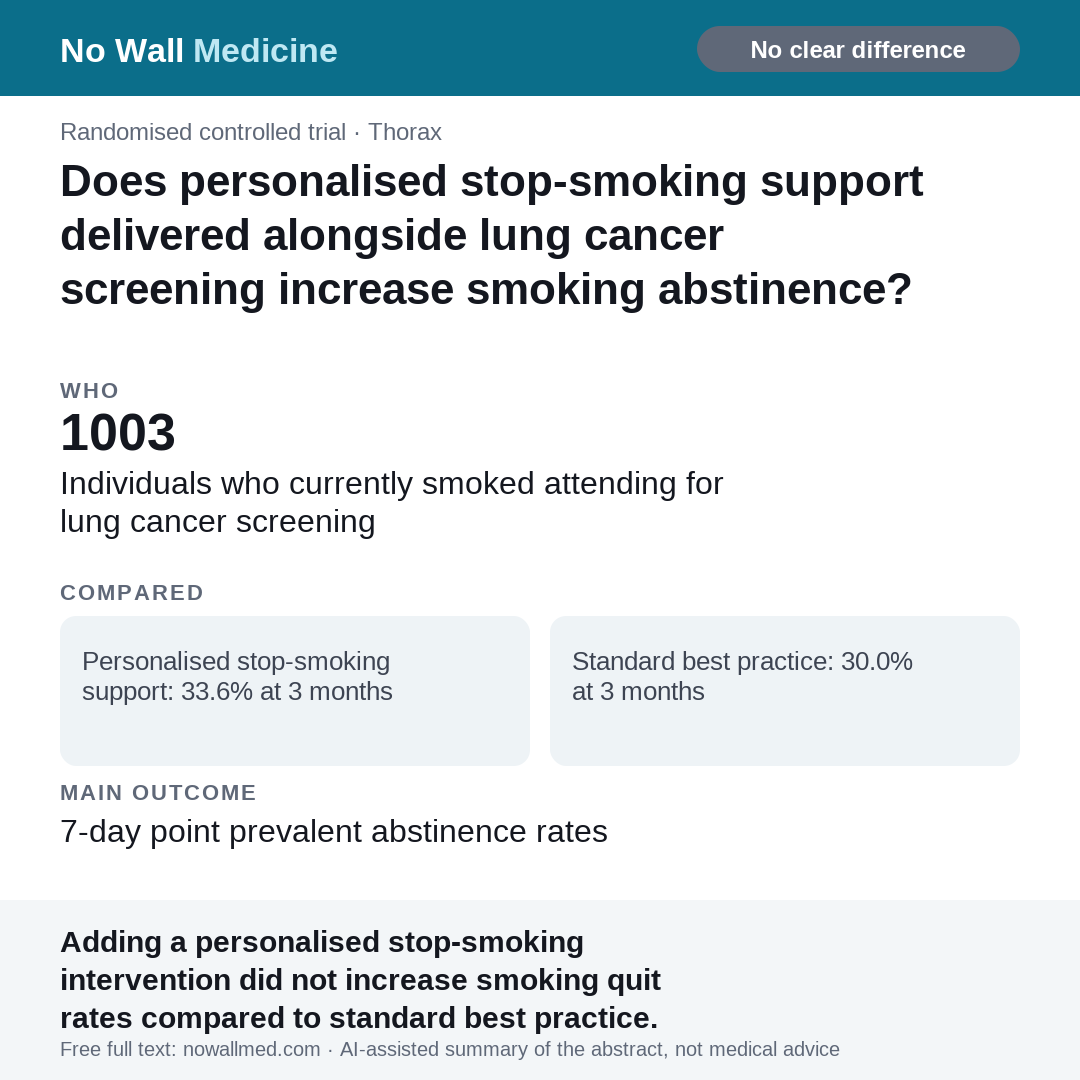
Clinical question: Does personalised stop-smoking support delivered alongside lung cancer screening increase smoking abstinence?
Why it matters: The optimal way to implement smoking cessation support within lung cancer screening programs is currently unclear.
Key points
- Researchers studied 1003 people to compare standard best practice smoking support against a personalised package including annotated lung and heart images.
- At 3 months, 7-day smoking abstinence rates were 33.6% for the personalised group and 30.0% for the standard group.
- At 12 months, abstinence rates were 29.2% for the personalised group and 28.6% for the standard group.
Headline and key points written with AI from the paper’s abstract, with every number checked against it. Read the paper before relying on them.
Abstract
Introduction
Lung cancer screening (LCS) with low-dose CT offers a teachable moment for smoking cessation (SC), but the optimal way to implement SC within LCS is unclear. The Yorkshire Enhanced Stop Smoking (YESS) study assessed the efficacy of a personalised stop-smoking intervention delivered alongside LCS. Methods
Opt-out, co-located SC support, comprising nicotine replacement therapy/e-cigarettes/pharmacotherapy and behavioural support, was offered to all individuals who currently smoked attending for LCS. Four weeks later, participants were offered recruitment to a randomised controlled trial of continued standard best practice (SBP) versus a personalised SC support package, including a booklet containing CT images of participants' own heart and lungs, annotated where appropriate to highlight emphysema or coronary artery calcification and scripted communication delivered by a smoking cessation practitioner. Results
1003 people were recruited; 52.5% were allocated to the intervention group. Validated 7-day point prevalent (PP) abstinence rates were 33.6% and 30.0% in the intervention versus SBP groups, respectively (OR 1.17, 95% CI 0.90 to 1.54) at 3 months and 29.2% versus 28.6% (OR 1.03, 95% CI 0.78 to 1.36) at 12 months post-screening. Subgroup analyses indicated a significant increase in 7-day PP abstinence at 3 months with the intervention in women (33.9% intervention, 23.1% SBP, OR 1.70, 95% CI 1.15 to 2.53) but not in men (33.3% intervention, 37.8% SBP, OR 0.82, 95% CI 0.57 to 1.19). Conclusion
Around one-third of study participants were abstinent from smoking at 3 months post-screening irrespective of study arm, but adding the personalised intervention did not increase quit rates. Further research is needed exploring possible sex differences in efficacy of personalised SC support. The high overall quit rate reinforces the value of SC support delivered alongside LCS. Trial registration number
ISRCRN 63825779 and NCT03750110.
Abstract reproduced under the article’s CC BY licence.
Topics
Cite this article
Murray RL, Baldwin D, Brain K, Britton J, Chalitsios CV, Crosbie PA. Randomised trial of delivering co-located, personalised stop-smoking support within lung cancer screening: the YESS study. Thorax. 2026. doi:10.1136/thorax-2025-224217
Spotted a mistake? Suggest a correction