Zoledronic acid prevented progression of early Paget's disease in people with genetic risk
Randomised trial of genetic testing and targeted intervention to prevent the development and progression of Paget's disease of bone
Randomized trialBenefit found
Does zoledronic acid prevent development and progression of Paget's disease of bone?
Who
222
Individuals at increased risk of Paget's disease of bone due to SQSTM1 variants
Compared
Zoledronic acid
Placebo: two
Main outcome
New bone lesions assessed by radionuclide bone scan
Result: odds ratio 0.41 (95% CI 0.00 to 3.43)
Bottom line: Zoledronic acid coupled with genetic testing has favourable effects on the progression of early Paget's disease of bone.
Ann Rheum Dis · 2024-03-12Download image
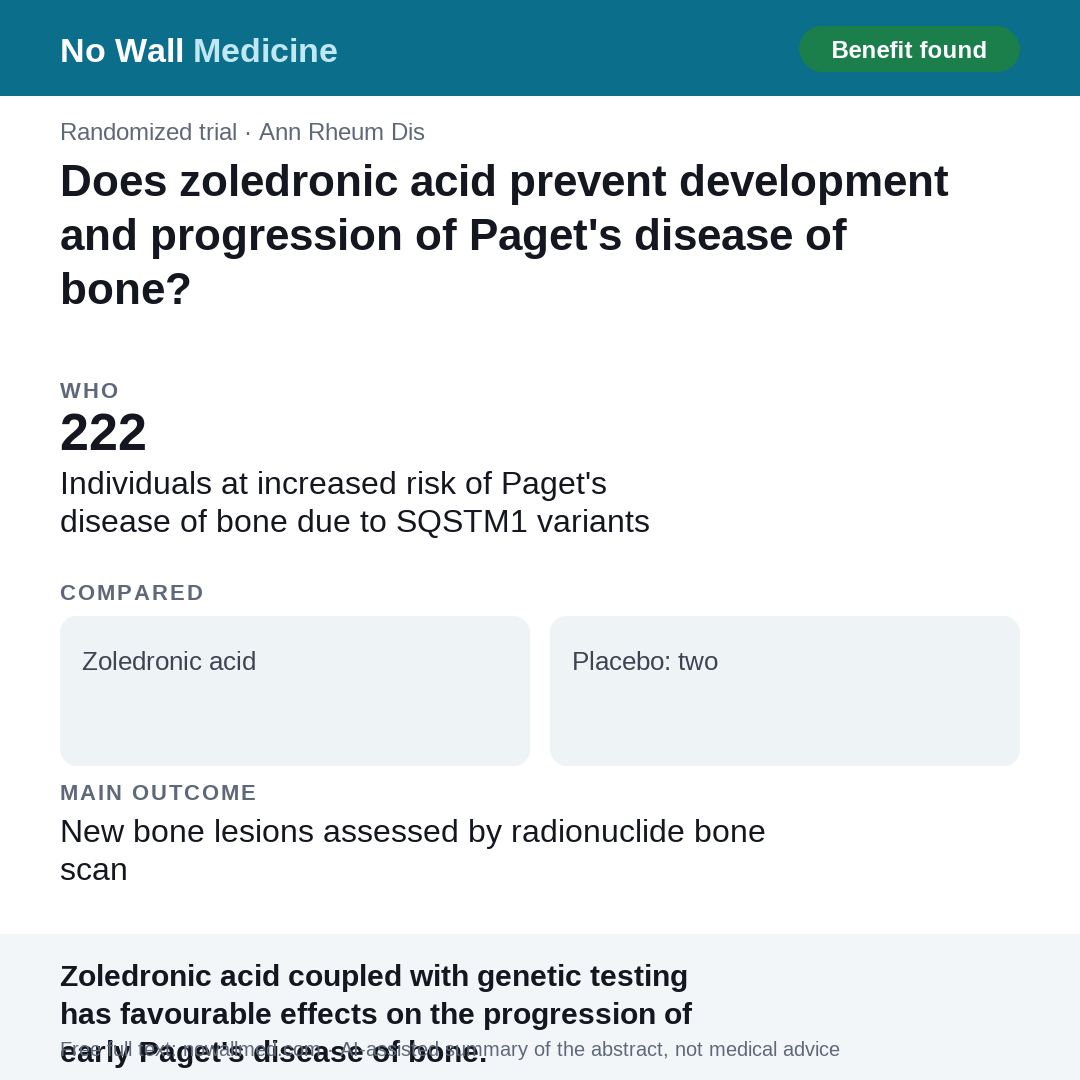
Clinical question: Does zoledronic acid prevent development and progression of Paget's disease of bone?
Why it matters: It is unknown if early diagnosis through genetic testing and prophylactic treatment can prevent irreversible skeletal damage in Paget's disease of bone.
Key points
- Researchers randomized 222 individuals with genetic variants linked to Paget's disease of bone to receive either 5 mg of zoledronic acid or a placebo.
- While the development of new bone lesions was not statistically significant, eight placebo participants had poor outcomes compared to none in the zoledronic acid group (p=0.003).
- At the end of the study, 1 participant in the zoledronic acid group had lesions compared with 11 in the placebo group.
Headline and key points written with AI from the paper’s abstract, with every number checked against it. Read the paper before relying on them.
Was this summary helpful?
Abstract
Introduction
Paget's disease of bone (PDB) frequently presents at an advanced stage with irreversible skeletal damage. Clinical outcomes might be improved by earlier diagnosis and prophylactic treatment. Methods
We randomised 222 individuals at increased risk of PDB because of pathogenic SQSTM1 variants to receive 5 mg zoledronic acid (ZA) or placebo. The primary outcome was new bone lesions assessed by radionuclide bone scan. Secondary outcomes included change in existing lesions, biochemical markers of bone turnover and skeletal events related to PDB. Results
The median duration of follow-up was 84 months (range 0-127) and 180 participants (81%) completed the study. At baseline, 9 (8.1%) of the ZA group had PDB lesions vs 12 (10.8%) of the placebo group. Two of the placebo group developed new lesions versus none in the ZA group (OR 0.41, 95% CI 0.00 to 3.43, p=0.25). Eight of the placebo group had a poor outcome (lesions which were new, unchanged or progressing) compared with none of the ZA group (OR 0.08, 95% CI 0.00 to 0.42, p=0.003). At the study end, 1 participant in the ZA group had lesions compared with 11 in the placebo group. Biochemical markers of bone turnover were significantly reduced in the ZA group. One participant allocated to placebo required rescue therapy with ZA because of symptomatic disease. The number and severity of adverse events did not differ between groups. Conclusions
Genetic testing for pathogenic SQSTM1 variants coupled with intervention with ZA is well tolerated and has favourable effects on the progression of early PDB. Trial registration number
ISRCTN11616770.
Abstract reproduced under the article’s CC BY licence.
Subject terms
Cite this article
Phillips J, Subedi D, Lewis SC, Keerie C, Cronin O, Porteous M. Randomised trial of genetic testing and targeted intervention to prevent the development and progression of Paget's disease of bone. Ann Rheum Dis. 2024. doi:10.1136/ard-2023-224990
Spotted a mistake? Suggest a correction
Top studies every Monday
The week’s key trials and guidelines in your specialties, plus any topics you follow. By email, free.
Get the weekly digest