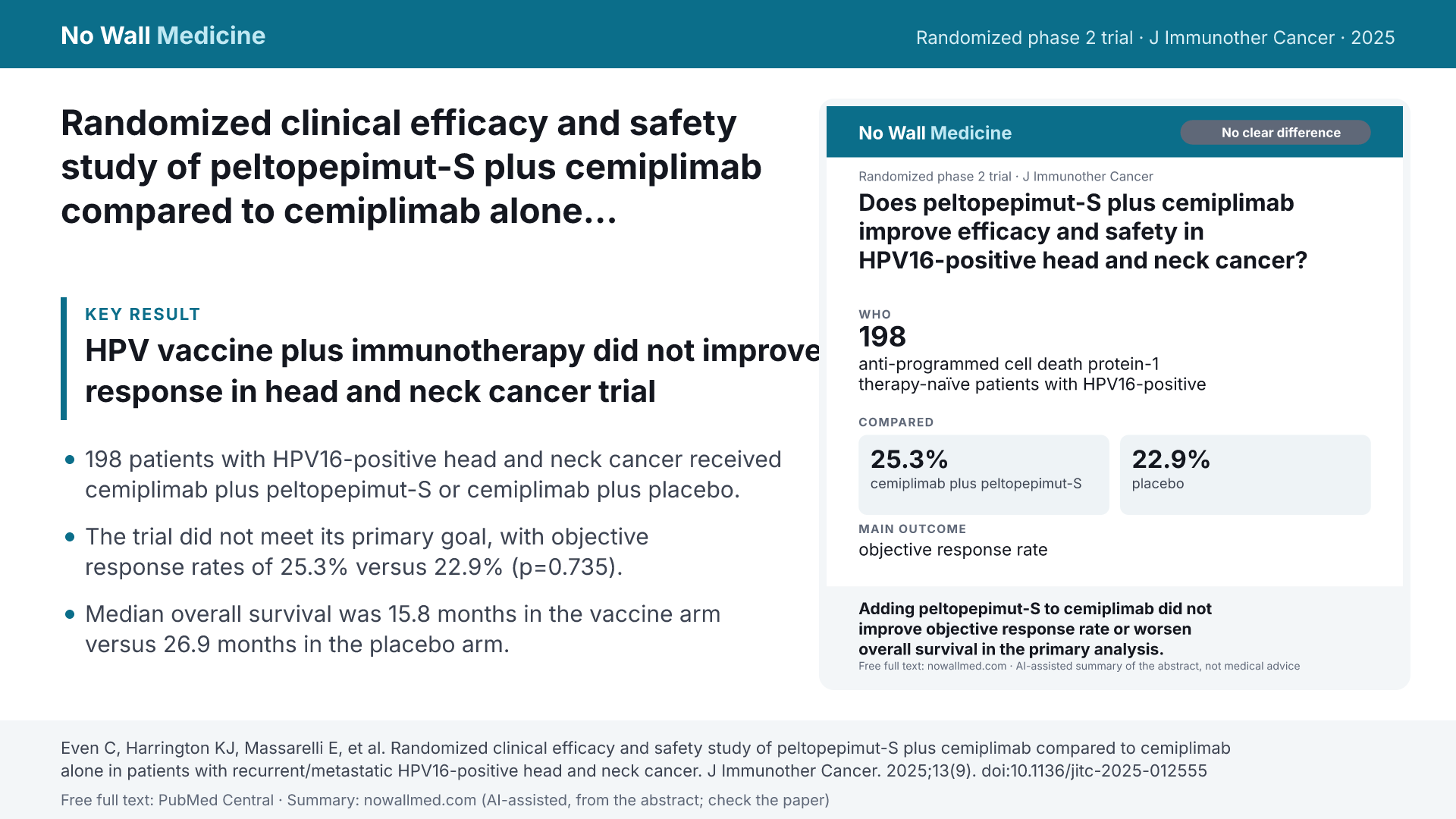
HPV vaccine plus immunotherapy did not improve response in head and neck cancer trial
Randomized clinical efficacy and safety study of peltopepimut-S plus cemiplimab compared to cemiplimab alone in patients with recurrent/metastatic HPV16-positive head and neck cancer
Randomized phase 2 trialNo clear difference
Does peltopepimut-S plus cemiplimab improve efficacy and safety in HPV16-positive head and neck cancer?
Who
198
anti-programmed cell death protein-1 therapy-naïve patients with HPV16-positive recurrent/metastatic oropharyngeal cancer
Compared
25.3%cemiplimab plus peltopepimut-S
22.9%placebo
Main outcome
objective response rate
Bottom line: Adding peltopepimut-S to cemiplimab did not improve objective response rate or worsen overall survival in the primary analysis.
J Immunother Cancer · 2025-09-08 · Save PNG
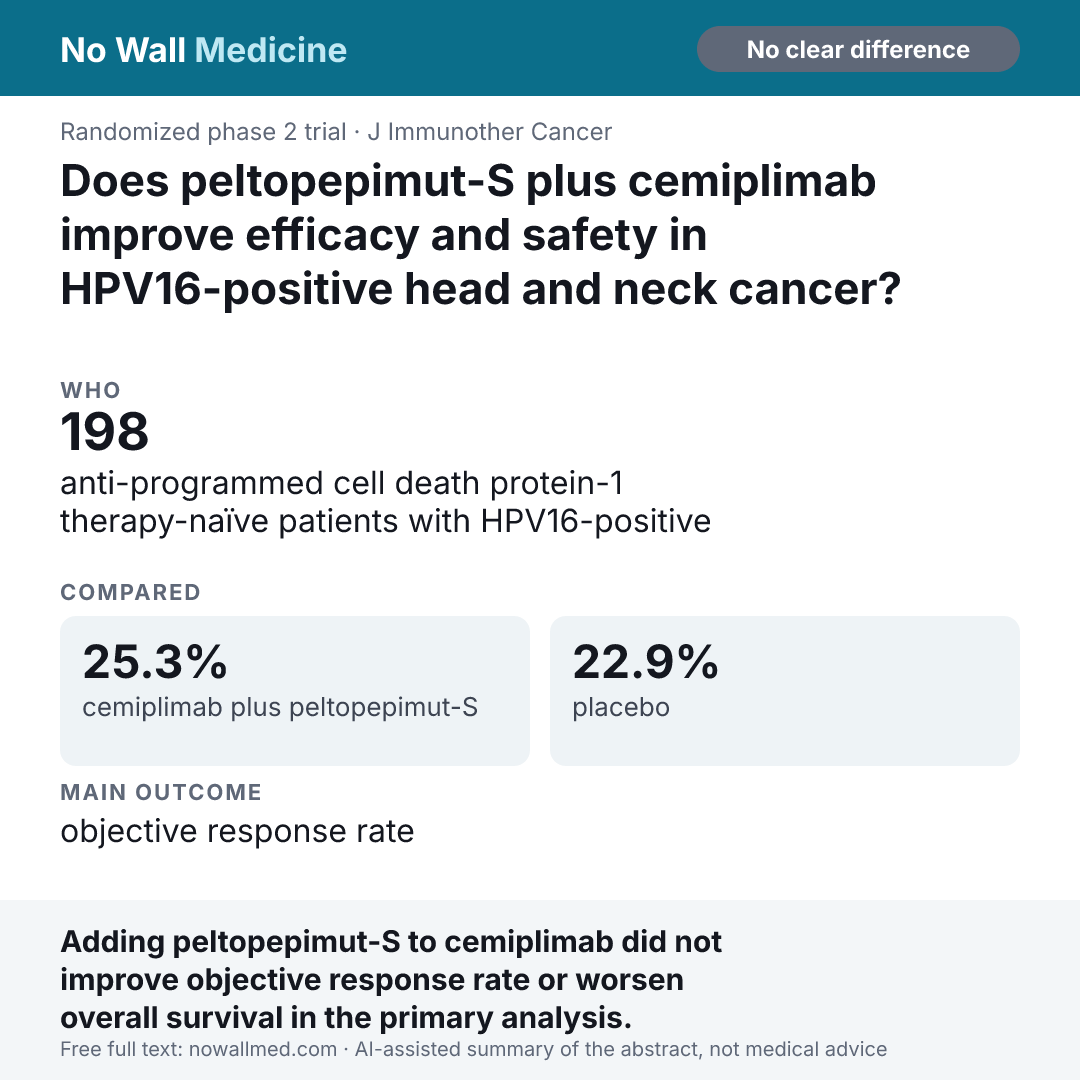
Clinical question: Does peltopepimut-S plus cemiplimab improve efficacy and safety in HPV16-positive head and neck cancer?
Key points
- 198 patients with HPV16-positive head and neck cancer received cemiplimab plus peltopepimut-S or cemiplimab plus placebo.
- The trial did not meet its primary goal, with objective response rates of 25.3% versus 22.9% (p=0.735).
- Median overall survival was 15.8 months in the vaccine arm versus 26.9 months in the placebo arm.
Headline and key points written with AI from the paper’s abstract, with every number checked against it. Read the paper before relying on them.
Was this summary helpful?
Abstract
Background
Peltopepimut-S is a therapeutic vaccine, which induces specific expansion of both CD4+helper and CD8+cytotoxic T-cells against human papillomavirus type 16 (HPV16) E6/E7 oncoproteins. Patients and methods
In a randomized phase 2 trial, we evaluated the efficacy and safety of peltopepimut-S plus cemiplimab compared with cemiplimab alone as first-line or second-line therapy in recurrent/metastatic HPV16-positive head and neck cancer. The primary efficacy endpoint was the objective response rate (ORR) by an independent review (Response Evaluation Criteria in Solid Tumors version 1.1, RECIST v1.1), while the primary safety endpoint was frequency and severity of adverse events. Secondary endpoints included progression-free survival (PFS) and overall survival (OS). Results
Overall, 198 anti-programmed cell death protein-1 therapy-naïve patients with confirmed HPV16-positive recurrent/metastatic oropharyngeal cancer were randomized to receive cemiplimab plus peltopepimut-S (n=100) or placebo (n=99). The trial did not meet its primary objective (ORR, 25.3% in peltopepimut-S arm vs 22.9% in placebo arm; p=0.735). The median OS (mOS) and PFS in the placebo arm were unexpectedly longer than in the peltopepimut-S arm (26.9 vs 15.8 months) and (20.3 vs 5.5 months), respectively. In predefined exploratory analyses this was associated with an excess death rate from progressive disease in patients with pre-treatment programmed death-ligand 1 (PD-L1) combined positive score (CPS) <20. In contrast, patients with CPS ≥20 had a higher ORR of 51.7% (95% CI, 32.5% to 70.6%) vs 25.8% (95% CI, 11.9% to 44.6%) and a longer mOS in the peltopepimut-S arm (34.8 vs 28.8 months) compared with the placebo arm, respectively. If patients had received all three vaccine or placebo doses, the ORR in patients with CPS ≥20 was 70.0% (95% CI, 45.7% to 88.1%) vs 29.2% (95% CI, 12.6% to 51.1%) in the peltopepimut-S arm and placebo arms, respectively, associated with mOS not reached (after 42 months) versus 23.3 months. The addition of peltopepimut-S to cemiplimab did not increase cemiplimab's toxicity. Conclusion
Adding peltopepimut-S to cemiplimab did not improve ORR and worsened mOS in the primary analysis. Divergent outcomes were seen in patients with pretreatment PD-L1 CPS <20 (worse ORR and mOS compared with placebo) and CPS ≥20 (higher ORR and longer mOS compared with placebo) values. Future drug development is justifiable in the CPS ≥20 patient population. Trial registration number
NCT03669718.
Abstract reproduced under the article’s CC BY NC licence.
Subject terms
Headline, design, result, key points, caveat and citation as plain text.
Cite this article
Even C, Harrington KJ, Massarelli E, et al. Randomized clinical efficacy and safety study of peltopepimut-S plus cemiplimab compared to cemiplimab alone in patients with recurrent/metastatic HPV16-positive head and neck cancer. J Immunother Cancer. 2025;13(9). doi:10.1136/jitc-2025-012555
Spotted a mistake? Suggest a correction