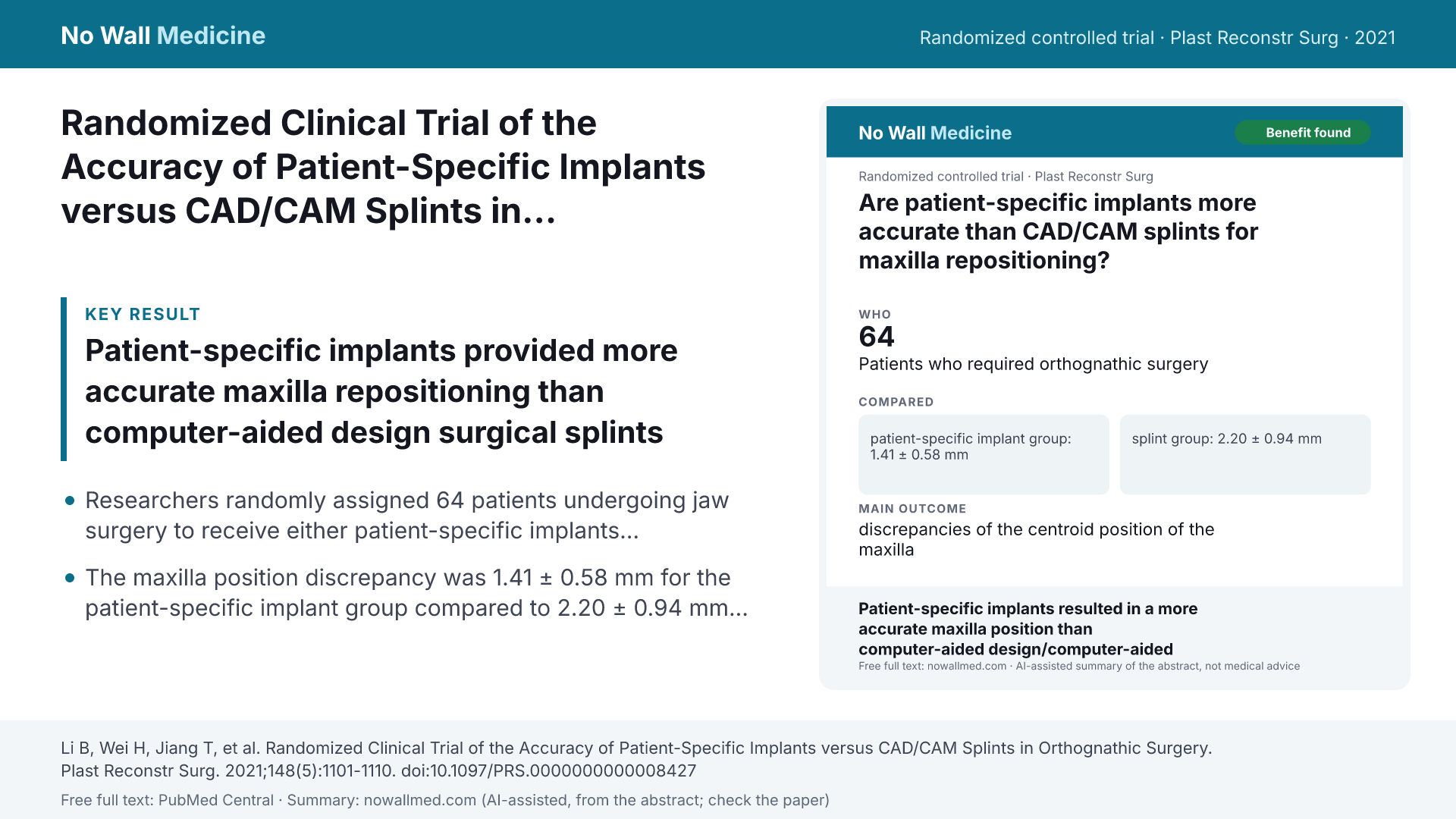
Patient-specific implants provided more accurate maxilla repositioning than computer-aided design surgical splints
Randomized Clinical Trial of the Accuracy of Patient-Specific Implants versus CAD/CAM Splints in Orthognathic Surgery
Randomized controlled trialBenefit found
Are patient-specific implants more accurate than CAD/CAM splints for maxilla repositioning?
Who
64
Patients who required orthognathic surgery
Compared
patient-specific implant group: 1.41 ± 0.58 mm
splint group: 2.20 ± 0.94 mm
Main outcome
discrepancies of the centroid position of the maxilla
Bottom line: Patient-specific implants resulted in a more accurate maxilla position than computer-aided design/computer-aided manufacturing surgical splints.
Plast Reconstr Surg · 2021-10-27 · Save PNG
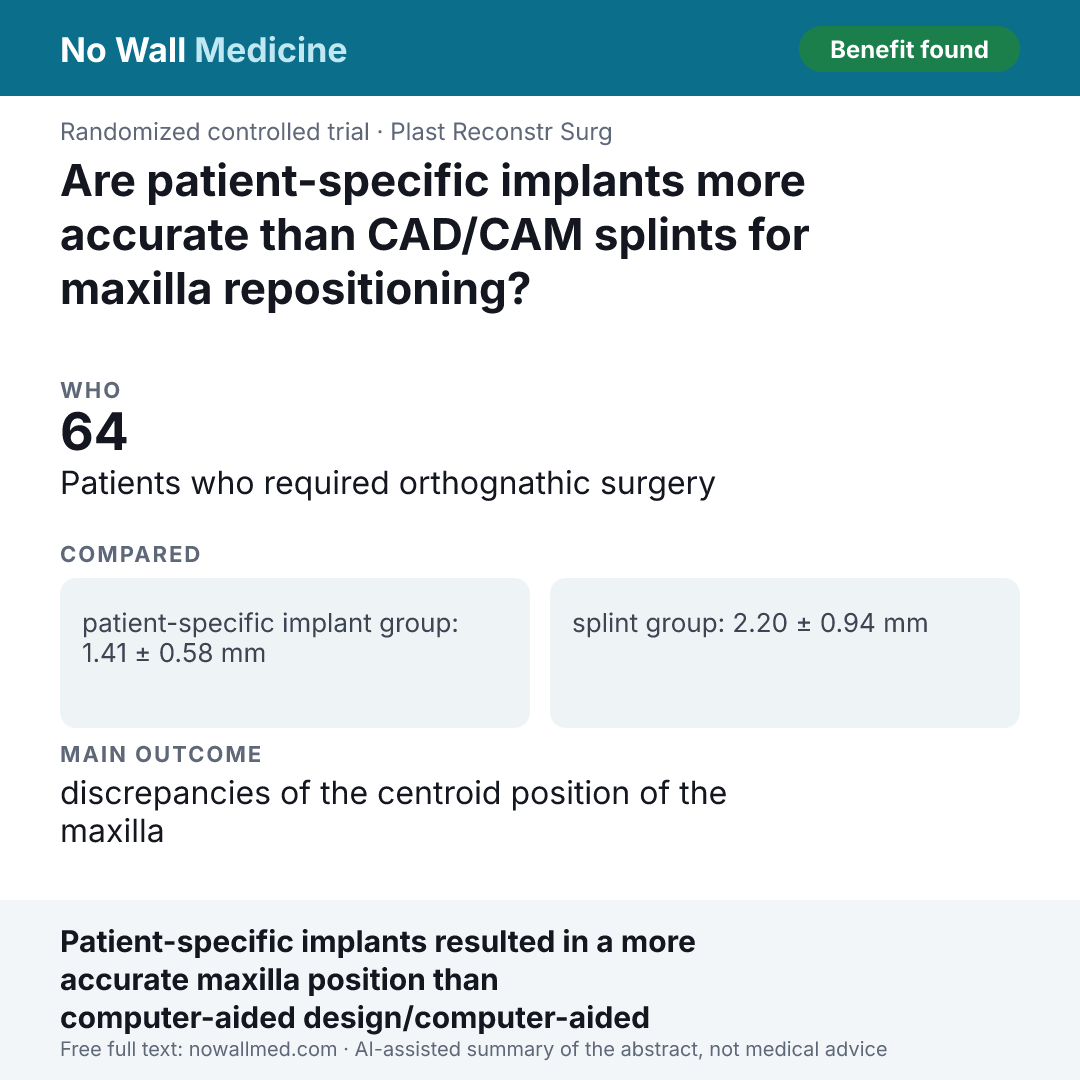
Clinical question: Are patient-specific implants more accurate than CAD/CAM splints for maxilla repositioning?
Key points
- Researchers randomly assigned 64 patients undergoing jaw surgery to receive either patient-specific implants or computer-aided design/computer-aided manufacturing (CAD/CAM) surgical splints.
- The maxilla position discrepancy was 1.41 ± 0.58 mm for the patient-specific implant group compared to 2.20 ± 0.94 mm for the splint group.
- In the patient-specific implant group, the largest translation discrepancy was 1.02 ± 0.66 mm in the anteroposterior direction and the largest orientation discrepancy was 1.85 ± 1.42 degrees in pitch.
Headline and key points written with AI from the paper’s abstract, with every number checked against it. Read the paper before relying on them.
Was this summary helpful?
Subject terms
Headline, design, result, key points, caveat and citation as plain text.
Cite this article
Li B, Wei H, Jiang T, et al. Randomized Clinical Trial of the Accuracy of Patient-Specific Implants versus CAD/CAM Splints in Orthognathic Surgery. Plast Reconstr Surg. 2021;148(5):1101-1110. doi:10.1097/PRS.0000000000008427
Spotted a mistake? Suggest a correction