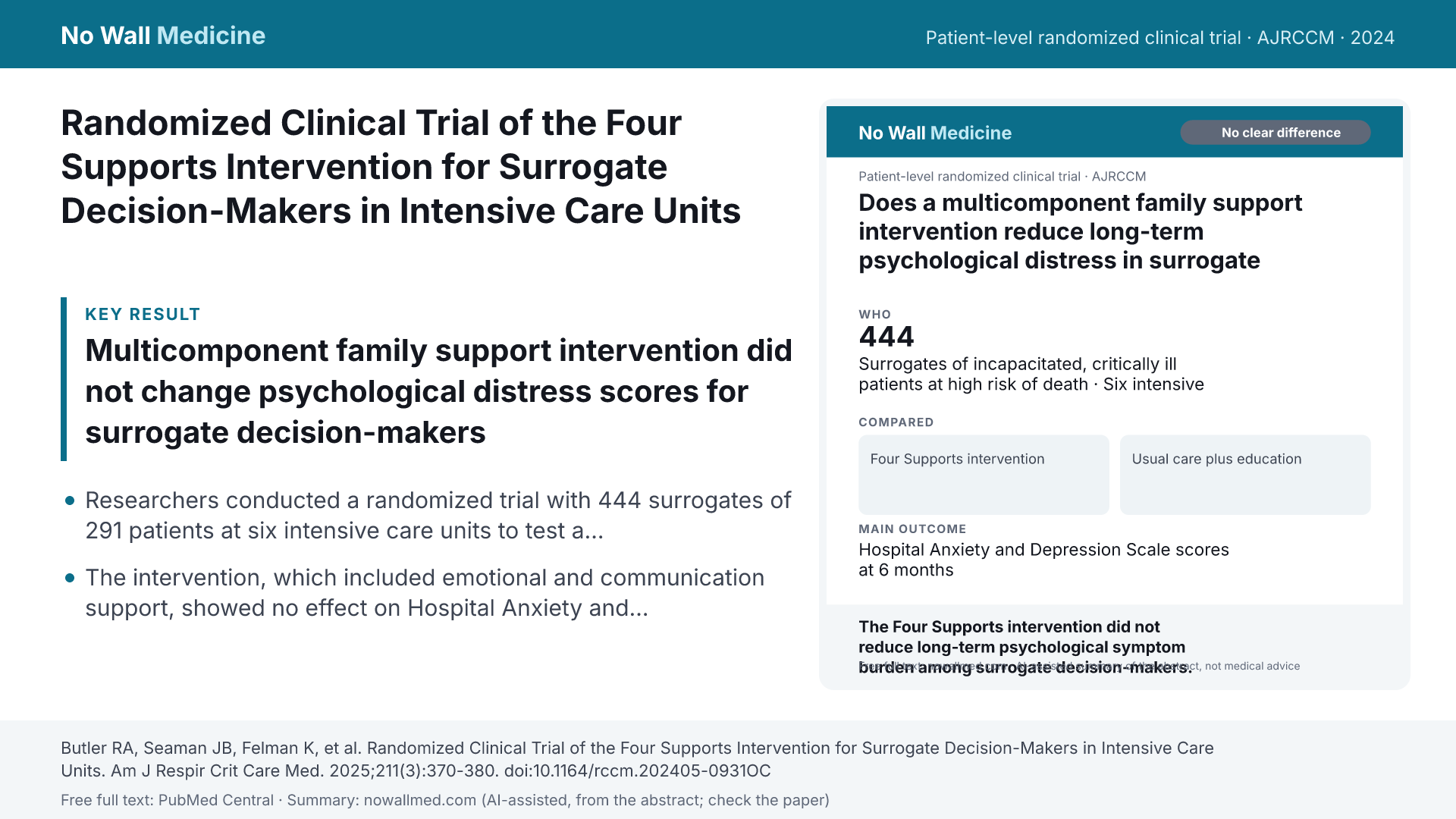
Multicomponent family support intervention did not change psychological distress scores for surrogate decision-makers
Randomized Clinical Trial of the Four Supports Intervention for Surrogate Decision-Makers in Intensive Care Units
Patient-level randomized clinical trialNo clear difference
Does a multicomponent family support intervention reduce long-term psychological distress in surrogate decision-makers?
Who
444
Surrogates of incapacitated, critically ill patients at high risk of death · Six intensive care units in Pennsylvania
Compared
Four Supports intervention
Usual care plus education
Main outcome
Hospital Anxiety and Depression Scale scores at 6 months
Result: β = 0.06 (95% confidence interval, -0.07 to 0.19)
Bottom line: The Four Supports intervention did not reduce long-term psychological symptom burden among surrogate decision-makers.
AJRCCM · 2024-11-25 · Save PNG
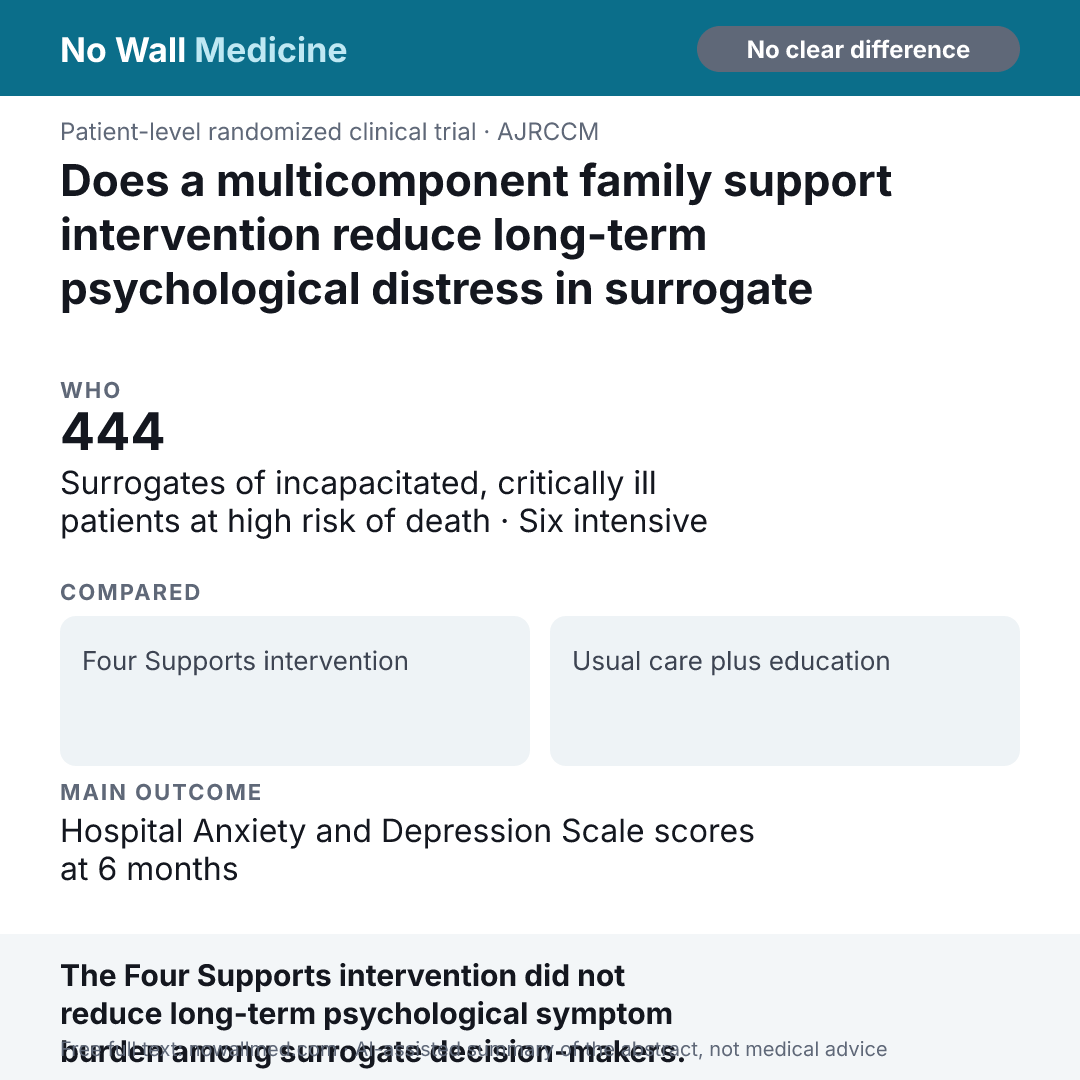
Clinical question: Does a multicomponent family support intervention reduce long-term psychological distress in surrogate decision-makers?
Why it matters: Surrogates for critically ill patients often experience high levels of long-term psychological distress, and previous interventions focused only on information sharing have been ineffective.
Key points
- Researchers conducted a randomized trial with 444 surrogates of 291 patients at six intensive care units to test a four-part support intervention.
- The intervention, which included emotional and communication support, showed no effect on Hospital Anxiety and Depression Scale scores at 6 months (P = 0.35).
- The intervention was delivered with 97.1% fidelity and a quality rating of 2.9 ± 0.2 on a 3-point scale.
Headline and key points written with AI from the paper’s abstract, with every number checked against it. Read the paper before relying on them.
Was this summary helpful?
Subject terms
Headline, design, result, key points, caveat and citation as plain text.
Cite this article
Butler RA, Seaman JB, Felman K, et al. Randomized Clinical Trial of the Four Supports Intervention for Surrogate Decision-Makers in Intensive Care Units. Am J Respir Crit Care Med. 2025;211(3):370-380. doi:10.1164/rccm.202405-0931OC
Spotted a mistake? Suggest a correction