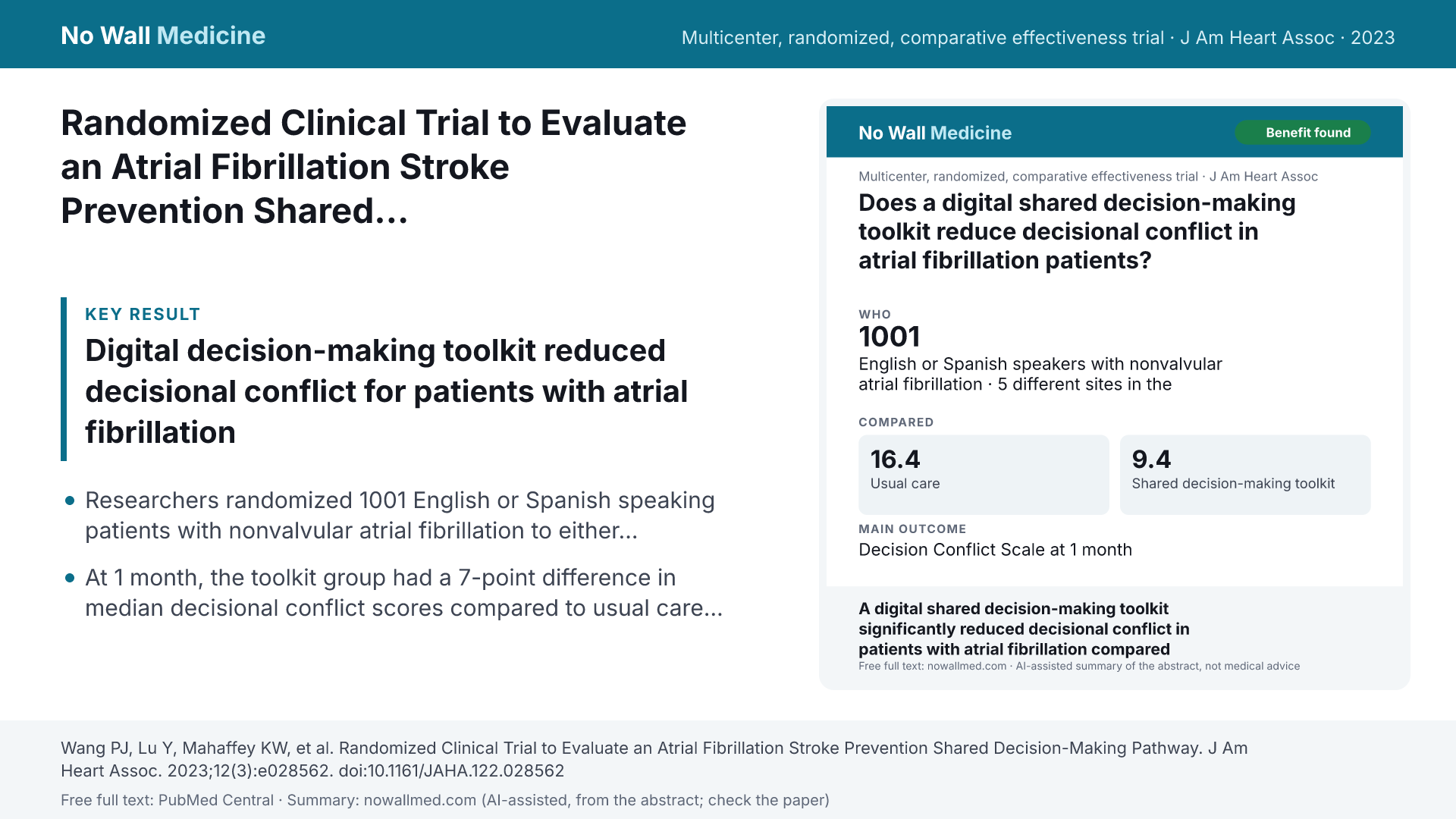
Randomized Clinical Trial to Evaluate an Atrial Fibrillation Stroke Prevention Shared Decision-Making Pathway
Key result: Digital decision-making toolkit reduced decisional conflict for patients with atrial fibrillation
Multicenter, randomized, comparative effectiveness trialBenefit found
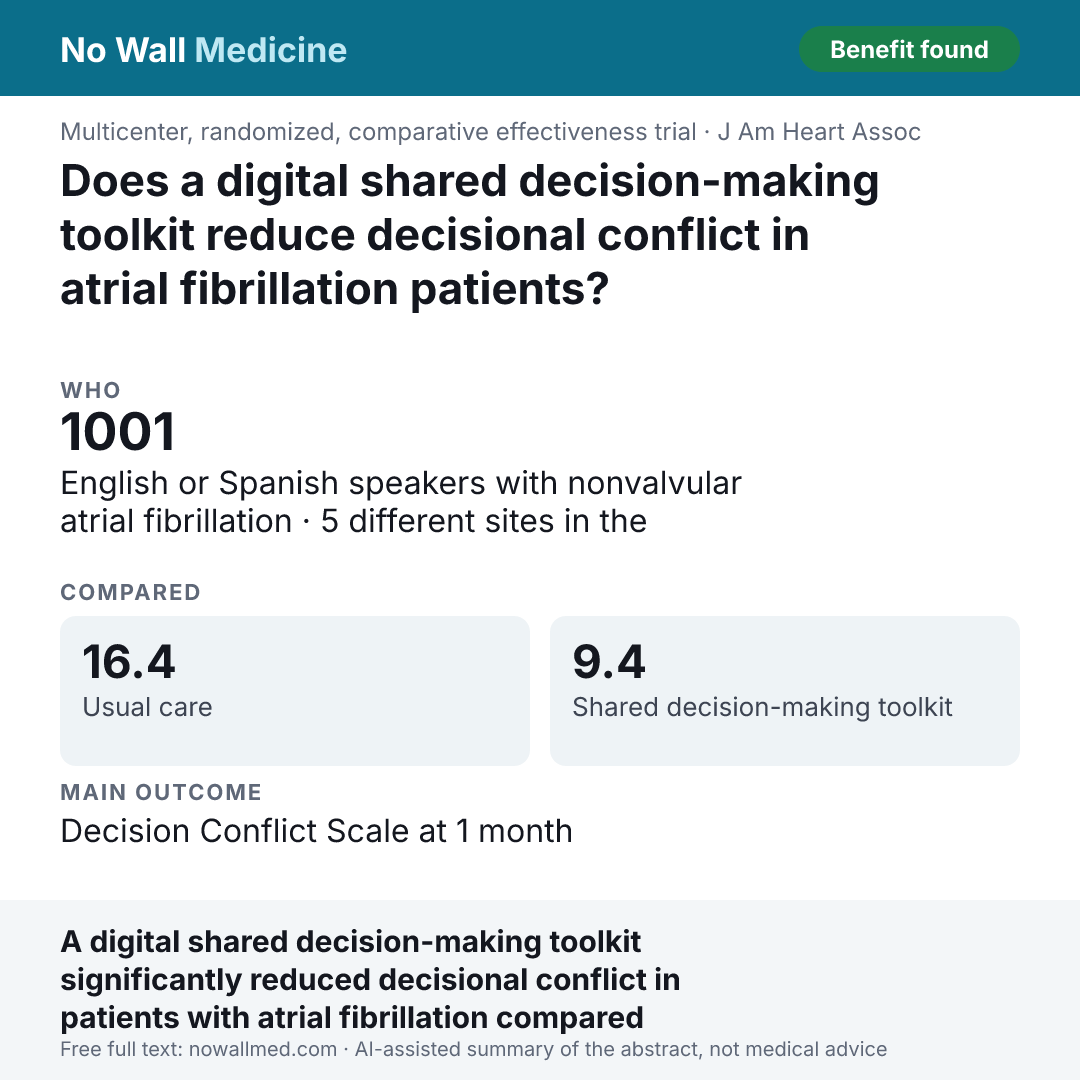
Does a digital shared decision-making toolkit reduce decisional conflict in atrial fibrillation patients?
Who
1001
English or Spanish speakers with nonvalvular atrial fibrillation · 5 different sites in the United States
Compared
16.4Usual care
9.4Shared decision-making toolkit
Main outcome
Decision Conflict Scale at 1 month
Result: 7-point difference in median scores (P=0.007)
Bottom line: A digital shared decision-making toolkit significantly reduced decisional conflict in patients with atrial fibrillation compared to usual care.
J Am Heart Assoc · 2023-02-07 · Save PNG
Key points
- Researchers randomized 1001 English or Spanish speaking patients with nonvalvular atrial fibrillation to either a digital decision-making toolkit or usual care.
- At 1 month, the toolkit group had a 7-point difference in median decisional conflict scores compared to usual care (16.4 versus 9.4; P=0.007).
- The difference in decisional conflict scores between the two groups decreased to 4.7 points at 6 months (P=0.060).
Why it matters: Oral anticoagulation is underused for stroke prevention in patients with atrial fibrillation.
Discussion prompts
- Would these patients look like yours? Who was left out?
- Is the main outcome one that matters to patients?
- Is the difference large enough to change what you do?
Cite: Wang PJ, Lu Y, Mahaffey KW, et al. Randomized Clinical Trial to Evaluate an Atrial Fibrillation Stroke Prevention Shared Decision-Making Pathway. J Am Heart Assoc. 2023;12(3):e028562. doi:10.1161/JAHA.122.028562
Free full text: PubMed Central · Summary and visual abstract: nowallmed.com/a/randomized-clinical-trial-to-evaluate-an-atrial-fibrillation-stroke-1vq12gc/ (AI-assisted from the abstract; check the paper before relying on it).