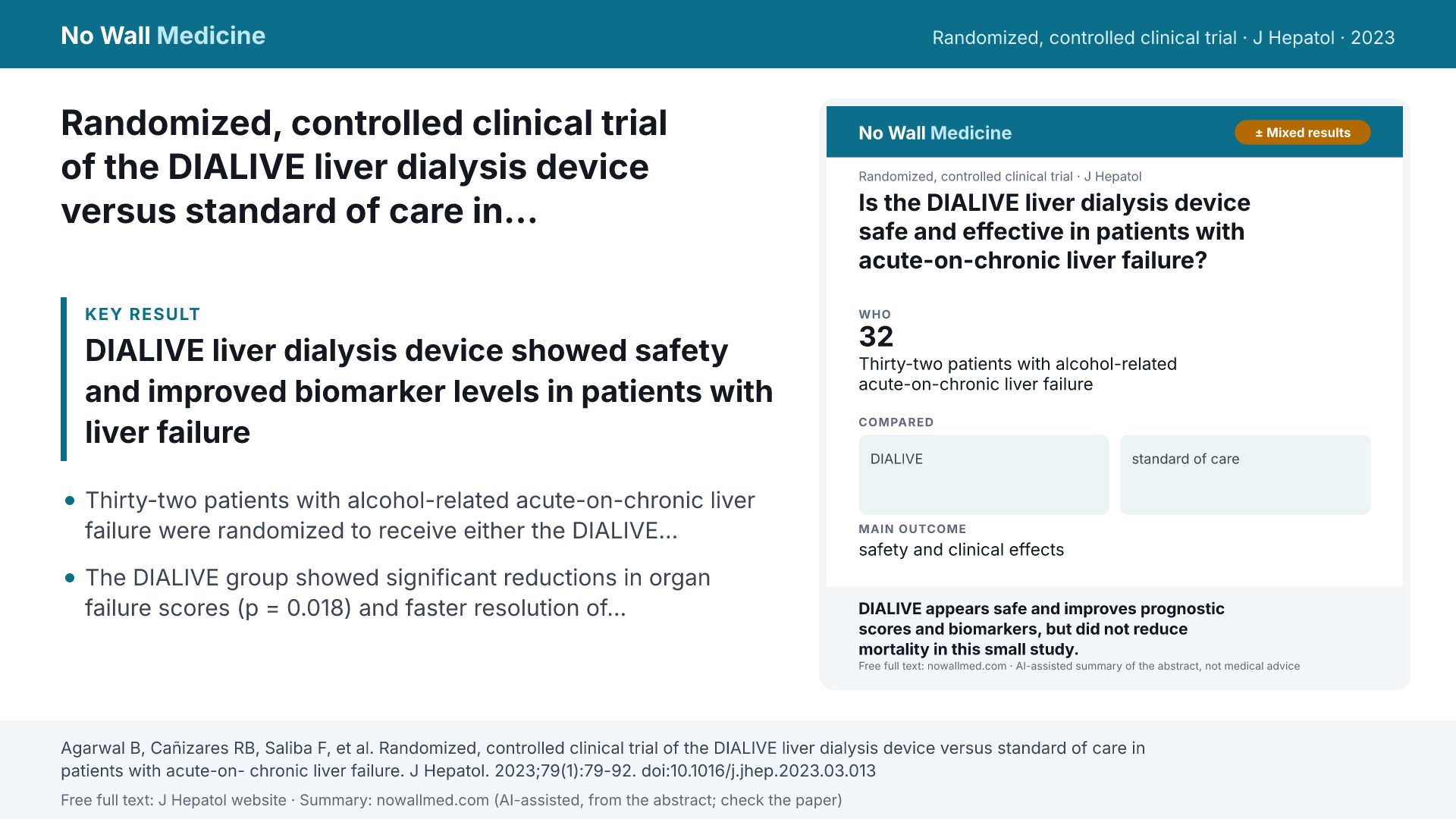
DIALIVE liver dialysis device showed safety and improved biomarker levels in patients with liver failure
Randomized, controlled clinical trial of the DIALIVE liver dialysis device versus standard of care in patients with acute-on- chronic liver failure
Randomized, controlled clinical trialMixed results
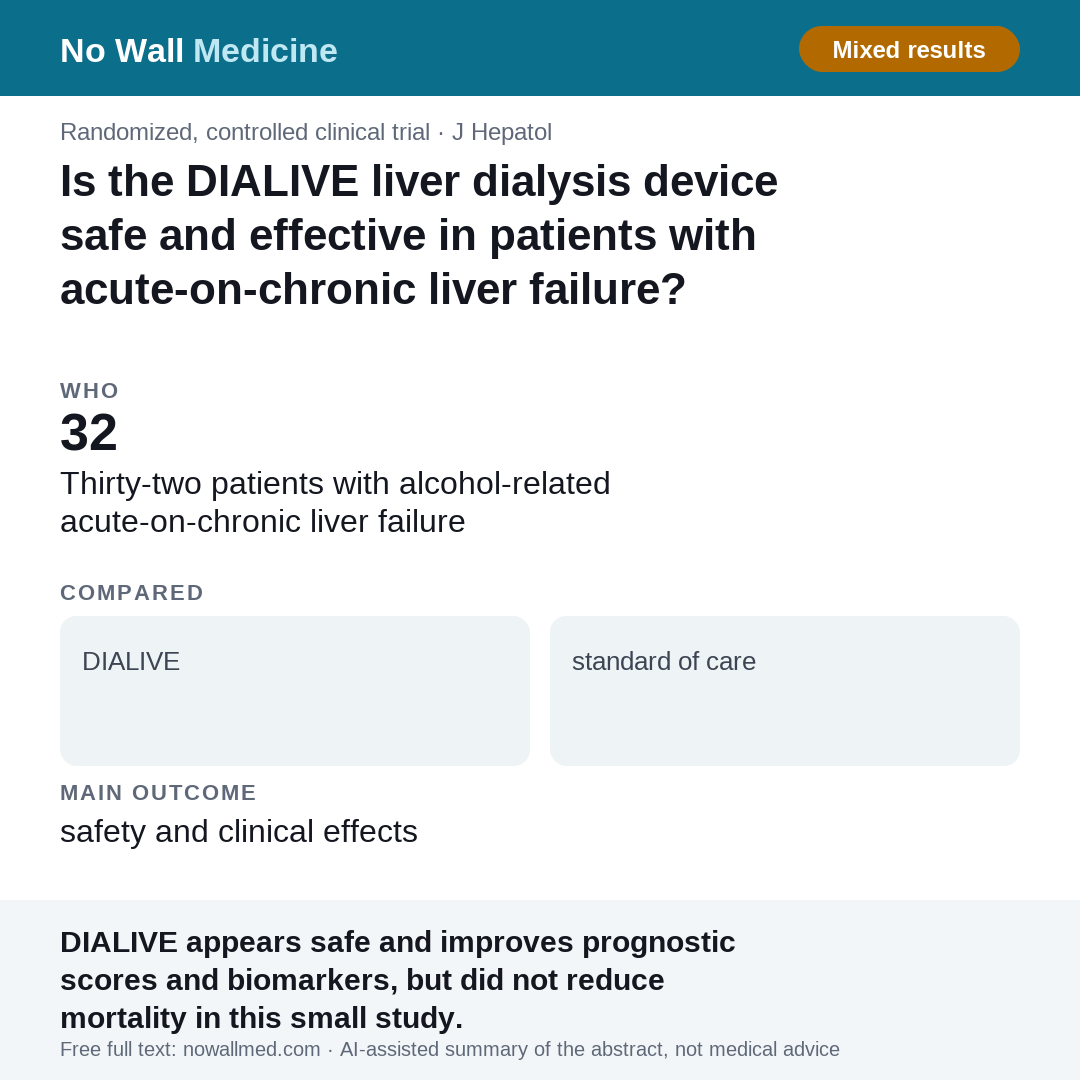
Is the DIALIVE liver dialysis device safe and effective in patients with acute-on-chronic liver failure?
Who
32
Thirty-two patients with alcohol-related acute-on-chronic liver failure
Compared
DIALIVE
standard of care
Main outcome
safety and clinical effects
Bottom line: DIALIVE appears safe and improves prognostic scores and biomarkers, but did not reduce mortality in this small study.
Limitation: This was a small first-in-man study requiring larger, adequately powered trials.
J Hepatol · 2023-05-31Download image
Clinical question: Is the DIALIVE liver dialysis device safe and effective in patients with acute-on-chronic liver failure?
Why it matters: Treatment for acute-on-chronic liver failure, which involves severe inflammation and organ failure, remains an urgent unmet need.
Key points
- Thirty-two patients with alcohol-related acute-on-chronic liver failure were randomized to receive either the DIALIVE liver dialysis device or standard care.
- The DIALIVE group showed significant reductions in organ failure scores (p = 0.018) and faster resolution of liver failure (p = 0.036) by Day 10.
- There were no significant differences in 28-day mortality or serious adverse events between the DIALIVE and standard care groups.
Limitation the authors note: The authors state that larger, adequately powered studies are warranted to confirm safety and efficacy due to the small study size.
Headline and key points written with AI from the paper’s abstract, with every number checked against it. Read the paper before relying on them.
Was this summary helpful?
Subject terms
Headline, design, result, key points, caveat and citation as plain text.
Cite this article
Agarwal B, Cañizares RB, Saliba F, et al. Randomized, controlled clinical trial of the DIALIVE liver dialysis device versus standard of care in patients with acute-on- chronic liver failure. J Hepatol. 2023. doi:10.1016/j.jhep.2023.03.013
Spotted a mistake? Suggest a correction