Integrated kidney supportive care improved quality of life and reduced symptoms in kidney failure patients
Randomized Controlled Trial of Integrated Kidney Supportive Care in End-Stage Kidney Disease
Randomized controlled trialBenefit found
Does integrated kidney supportive care improve quality of life and symptom burden?
Who
Adult patients with kidney failure · A tertiary care hospital in India
Compared
Integrated kidney supportive care
Conventional care
Main outcome
Quality of life, symptom burden, and advance care planning engagement
Bottom line: Integrated kidney supportive care improves quality of life, reduces symptom burden, and enhances advance care planning engagement.
Kidney Int Rep · 2026-07-08Download image
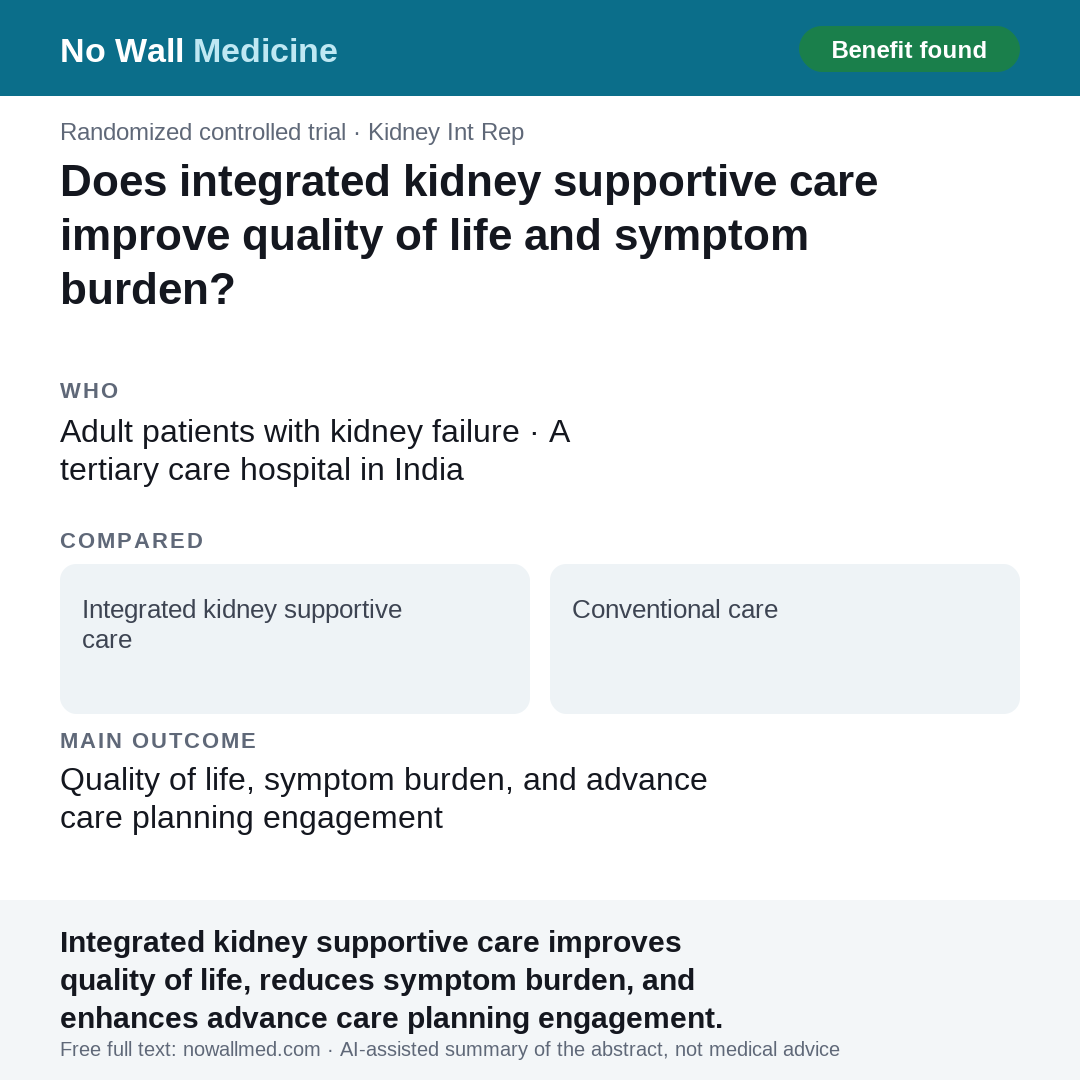
Clinical question: Does integrated kidney supportive care improve quality of life and symptom burden?
Why it matters: Data from developing countries are scarce regarding how kidney supportive care and advance care planning affect patient outcomes in kidney failure.
Key points
- Adult patients with kidney failure at a tertiary care hospital in India were randomized to receive either integrated kidney supportive care or conventional care.
- The intervention group showed significant improvements in quality of life scores and a reduction in symptom burden compared to the standard care group.
- Patients receiving integrated kidney supportive care also showed enhanced engagement with advance care planning, which involves discussing future medical preferences.
Headline and key points written with AI from the paper’s abstract, with every number checked against it. Read the paper before relying on them.
Spotted a mistake? Suggest a correction