Randomized Controlled Trial: Subcutaneous vs Intravenous Infliximab CT-P13 Maintenance in Inflammatory Bowel Disease
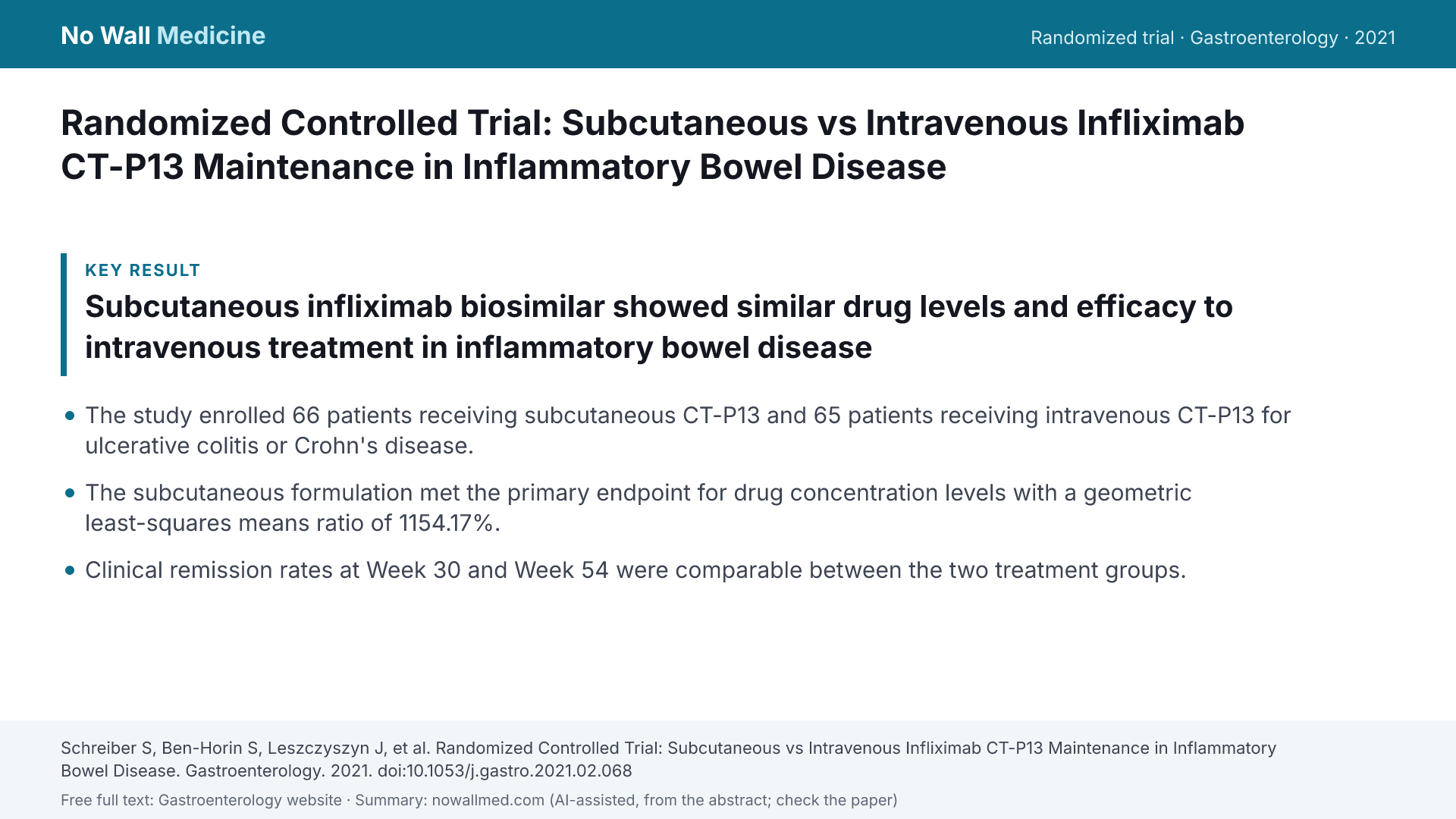
Key result: Subcutaneous infliximab biosimilar showed similar drug levels and efficacy to intravenous treatment in inflammatory bowel disease
Key points
- The study enrolled 66 patients receiving subcutaneous CT-P13 and 65 patients receiving intravenous CT-P13 for ulcerative colitis or Crohn's disease.
- The subcutaneous formulation met the primary endpoint for drug concentration levels with a geometric least-squares means ratio of 1154.17%.
- Clinical remission rates at Week 30 and Week 54 were comparable between the two treatment groups.
Why it matters: It was unknown if a subcutaneous formulation of the infliximab biosimilar CT-P13 is as effective and safe as the intravenous version for maintaining remission in inflammatory bowel disease.
Discussion prompts
- Would these patients look like yours? Who was left out?
- Is the main outcome one that matters to patients?
- Is the difference large enough to change what you do?
Cite: Schreiber S, Ben-Horin S, Leszczyszyn J, Dudkowiak R, Lahat A, Gawdis-Wojnarska B. Randomized Controlled Trial: Subcutaneous vs Intravenous Infliximab CT-P13 Maintenance in Inflammatory Bowel Disease. Gastroenterology. 2021. doi:10.1053/j.gastro.2021.02.068
Free full text: Gastroenterology website · Summary and visual abstract: nowallmed.com/a/randomized-controlled-trial-subcutaneous-vs-intravenous-infliximab-ct-159a5hj/ (AI-assisted from the abstract; check the paper before relying on it).