Randomized Controlled Trials Evaluating Artificial Intelligence in Cardiovascular Care: A Systematic Review
Systematic review of randomized controlled trialsBenefit found
Does artificial intelligence improve clinical outcomes in cardiovascular care compared to traditional methods?
Who
Patients receiving cardiovascular care · Multicenter trials
Compared
Artificial intelligence
Traditional methods
Main outcome
Clinical events, diagnostic accuracy, and resource utilization
Bottom line: Artificial intelligence shows potential to enhance cardiovascular care through improved diagnostic accuracy and resource efficiency.
Limitation: The limited number of randomized controlled trials indicates a need for more high-quality studies.
JACC Adv · 2025-09-24Download image
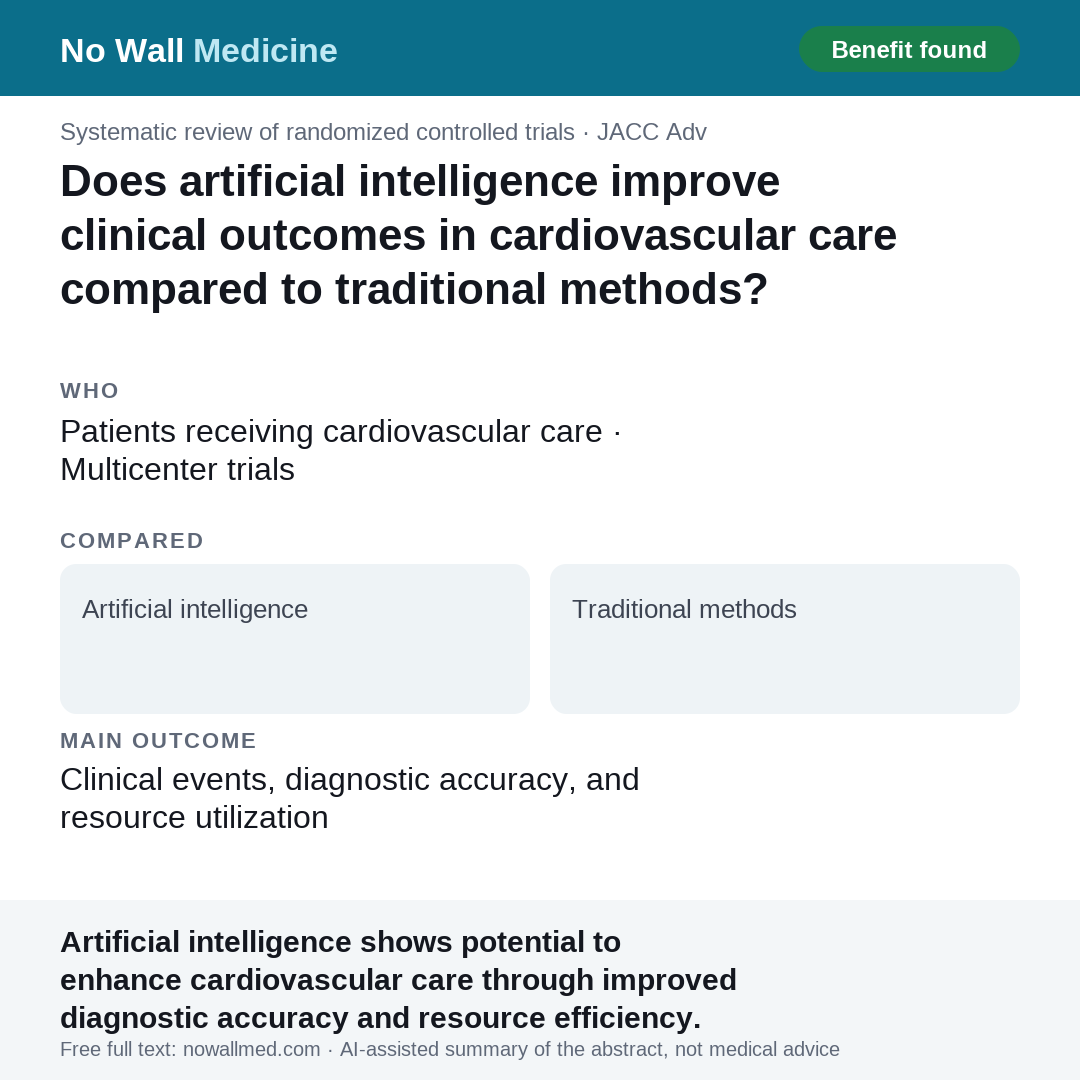
Clinical question: Does artificial intelligence improve clinical outcomes in cardiovascular care compared to traditional methods?
Abstract
Background
Artificial intelligence (AI) has shown promise in transforming health care, particularly in cardiology. However, there is a lack of high-quality evidence demonstrating its impact on crucial clinical outcomes. Objectives
The purpose of this study was to synthesize existing evidence from randomized controlled trials (RCTs) on the application of AI in cardiology, evaluating its impact on key clinical outcomes. Methods
We conducted a systematic review following Preferred Reporting Items for Systematic Reviews and Meta-Analyses (PRISMA) guidelines, searching MEDLINE, Web of Science, and the Cochrane Library from inception to November 2024. We included RCTs evaluating machine learning models compared to traditional methods in cardiovascular care. Primary outcomes focused on patient-important metrics, while secondary outcomes covered time and resource savings. Results
Eleven RCTs met the inclusion criteria. Studies were conducted between 2021 and 2024, with 81.2% being multicenter trials. Five studies (45.5%) reported improvements in clinical events, 6 (54.5%) showed enhanced diagnostic accuracy and early detection, and 3 (27.3%) demonstrated improved resource utilization. Conclusions
This review highlights AI's potential to enhance cardiovascular care through improved early detection, diagnostic accuracy, and resource efficiency. However, the limited number of RCTs indicates a need for more high-quality studies to validate AI's effectiveness across various clinical domains.
Cite this article
Hadida Barzilai D, Sudri K, Goshen G, Klang E, Zimlichman E, Barbash I. Randomized Controlled Trials Evaluating Artificial Intelligence in Cardiovascular Care: A Systematic Review. JACC Adv. 2025. doi:10.1016/j.jacadv.2025.102152
Spotted a mistake? Suggest a correction