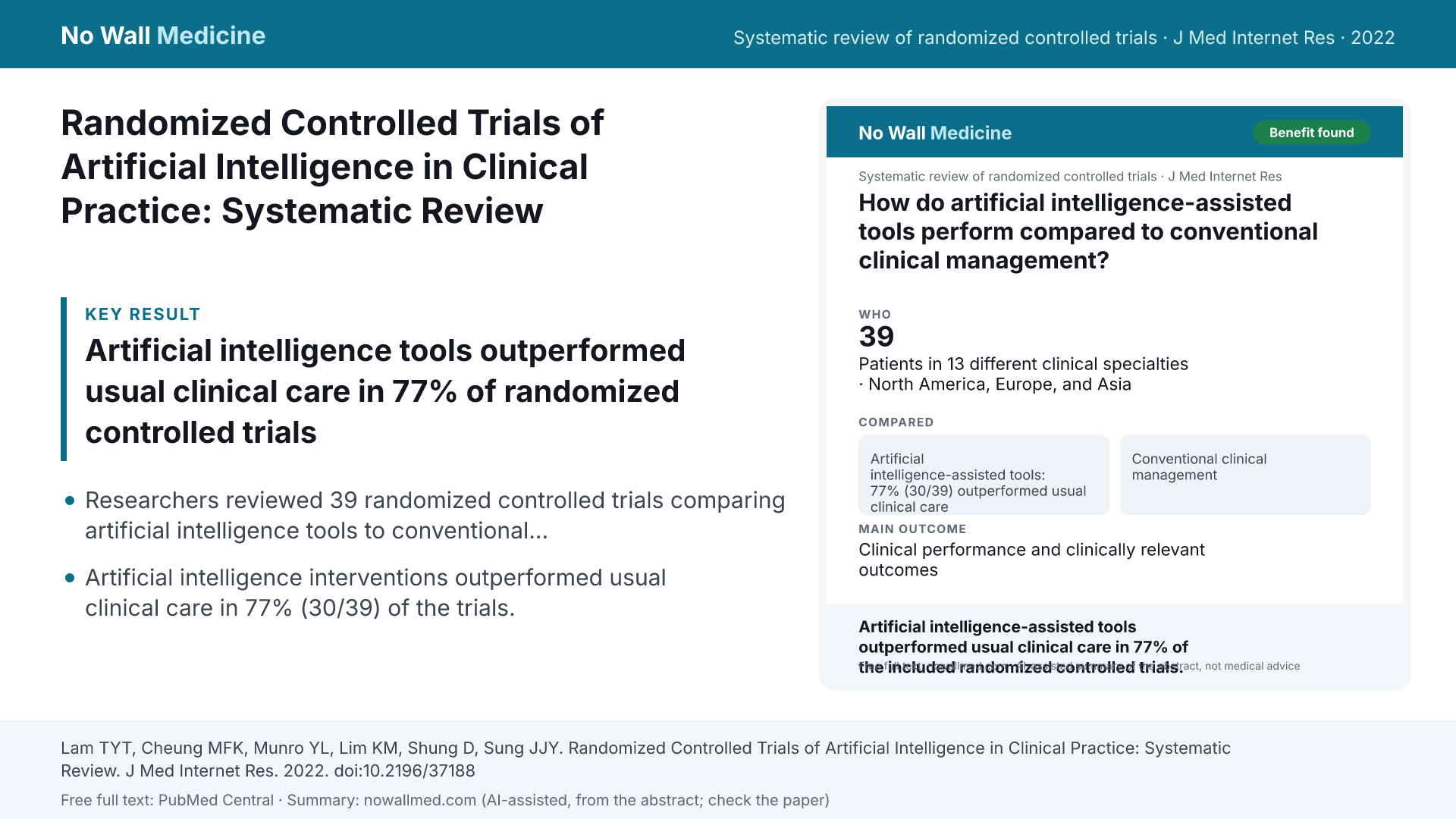
Randomized Controlled Trials of Artificial Intelligence in Clinical Practice: Systematic Review
Key result: Artificial intelligence tools outperformed usual clinical care in 77% of randomized controlled trials
Key points
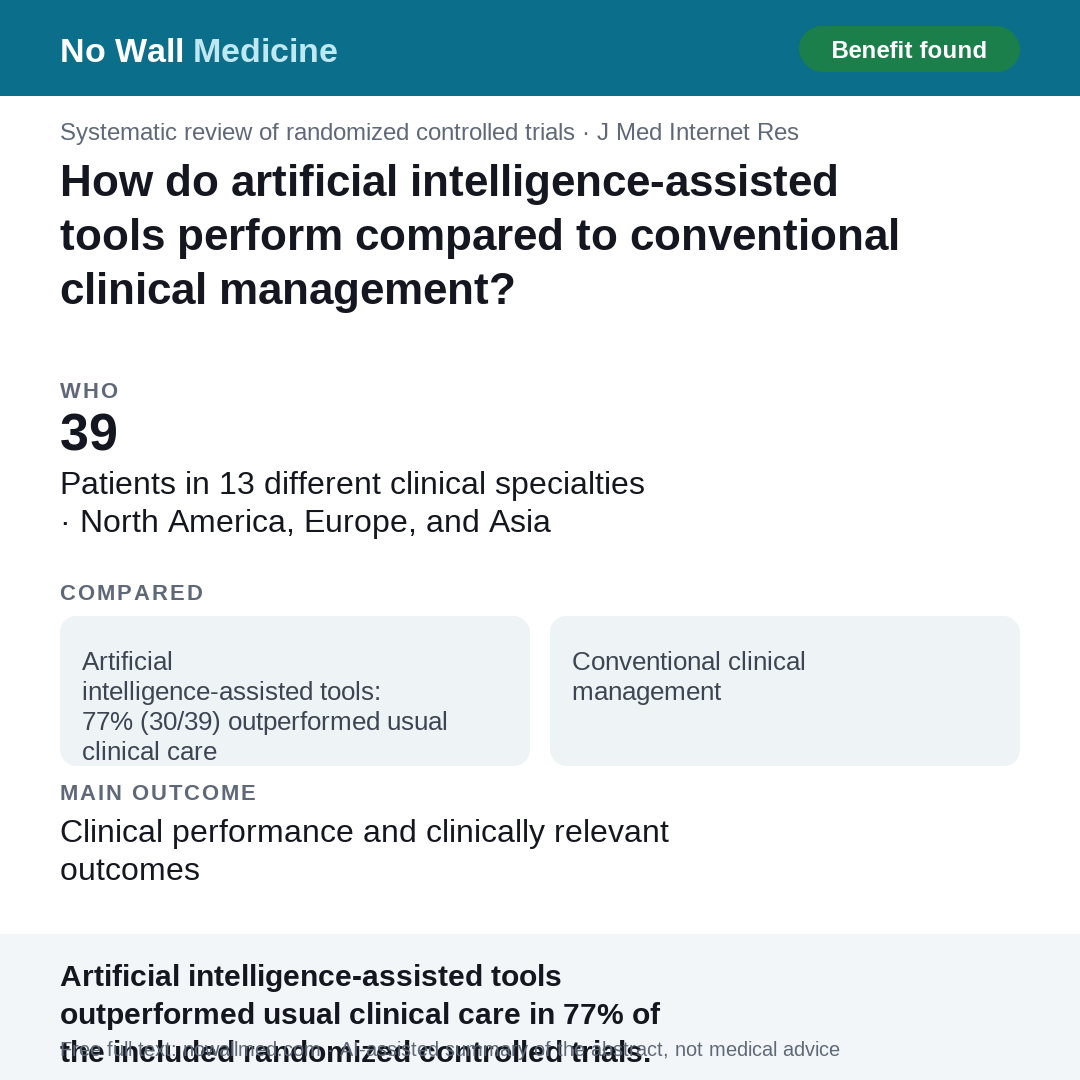
- Researchers reviewed 39 randomized controlled trials comparing artificial intelligence tools to conventional clinical management across 13 different medical specialties.
- Artificial intelligence interventions outperformed usual clinical care in 77% (30/39) of the trials.
- Clinically relevant outcomes improved with artificial intelligence assistance in 70% (21/30) of those successful studies.
Why it matters: The clinical benefits of implementing artificial intelligence-assisted tools in patient care have not been clearly quantified.
Limitation the authors note: Small sample size and single-center design limited the generalizability of these studies.
Discussion prompts
- Would these patients look like yours? Who was left out?
- Is the main outcome one that matters to patients?
- Is the difference large enough to change what you do?
Cite: Lam TYT, Cheung MFK, Munro YL, Lim KM, Shung D, Sung JJY. Randomized Controlled Trials of Artificial Intelligence in Clinical Practice: Systematic Review. J Med Internet Res. 2022. doi:10.2196/37188
Free full text: PubMed Central · Summary and visual abstract: nowallmed.com/a/randomized-controlled-trials-of-artificial-intelligence-in-clinical-zd41we/ (AI-assisted from the abstract; check the paper before relying on it).