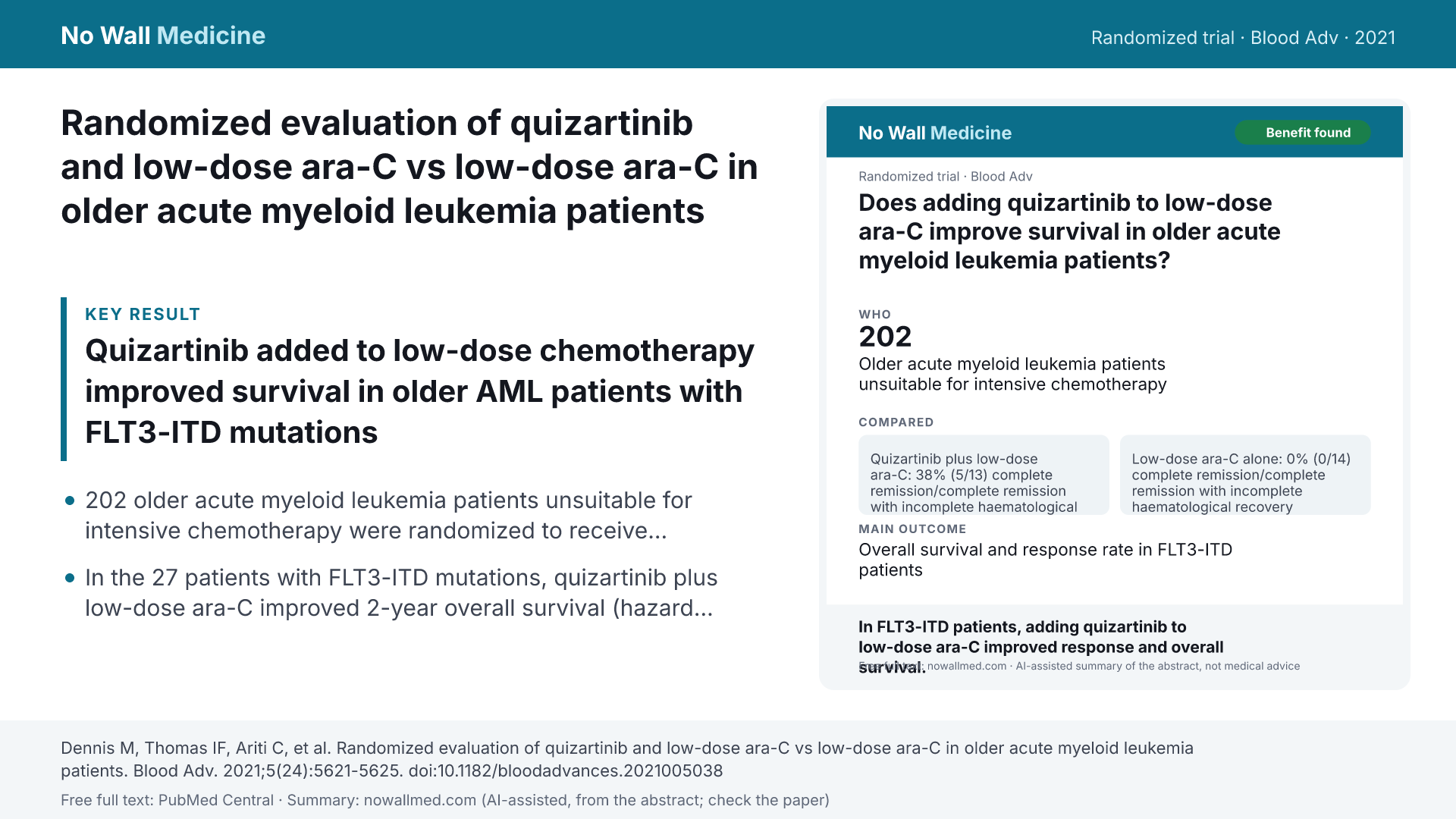
Quizartinib added to low-dose chemotherapy improved survival in older AML patients with FLT3-ITD mutations
Randomized evaluation of quizartinib and low-dose ara-C vs low-dose ara-C in older acute myeloid leukemia patients
Randomized trialBenefit found
Does adding quizartinib to low-dose ara-C improve survival in older acute myeloid leukemia patients?
Who
202
Older acute myeloid leukemia patients unsuitable for intensive chemotherapy
Compared
Quizartinib plus low-dose ara-C: 38% (5/13) complete remission/complete remission with incomplete haematological recovery
Low-dose ara-C alone: 0% (0/14) complete remission/complete remission with incomplete haematological recovery
Main outcome
Overall survival and response rate in FLT3-ITD patients
Result: hazard ratio 0.36 (95% confidence intervals: 0.16, 0.85)
Bottom line: In FLT3-ITD patients, adding quizartinib to low-dose ara-C improved response and overall survival.
Blood Adv · 2021-10-02 · Save PNG
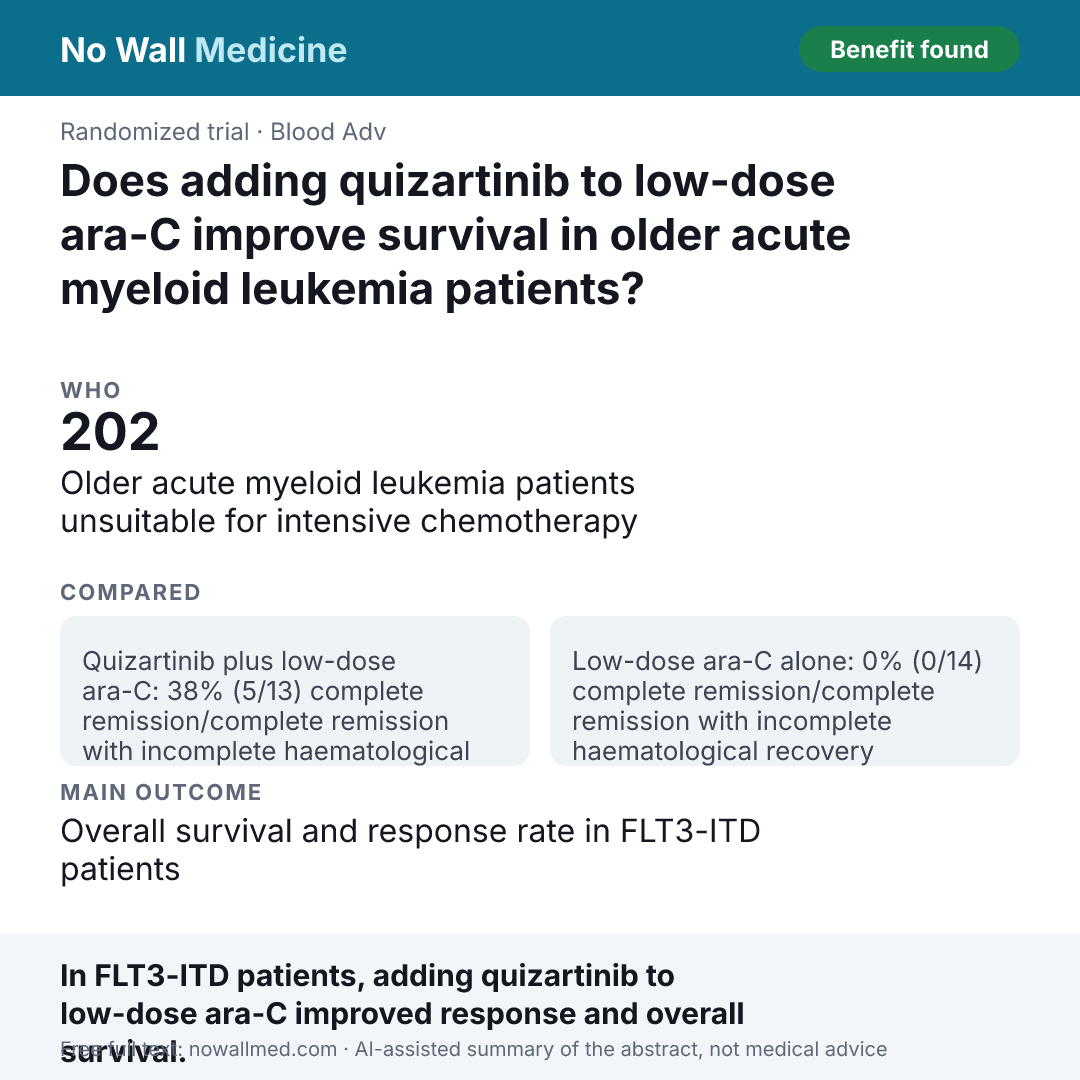
Clinical question: Does adding quizartinib to low-dose ara-C improve survival in older acute myeloid leukemia patients?
Why it matters: Standard nonintensive therapies for older acute myeloid leukemia patients have low response rates and only extend life by a few months.
Key points
- 202 older acute myeloid leukemia patients unsuitable for intensive chemotherapy were randomized to receive low-dose ara-C with or without quizartinib.
- In the 27 patients with FLT3-ITD mutations, quizartinib plus low-dose ara-C improved 2-year overall survival (hazard ratio 0.36) and response rates.
- Median overall survival was 13.7 months for the quizartinib group compared with 4.2 months for the low-dose ara-C alone group.
Headline and key points written with AI from the paper’s abstract, with every number checked against it. Read the paper before relying on them.
Was this summary helpful?
Abstract
Survival for older patients with acute myeloid leukemia (AML) unsuitable for intensive chemotherapy is unsatisfactory. Standard nonintensive therapies have low response rates and only extend life by a few months. Quizartinib is an oral Fms-like tyrosine kinase 3 (FLT3) inhibitor with reported activity in wild-type patients. As part of the AML LI trial, we undertook a randomized evaluation of low-dose ara-C (LDAC) with or without quizartinib in patients not fit for intensive chemotherapy. Overall, survival was not improved (202 patients), but in the 27 FLT3-ITD patients, the addition of quizartinib to LDAC improved response (P = .05) with complete remission/complete remission with incomplete haematological recovery for quizartinib + LDAC in 5/13 (38%) vs 0/14 (0%) in patients receiving LDAC alone. Overall survival (OS) in these FLT3-ITD+ patients was also significantly improved at 2 years for quizartinib + LDAC (hazard ratio 0.36; 95% confidence intervals: 0.16, 0.85, P = .04). Median OS was 13.7 months compared with 4.2 months with LDAC alone. This is the first report of an FLT3-targeted therapy added to standard nonintensive chemotherapy that has improved survival in this population. Quizartinib merits consideration for future triplet-based treatment approaches. This trial was registered at www.clinicaltrials.gov as ISRCTN #ISRCTN40571019 and EUDRACT @2011-000749-19.
Abstract reproduced under the article’s CC BY NC ND licence.
Subject terms
Headline, design, result, key points, caveat and citation as plain text.
Cite this article
Dennis M, Thomas IF, Ariti C, et al. Randomized evaluation of quizartinib and low-dose ara-C vs low-dose ara-C in older acute myeloid leukemia patients. Blood Adv. 2021;5(24):5621-5625. doi:10.1182/bloodadvances.2021005038
Spotted a mistake? Suggest a correction