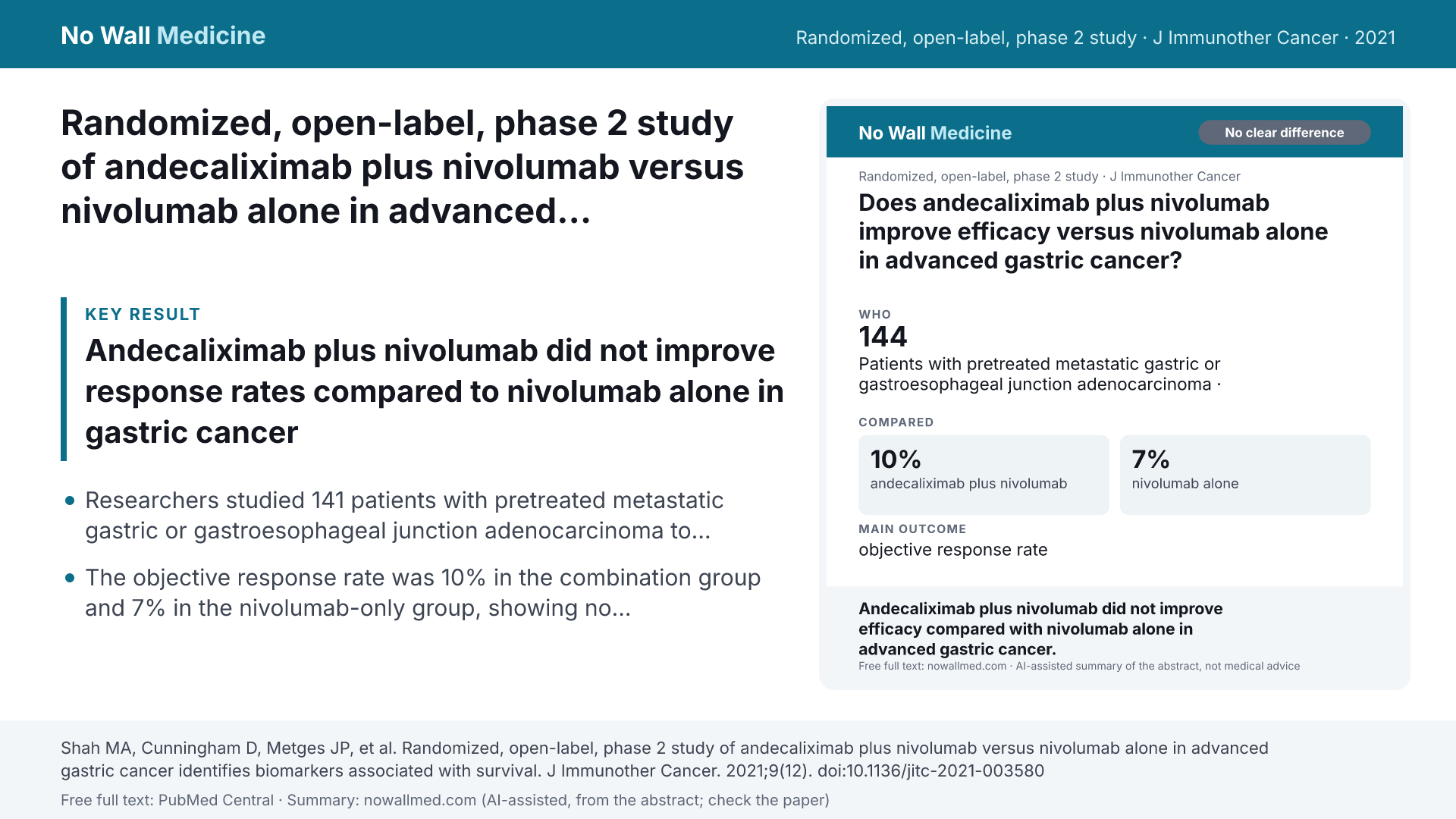
Andecaliximab plus nivolumab did not improve response rates compared to nivolumab alone in gastric cancer
Randomized, open-label, phase 2 study of andecaliximab plus nivolumab versus nivolumab alone in advanced gastric cancer identifies biomarkers associated with survival
Randomized, open-label, phase 2 studyNo clear difference
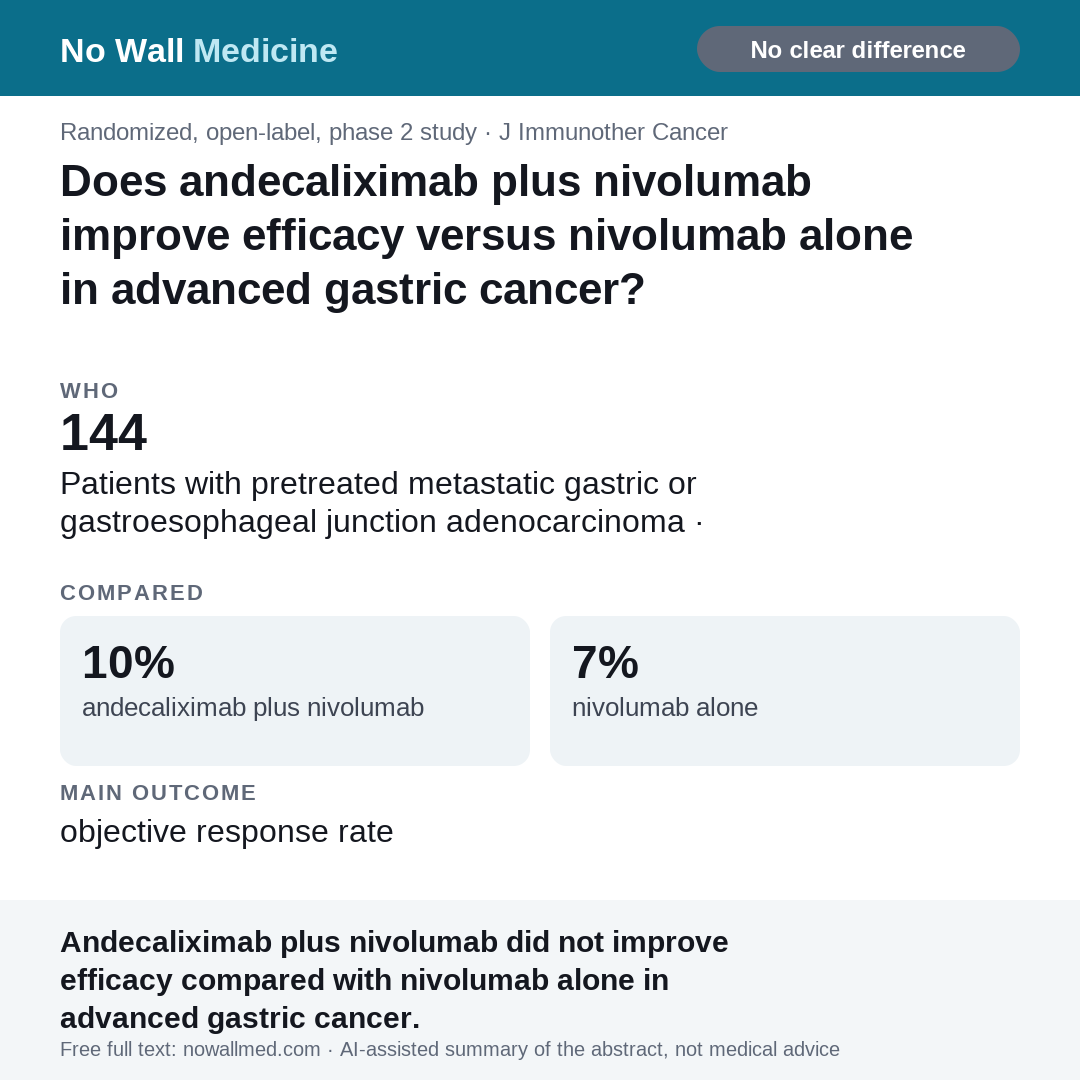
Does andecaliximab plus nivolumab improve efficacy versus nivolumab alone in advanced gastric cancer?
Who
144
Patients with pretreated metastatic gastric or gastroesophageal junction adenocarcinoma · multicenter study
Compared
10%andecaliximab plus nivolumab (95% CI 4 to 19)
7%nivolumab alone (95% CI 2 to 16)
Main outcome
objective response rate
Result: OR: 1.5 (95% CI 0.4 to 6.1; p=0.8)
Bottom line: Andecaliximab plus nivolumab did not improve efficacy compared with nivolumab alone in advanced gastric cancer.
J Immunother Cancer · 2021-12-11Download image
Clinical question: Does andecaliximab plus nivolumab improve efficacy versus nivolumab alone in advanced gastric cancer?
Why it matters: It was unknown if adding an inhibitor of matrix metalloproteinase-9 to nivolumab would improve outcomes for patients with advanced gastric or gastroesophageal junction adenocarcinoma.
Key points
- Researchers studied 141 patients with pretreated metastatic gastric or gastroesophageal junction adenocarcinoma to compare andecaliximab plus nivolumab against nivolumab alone.
- The objective response rate was 10% in the combination group and 7% in the nivolumab-only group, showing no significant difference (p=0.8).
- Higher tumor mutation burden, HER2-positive disease, and GRB7 expression were associated with longer survival.
Headline and key points written with AI from the paper’s abstract, with every number checked against it. Read the paper before relying on them.
Was this summary helpful?
Abstract
Background
Matrix metalloproteinase-9 (MMP9) selectively cleaves extracellular matrix proteins contributing to tumor growth and an immunosuppressive microenvironment. This study evaluated andecaliximab (ADX), an inhibitor of MMP9, in combination with nivolumab (NIVO), for the treatment of advanced gastric cancer. Methods
Phase 2, open-label, randomized multicenter study evaluating the efficacy, safety, and pharmacodynamics of ADX+NIVO versus NIVO in patients with pretreated metastatic gastric or gastroesophageal junction (GEJ) adenocarcinoma. The primary endpoint was objective response rate (ORR). Secondary endpoints included progression-free survival (PFS), overall survival (OS), and adverse events (AEs). We explored the correlation of efficacy outcomes with biomarkers. Results
144 patients were randomized; 141 were treated: 81% white, 69% male, median age was 61 years in the ADX+NIVO group and 62 years in the NIVO-alone group. The ORR was 10% (95% CI 4 to 19) in the ADX+NIVO group and 7% (95% CI 2 to 16) in the NIVO-alone group (OR: 1.5 (95% CI 0.4 to 6.1; p=0.8)). There was no response or survival benefit associated with adding ADX. AE rates were comparable in both treatment groups; the most common AEs were fatigue, decreased appetite, nausea, and vomiting. Programmed cell death ligand 1, interferon-γ (IFN), and intratumoral CD8+ cell density were not associated with treatment response or survival. The gene signature most correlated with shorter survival was the epithelial-to-mesenchymal gene signature; high transforming growth factor (TGF)-β fibrosis score was negatively associated with OS (p=0.036). Gene expression analysis of baseline tumors comparing long-(1+ years) and short-term (<1 year) survivors showed that GRB7 was associated with survival beyond 1 year. Human epidermal growth factor receptor 2 (HER2)-positive disease was associated with significantly longer survival (p=0.0077). Median tumor mutation burden (TMB) was 2.01; patients with TMB ≥median had longer survival (p=0.0025) and improved PFS (p=0.016). Based on a model accounting for TMB, TGF-β fibrosis, and HER2, TMB was the main driver of survival in this patient population. Conclusion
Combination of ADX+NIVO had a favorable safety profile but did not improve efficacy compared with NIVO alone in patients with pretreated metastatic gastric or GEJ adenocarcinoma. HER2 positivity, higher TMB or GRB7, and lower TGF-β were associated with improved outcomes. Trial registration number
NCT02864381 or GS-US-296--2013.
Abstract reproduced under the article’s CC BY NC licence.
Subject terms
Cite this article
Shah MA, Cunningham D, Metges JP, et al. Randomized, open-label, phase 2 study of andecaliximab plus nivolumab versus nivolumab alone in advanced gastric cancer identifies biomarkers associated with survival. J Immunother Cancer. 2021. doi:10.1136/jitc-2021-003580
Spotted a mistake? Suggest a correction