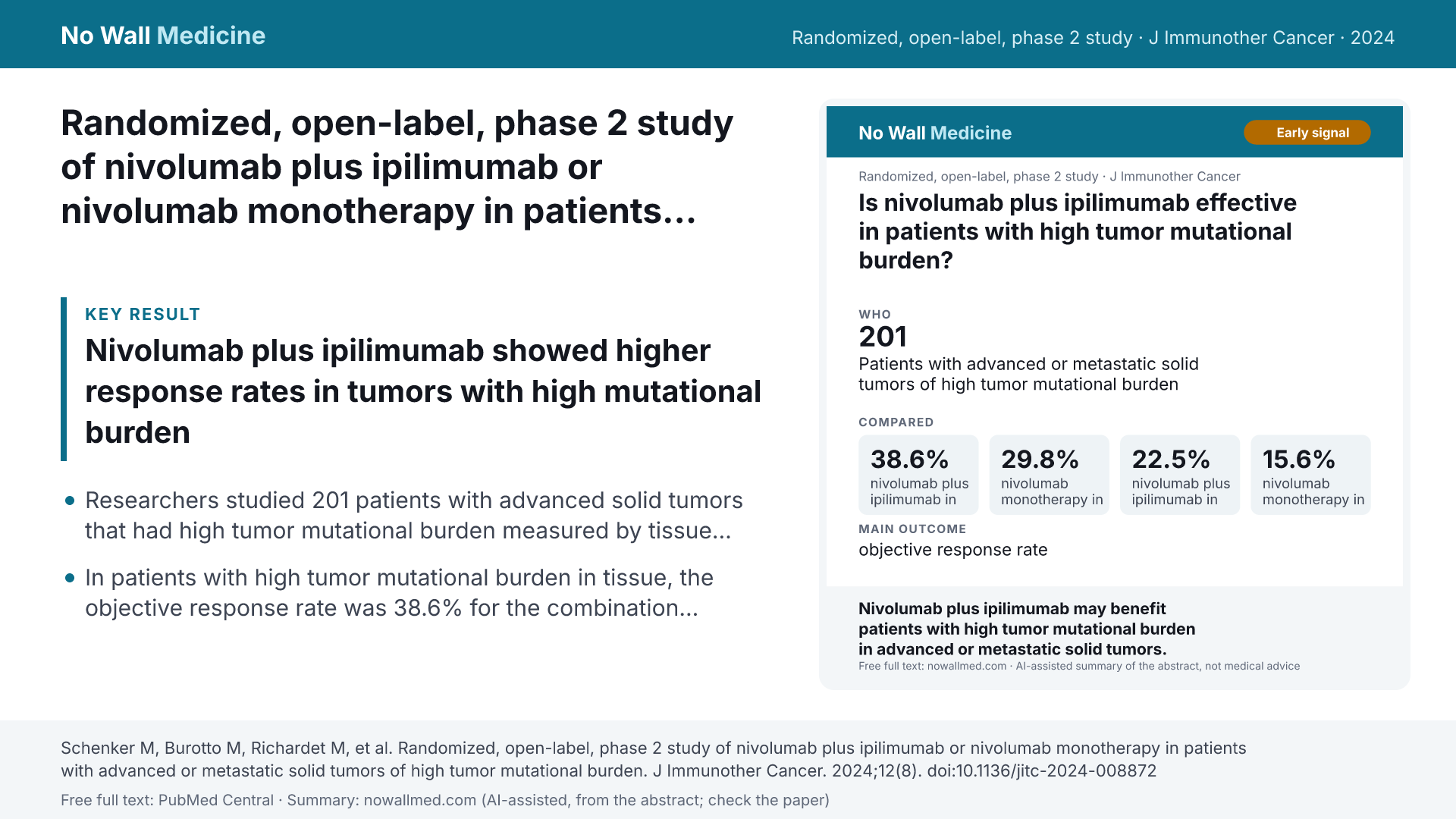
Nivolumab plus ipilimumab showed higher response rates in tumors with high mutational burden
Randomized, open-label, phase 2 study of nivolumab plus ipilimumab or nivolumab monotherapy in patients with advanced or metastatic solid tumors of high tumor mutational burden
Randomized, open-label, phase 2 studyBenefit found
Is nivolumab plus ipilimumab effective in patients with high tumor mutational burden?
Who
201
Patients with advanced or metastatic solid tumors of high tumor mutational burden
Compared
38.6%nivolumab plus ipilimumab in tTMB-H (95% CI 28.4% to 49.6%)
29.8%nivolumab monotherapy in tTMB-H (95% CI 17.3% to 44.9%)
22.5%nivolumab plus ipilimumab in bTMB-H (95% CI 13.9% to 33.2%)
15.6%nivolumab monotherapy in bTMB-H (95% CI 6.5% to 29.5%)
Main outcome
objective response rate
Bottom line: Nivolumab plus ipilimumab may benefit patients with high tumor mutational burden in advanced or metastatic solid tumors.
J Immunother Cancer · 2024-08-06Download image
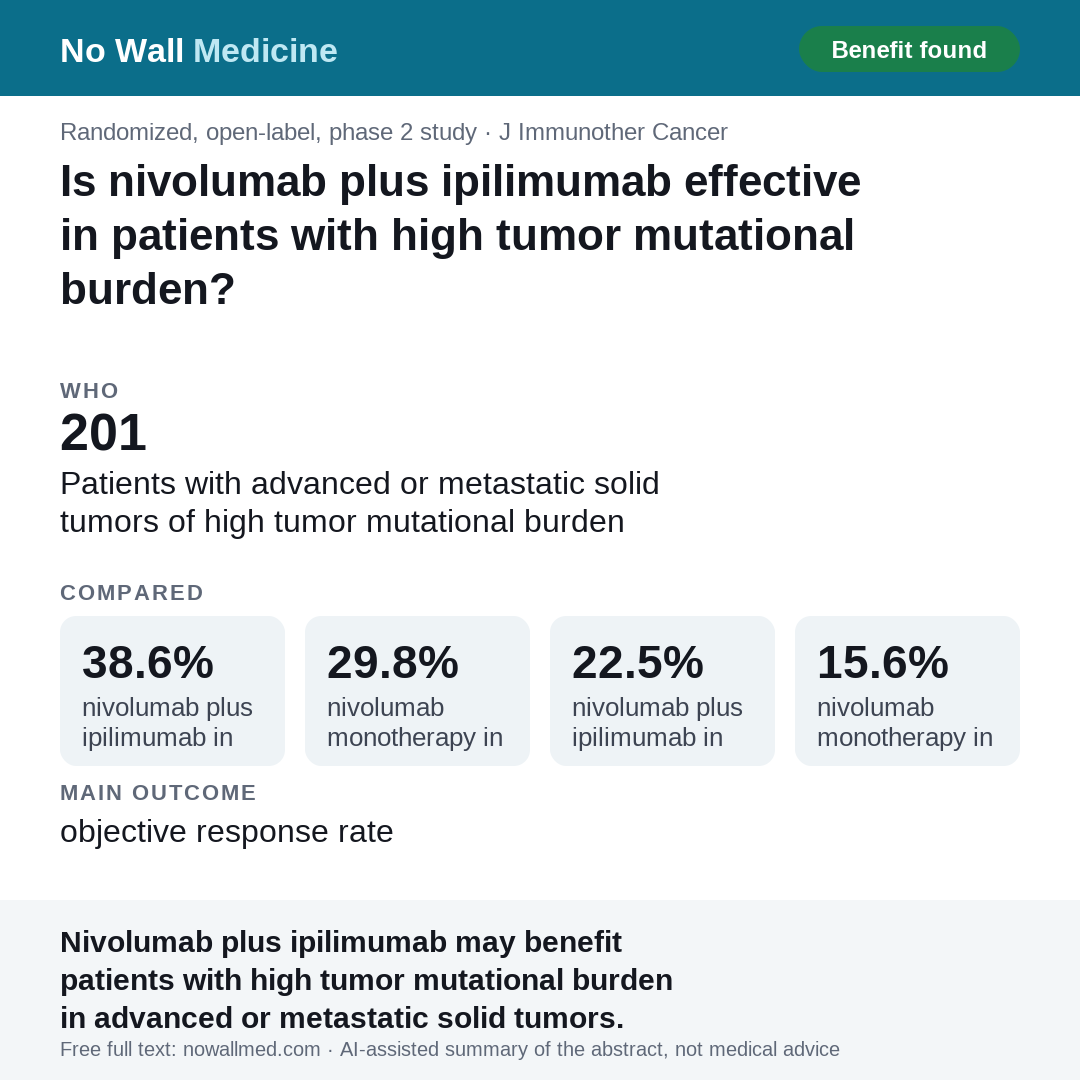
Clinical question: Is nivolumab plus ipilimumab effective in patients with high tumor mutational burden?
Why it matters: It was unknown if combining nivolumab and ipilimumab provides better efficacy than nivolumab alone for patients with high tumor mutational burden in tissue or blood.
Key points
- Researchers studied 201 patients with advanced solid tumors that had high tumor mutational burden measured by tissue or blood.
- In patients with high tumor mutational burden in tissue, the objective response rate was 38.6% for the combination therapy and 29.8% for nivolumab alone.
- For patients with high tumor mutational burden in blood, the objective response rate was 22.5% for the combination therapy and 15.6% for nivolumab alone.
Headline and key points written with AI from the paper’s abstract, with every number checked against it. Read the paper before relying on them.
Was this summary helpful?
Abstract
Background
Checkpoint inhibitor therapy has demonstrated overall survival benefit in multiple tumor types. Tumor mutational burden (TMB) is a predictive biomarker for response to immunotherapies. This study evaluated the efficacy of nivolumab+ipilimumab in multiple tumor types based on TMB status evaluated using either tumor tissue (tTMB) or circulating tumor DNA in the blood (bTMB). Patients and methods
Patients with metastatic or unresectable solid tumors with high (≥10 mutations per megabase) tTMB (tTMB-H) and/or bTMB (bTMB-H) who were refractory to standard therapies were randomized 2:1 to receive nivolumab+ipilimumab or nivolumab monotherapy in an open-label, phase 2 study (CheckMate 848; NCT03668119). tTMB and bTMB were determined by the Foundation Medicine FoundationOne® CDx test and bTMB Clinical Trial Assay, respectively. The dual primary endpoints were objective response rate (ORR) in patients with tTMB-H and/or bTMB-H tumors treated with nivolumab+ipilimumab. Results
In total, 201 patients refractory to standard therapies were randomized: 135 had tTMB-H and 125 had bTMB-H; 82 patients had dual tTMB-H/bTMB-H. In patients with tTMB-H, ORR was 38.6% (95% CI 28.4% to 49.6%) with nivolumab+ipilimumab and 29.8% (95% CI 17.3% to 44.9%) with nivolumab monotherapy. In patients with bTMB-H, ORR was 22.5% (95% CI 13.9% to 33.2%) with nivolumab+ipilimumab and 15.6% (95% CI 6.5% to 29.5%) with nivolumab monotherapy. Early and durable responses to treatment with nivolumab+ipilimumab were seen in patients with tTMB-H or bTMB-H. The safety profile of nivolumab+ipilimumab was manageable, with no new safety signals. Conclusions
Patients with metastatic or unresectable solid tumors with TMB-H, as determined by tissue biopsy or by blood sample when tissue biopsy is unavailable, who have no other treatment options, may benefit from nivolumab+ipilimumab. Trial registration number
NCT03668119.
Abstract reproduced under the article’s CC BY NC licence.
Subject terms
Cite this article
Schenker M, Burotto M, Richardet M, Ciuleanu TE, Gonçalves A, Steeghs N. Randomized, open-label, phase 2 study of nivolumab plus ipilimumab or nivolumab monotherapy in patients with advanced or metastatic solid tumors of high tumor mutational burden. J Immunother Cancer. 2024. doi:10.1136/jitc-2024-008872
Spotted a mistake? Suggest a correction
Top studies every Monday
The week’s key trials and guidelines in your specialties, plus any topics you follow. By email, free.
Get the weekly digest