Flexible dosing schedule of radiopharmaceutical therapy compared to standard schedule in prostate cancer trial
Randomized Phase 2 Trial of an Extended and Flexible Dosing Schedule of 177Lu-PSMA Molecular Radiotherapy in Patients with Metastatic Castration-Resistant Prostate Cancer (FLEX-MRT): Study Protocol
Randomized, open-label, single-center, phase 2 trialUnclear result
Does an extended and flexible dosing schedule improve 2-year survival in mCRPC?
Who
90
Men with metastatic castration-resistant prostate cancer · Single-center
Compared
Standard fixed dosing schedule
Flexible and extended dosing schedule
Main outcome
2-year survival rate
Bottom line: This study protocol aims to compare survival rates between flexible and standard dosing schedules in mCRPC.
J Nucl Med · 2025-10-01Download image
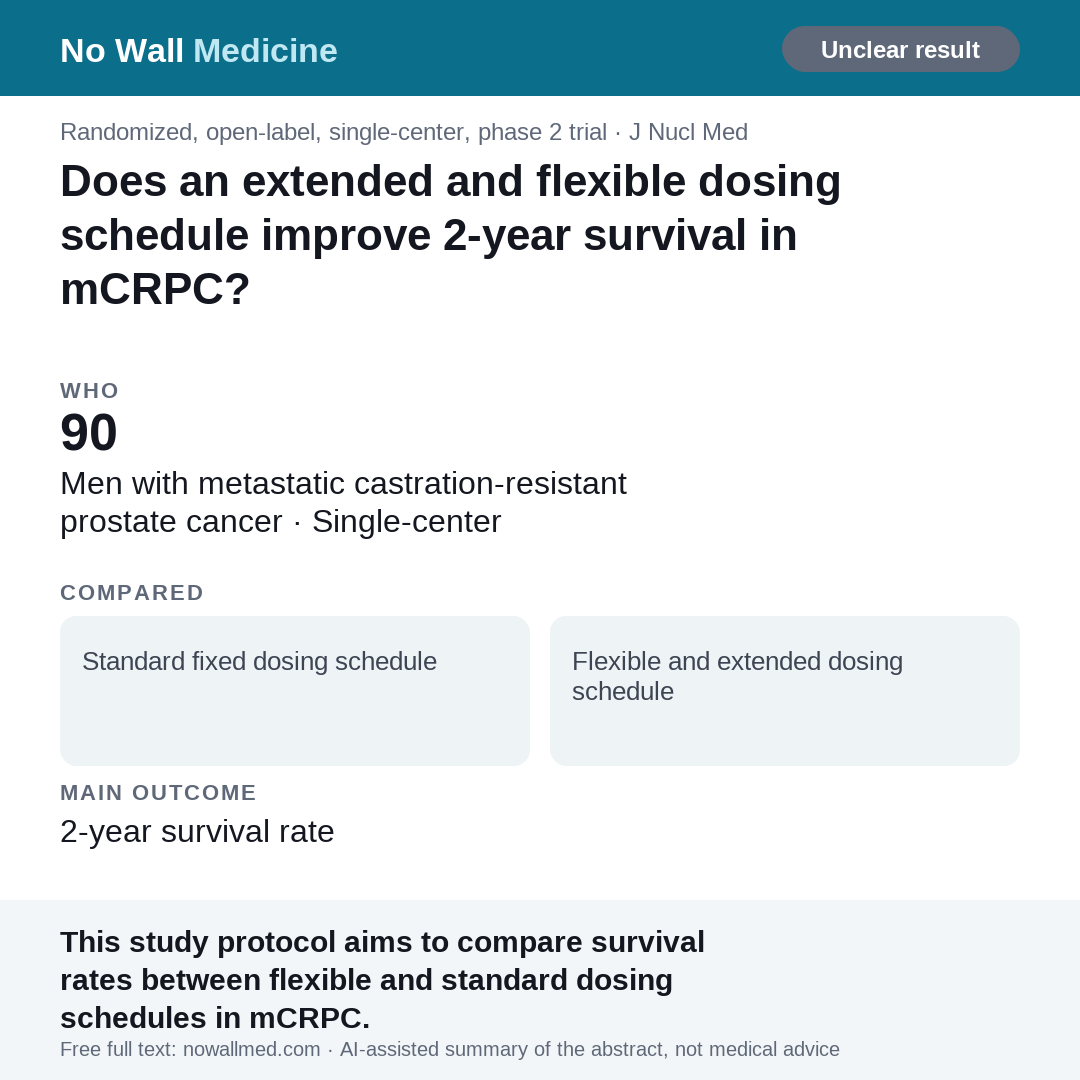
Clinical question: Does an extended and flexible dosing schedule improve 2-year survival in mCRPC?
Why it matters: Current approved treatment for metastatic castration-resistant prostate cancer uses a fixed schedule of up to 6 doses every 6 weeks.
Key points
- The FLEX-MRT trial will randomize 90 men with metastatic castration-resistant prostate cancer to receive either a standard 6-dose schedule or an extended schedule of up to 12 doses.
- The study aims to compare the 2-y survival rate between the standard fixed dosing group (n = 45) and the flexible dosing group (n = 45).
- Researchers will also measure safety, radiation dose to tissues, and overall survival in patients receiving the radiopharmaceutical therapy.
Headline and key points written with AI from the paper’s abstract, with every number checked against it. Read the paper before relying on them.
Topics
Cite this article
Holzgreve A, Delker A, Ells Z, Brosch-Lenz J, Unterrainer LM, Nikitas J. Randomized Phase 2 Trial of an Extended and Flexible Dosing Schedule of 177Lu-PSMA Molecular Radiotherapy in Patients with Metastatic Castration-Resistant Prostate Cancer (FLEX-MRT): Study Protocol. J Nucl Med. 2025. doi:10.2967/jnumed.125.269495
Spotted a mistake? Suggest a correction