Septin modulator REM127 showed changes in Alzheimer's disease biomarkers but caused liver side effects
Randomized phase 2a trial assessing a novel septin molecular glue in Alzheimer's disease
Randomized phase 2a trialMixed results
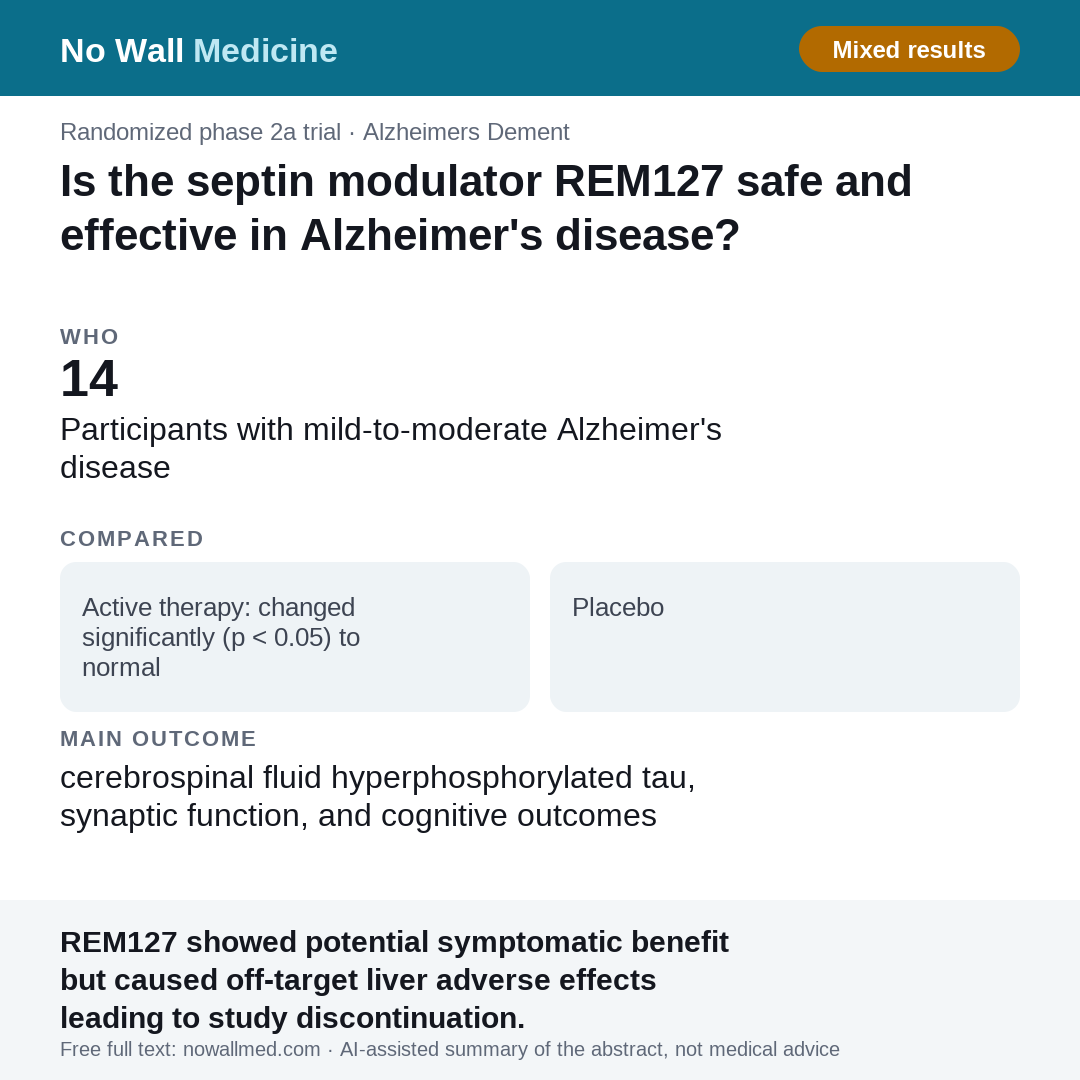
Is the septin modulator REM127 safe and effective in Alzheimer's disease?
Who
14
Participants with mild-to-moderate Alzheimer's disease
Compared
Active therapy: changed significantly (p < 0.05) to normal
Placebo
Main outcome
cerebrospinal fluid hyperphosphorylated tau, synaptic function, and cognitive outcomes
Bottom line: REM127 showed potential symptomatic benefit but caused off-target liver adverse effects leading to study discontinuation.
Limitation: Results are exploratory as statistical power is constrained due to small sample size.
Alzheimers Dement · 2025-09-12Download image
Clinical question: Is the septin modulator REM127 safe and effective in Alzheimer's disease?
Why it matters: It is unknown if restoring septin filament integrity can provide symptomatic benefit or modify the underlying processes of Alzheimer's disease.
Key points
- Researchers conducted a phase 2a trial with 14 participants having mild-to-moderate Alzheimer's disease to test the septin modulator REM127.
- Participants on active therapy experienced dose-dependent increases in serum aminotransferase, a liver enzyme, which led to study discontinuation.
- Exploratory results showed that cerebrospinal fluid hyperphosphorylated tau (P-tau181), a marker of brain pathology, changed significantly (p < 0.05) toward normal levels compared to placebo.
Limitation the authors note: The results are considered exploratory because statistical power was constrained by a small sample size caused by early termination.
Headline and key points written with AI from the paper’s abstract, with every number checked against it. Read the paper before relying on them.
Topics
Cite this article
Nuytten M, Voets M, Debroux E, Princen K, Pringels L, Fivaz M. Randomized phase 2a trial assessing a novel septin molecular glue in Alzheimer's disease. Alzheimers Dement. 2025. doi:10.1002/alz.70537
Spotted a mistake? Suggest a correction
Top studies every Monday
The week’s key trials and guidelines in your specialties, plus any topics you follow. By email, free.
Get the weekly digest