Two years of icotinib was associated with longer disease-free survival than one year in lung cancer patients
Randomized phase II adjuvant trial to compare two treatment durations of icotinib (2 years versus 1 year) for stage II-IIIA EGFR-positive lung adenocarcinoma patients (ICOMPARE study)
Randomized, open-label, phase II trialBenefit found
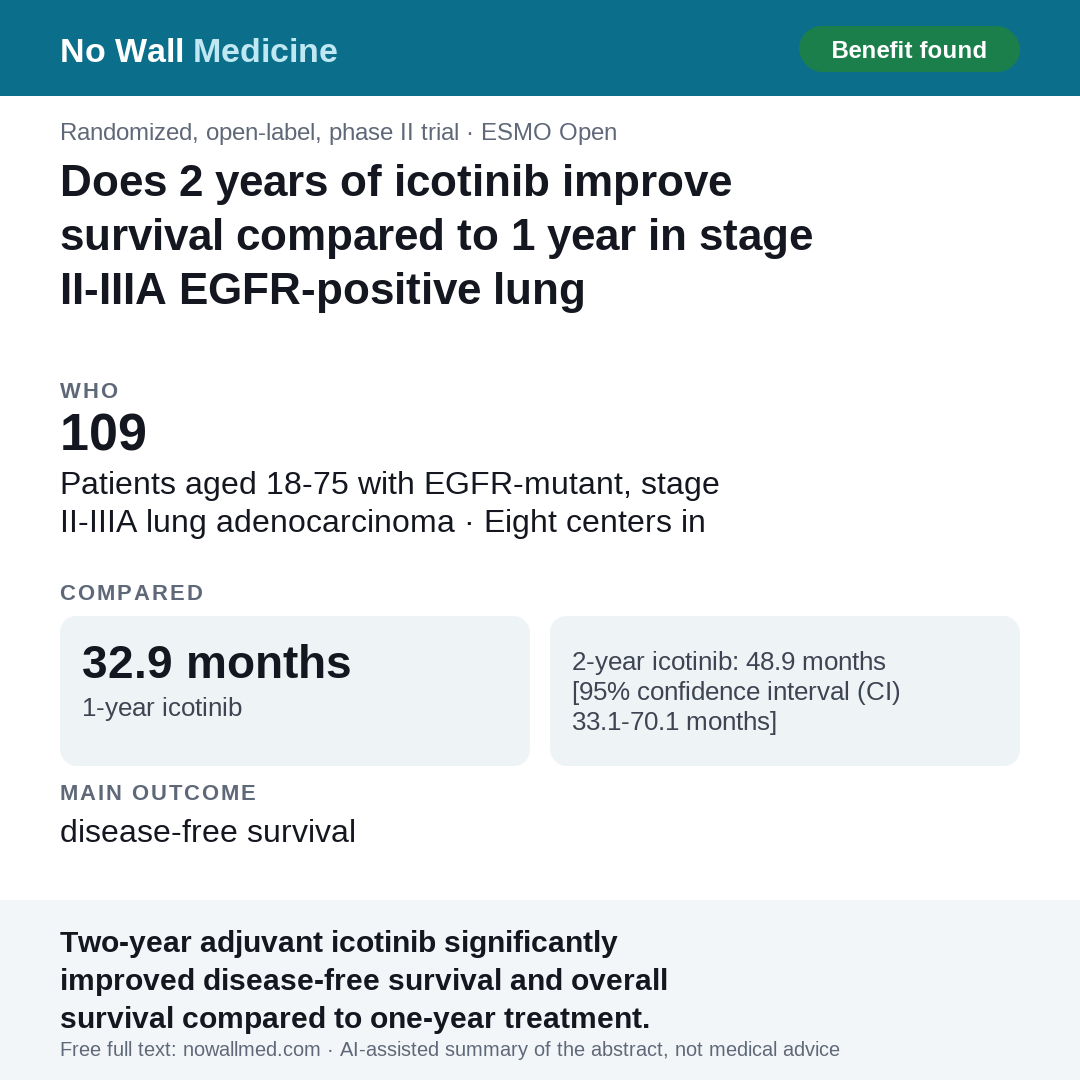
Does 2 years of icotinib improve survival compared to 1 year in stage II-IIIA EGFR-positive lung adenocarcinoma?
Who
109
Patients aged 18-75 with EGFR-mutant, stage II-IIIA lung adenocarcinoma · Eight centers in China
Compared
32.9 months1-year icotinib (95% CI 26.6-44.8 months)
2-year icotinib: 48.9 months [95% confidence interval (CI) 33.1-70.1 months]
Main outcome
disease-free survival
Result: hazard ratio 0.51 (95% CI 0.28-0.94)
Bottom line: Two-year adjuvant icotinib significantly improved disease-free survival and overall survival compared to one-year treatment.
ESMO Open · 2023-06-20Download image
Clinical question: Does 2 years of icotinib improve survival compared to 1 year in stage II-IIIA EGFR-positive lung adenocarcinoma?
Why it matters: The relationship between the duration of adjuvant targeted therapy and survival benefits in patients with epidermal growth factor receptor-mutant lung cancer remains unknown.
Key points
- The study followed 109 patients with stage II-IIIA epidermal growth factor receptor-positive lung adenocarcinoma who were randomized to receive either 1 year or 2 years of icotinib.
- Median disease-free survival was 48.9 months in the 2-year group compared to 32.9 months in the 1-year group, and median overall survival was 75.8 months in the 2-year group.
- Treatment-related adverse events occurred in 75% of the 1-year group and 67% of the 2-year group, with grade 3-4 events occurring in 7% and 6% respectively.
Limitation the authors note: This was an exploratory phase II study.
Headline and key points written with AI from the paper’s abstract, with every number checked against it. Read the paper before relying on them.
Topics
Cite this article
Lv C, Wang R, Li S, Yan S, Wang Y, Chen J. Randomized phase II adjuvant trial to compare two treatment durations of icotinib (2 years versus 1 year) for stage II-IIIA EGFR-positive lung adenocarcinoma patients (ICOMPARE study). ESMO Open. 2023. doi:10.1016/j.esmoop.2023.101565
Spotted a mistake? Suggest a correction
Top studies every Monday
The week’s key trials and guidelines in your specialties, plus any topics you follow. By email, free.
Get the weekly digest