Increasing radiation dose to tumor subvolumes did not improve survival in head and neck cancer
Randomized Phase II Study of Physiologic MRI-Directed Adaptive Radiation Boost in Poor Prognosis Head and Neck Cancer
Randomized phase II multicenter clinical trialMixed results
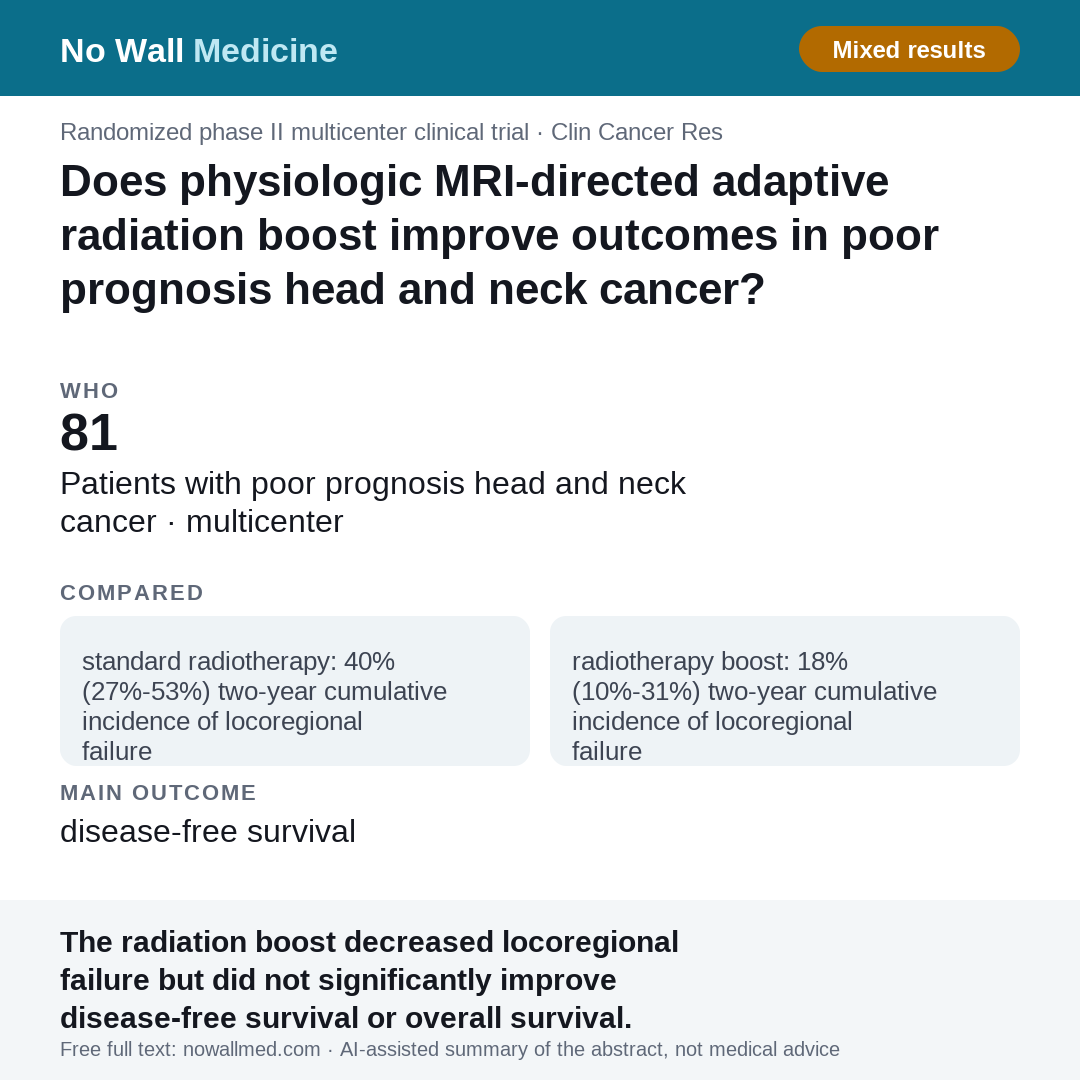
Does physiologic MRI-directed adaptive radiation boost improve outcomes in poor prognosis head and neck cancer?
Who
81
Patients with poor prognosis head and neck cancer · multicenter
Compared
standard radiotherapy: 40% (27%-53%) two-year cumulative incidence of locoregional failure
radiotherapy boost: 18% (10%-31%) two-year cumulative incidence of locoregional failure
Main outcome
disease-free survival
Result: hazard ratio 0.43 (P = 0.047) for locoregional failure
Bottom line: The radiation boost decreased locoregional failure but did not significantly improve disease-free survival or overall survival.
Limitation: Additional improvements in systemic therapy are likely necessary to realize improvements in disease-free survival and overall survival.
Clin Cancer Res · 2022-09-16Download image
Clinical question: Does physiologic MRI-directed adaptive radiation boost improve outcomes in poor prognosis head and neck cancer?
Why it matters: It was unknown if using magnetic resonance imaging to guide higher doses of radiation to specific tumor areas would improve outcomes for patients with poor prognosis head and neck cancer.
Key points
- Researchers randomized 81 patients with poor prognosis head and neck cancer to receive either 70 Gy of standard radiation or 80 Gy to a specific subvolume defined by magnetic resonance imaging (MRI).
- The radiation boost was associated with a lower incidence of locoregional failure, with two-year estimates of 18% in the boost arm compared to 40% in the standard arm.
- The study found no significant difference in disease-free survival or overall survival between the two treatment groups.
Headline and key points written with AI from the paper’s abstract, with every number checked against it. Read the paper before relying on them.
Was this summary helpful?
Subject terms
Cite this article
Mierzwa ML, Aryal M, Lee C, Schipper M, VanTil M, Morales K. Randomized Phase II Study of Physiologic MRI-Directed Adaptive Radiation Boost in Poor Prognosis Head and Neck Cancer. Clin Cancer Res. 2022. doi:10.1158/1078-0432.CCR-22-1522
Spotted a mistake? Suggest a correction
Top studies every Monday
The week’s key trials and guidelines in your specialties, plus any topics you follow. By email, free.
Get the weekly digest