Randomized Trial of Fetal Surgery for Severe Left Diaphragmatic Hernia
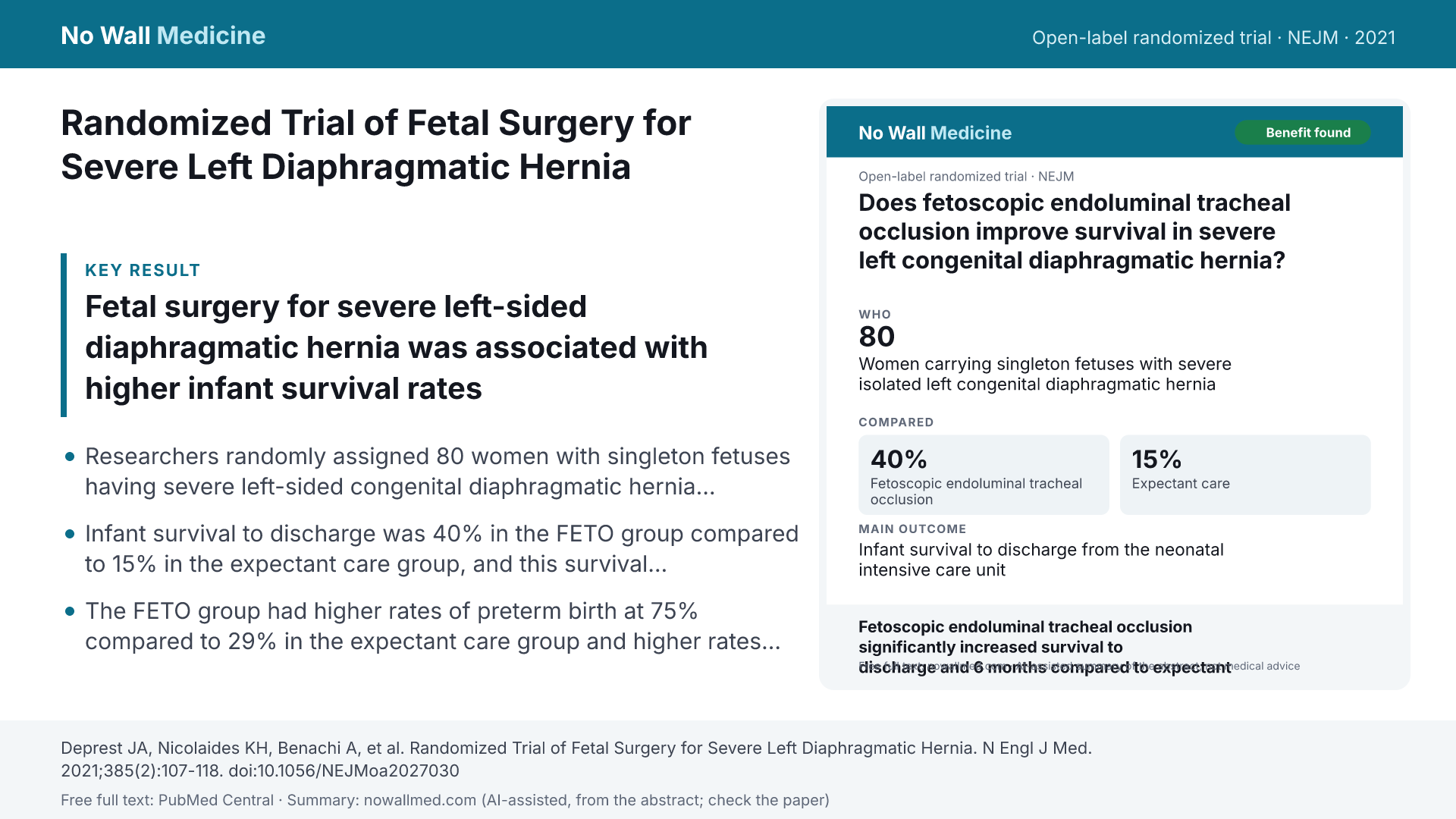
Key result: Fetal surgery for severe left-sided diaphragmatic hernia was associated with higher infant survival rates
Open-label randomized trialBenefit found
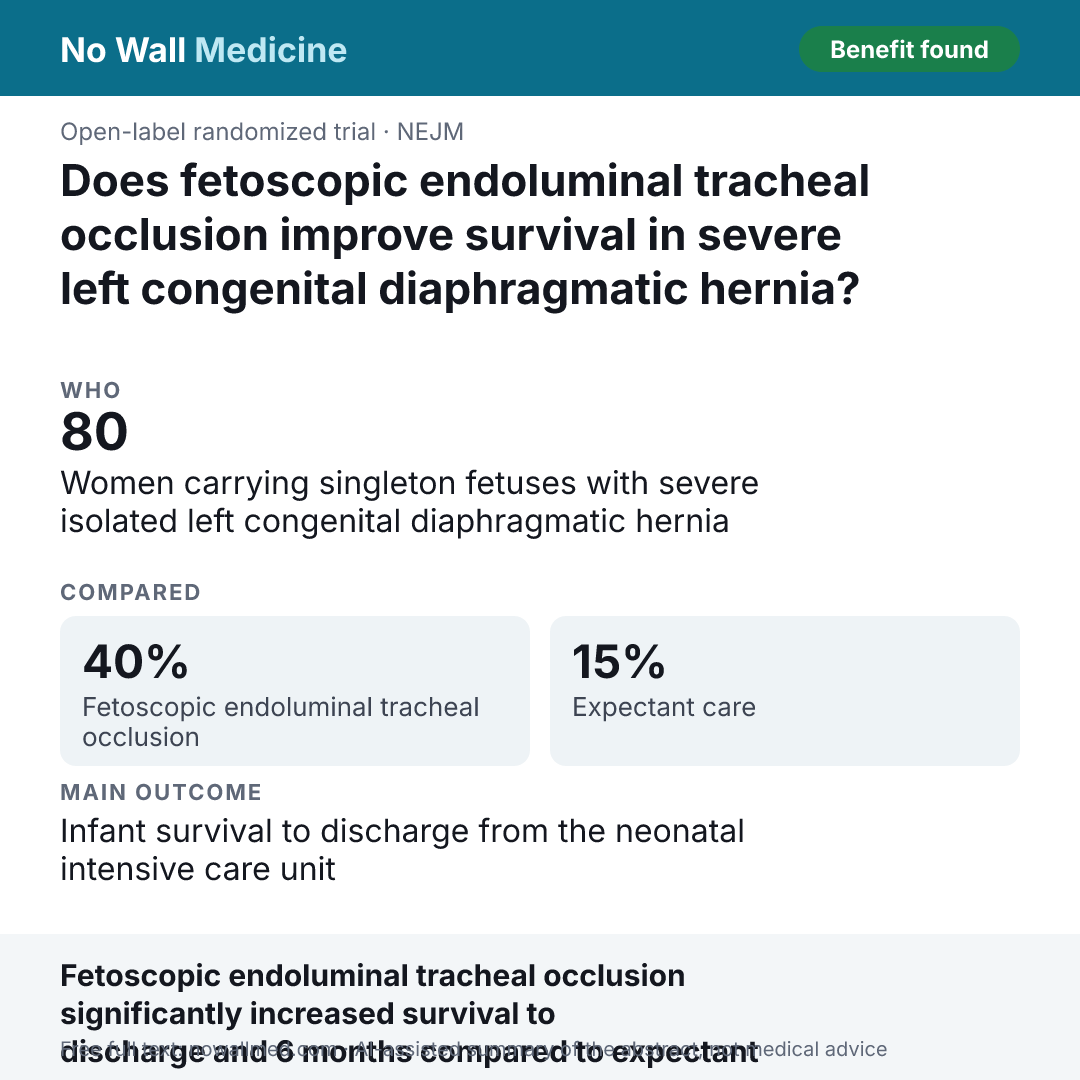
Does fetoscopic endoluminal tracheal occlusion improve survival in severe left congenital diaphragmatic hernia?
Who
80
Women carrying singleton fetuses with severe isolated left congenital diaphragmatic hernia · Centers with experience in prenatal surgery
Compared
40%Fetoscopic endoluminal tracheal occlusion (16 of 40)
15%Expectant care (6 of 40)
Main outcome
Infant survival to discharge from the neonatal intensive care unit
Result: relative risk 2.67 (95% CI 1.22 to 6.11)
Bottom line: Fetoscopic endoluminal tracheal occlusion significantly increased survival to discharge and 6 months compared to expectant care.
Funded by: European Commission and others
NEJM · 2021-06-08 · Save PNG
Key points
- Researchers randomly assigned 80 women with singleton fetuses having severe left-sided congenital diaphragmatic hernia to either fetoscopic endoluminal tracheal occlusion (FETO) or expectant care.
- Infant survival to discharge was 40% in the FETO group compared to 15% in the expectant care group, and this survival rate remained identical at 6 months.
- The FETO group had higher rates of preterm birth at 75% compared to 29% in the expectant care group and higher rates of preterm, prelabor rupture of membranes.
Discussion prompts
- Would these patients look like yours? Who was left out?
- Is the main outcome one that matters to patients?
- Is the difference large enough to change what you do?
Cite: Deprest JA, Nicolaides KH, Benachi A, et al. Randomized Trial of Fetal Surgery for Severe Left Diaphragmatic Hernia. N Engl J Med. 2021;385(2):107-118. doi:10.1056/NEJMoa2027030
Free full text: PubMed Central · Summary and visual abstract: nowallmed.com/a/randomized-trial-of-fetal-surgery-for-severe-left-diaphragmatic-tuzogj/ (AI-assisted from the abstract; check the paper before relying on it).