Randomized trial of two artificial intelligence coaching interventions to increase physical activity in cancer survivors
Key result: Voice-assisted artificial intelligence coaching increased daily steps in overweight or obese cancer survivors
Key points
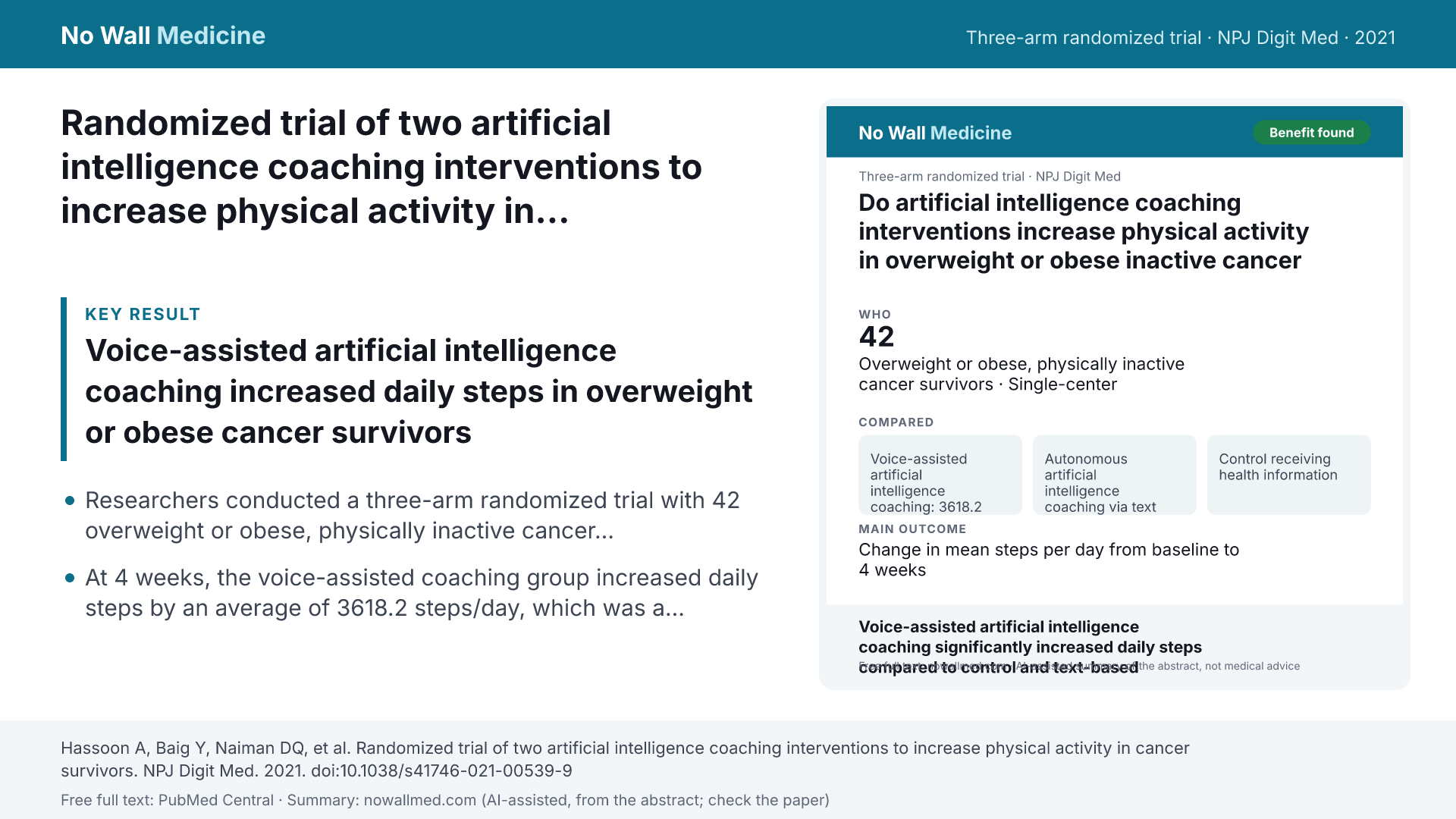
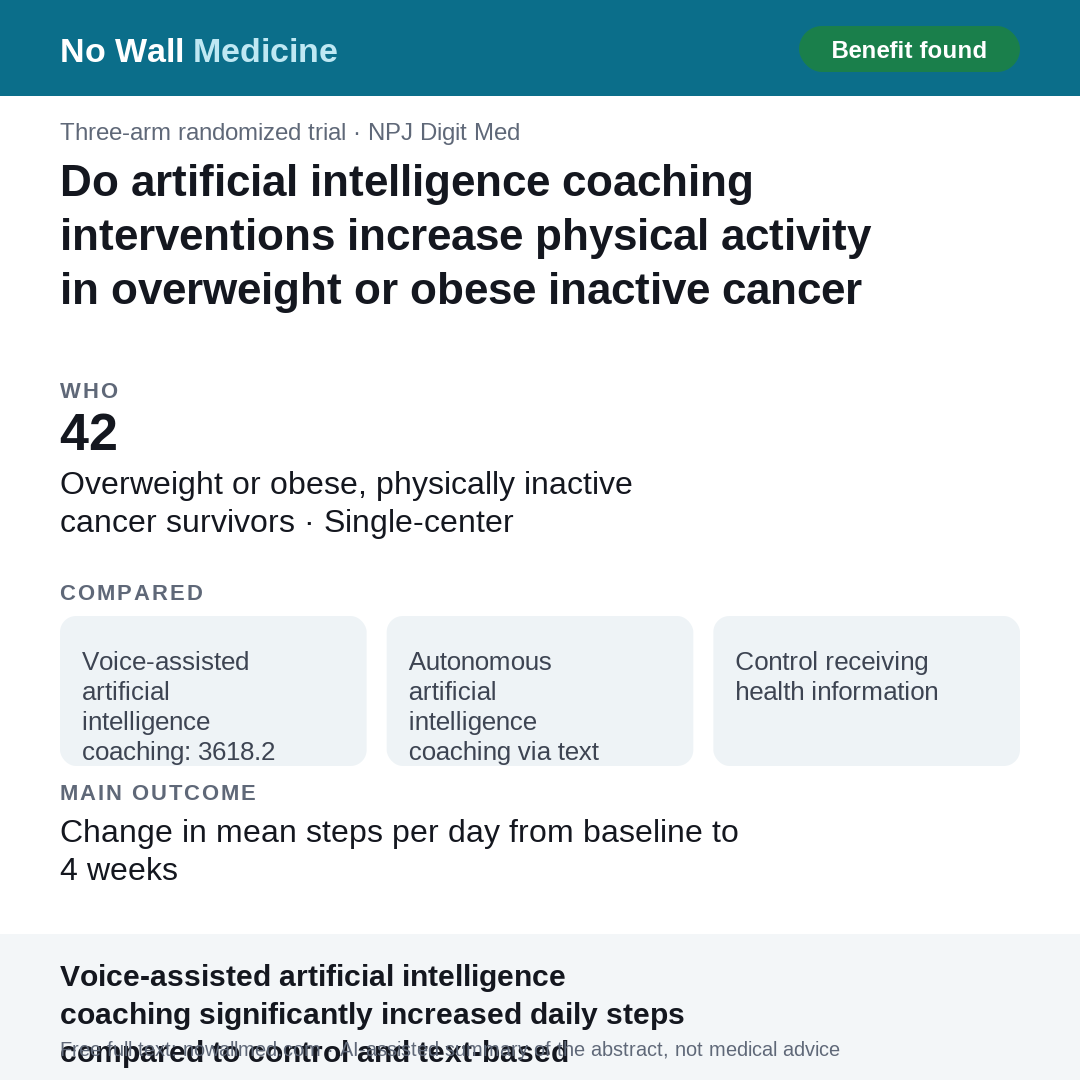
- Researchers conducted a three-arm randomized trial with 42 overweight or obese, physically inactive cancer survivors comparing voice-assisted artificial intelligence, text-based artificial intelligence, and a control group.
- At 4 weeks, the voice-assisted coaching group increased daily steps by an average of 3618.2 steps/day, which was a net difference of 3568.9 steps/day compared to control.
- The voice-assisted group also showed a net difference of 2160.6 steps/day compared to the text-based artificial intelligence group.
Why it matters: It is challenging to deliver personalized coaching in a scalable manner to increase physical activity adherence in cancer survivors.
Limitation the authors note: Additional research is needed to replicate these findings in a broader population of cancer survivors.
Discussion prompts
- Would these patients look like yours? Who was left out?
- Is the main outcome one that matters to patients?
- Is the difference large enough to change what you do?
Cite: Hassoon A, Baig Y, Naiman DQ, et al. Randomized trial of two artificial intelligence coaching interventions to increase physical activity in cancer survivors. NPJ Digit Med. 2021. doi:10.1038/s41746-021-00539-9
Free full text: PubMed Central · Summary and visual abstract: nowallmed.com/a/randomized-trial-of-two-artificial-intelligence-coaching-1yzjq3k/ (AI-assisted from the abstract; check the paper before relying on it).