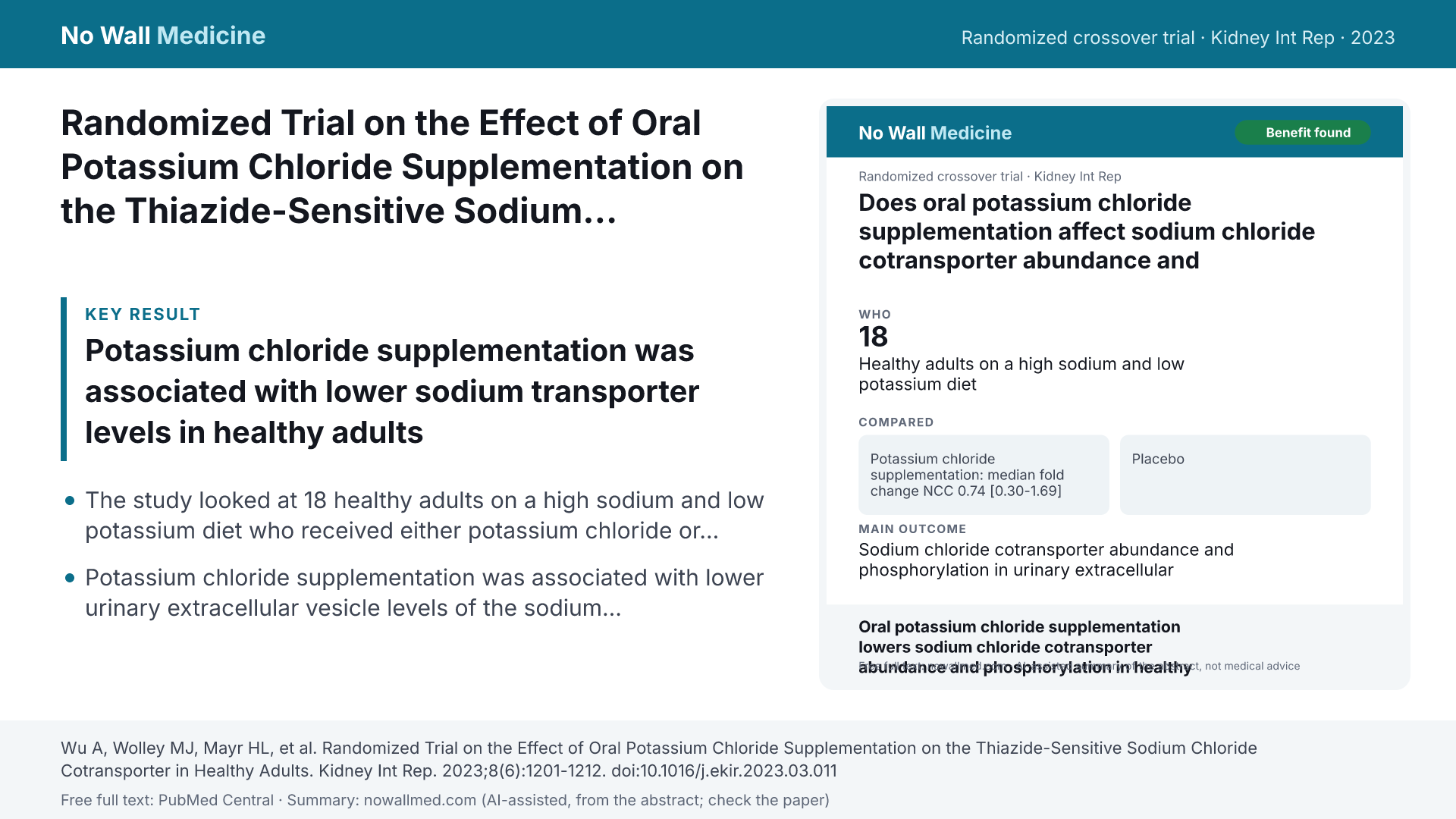
Potassium chloride supplementation was associated with lower sodium transporter levels in healthy adults
Randomized Trial on the Effect of Oral Potassium Chloride Supplementation on the Thiazide-Sensitive Sodium Chloride Cotransporter in Healthy Adults
Randomized crossover trialBenefit found
Does oral potassium chloride supplementation affect sodium chloride cotransporter abundance and phosphorylation?
Who
18
Healthy adults on a high sodium and low potassium diet
Compared
Potassium chloride supplementation: median fold change NCC 0.74 [0.30-1.69]
Placebo
Main outcome
Sodium chloride cotransporter abundance and phosphorylation in urinary extracellular vesicles
Result: median fold change NCC 0.74 [0.30-1.69], fold change pNCC 0.81 [0.19-1.75]
Bottom line: Oral potassium chloride supplementation lowers sodium chloride cotransporter abundance and phosphorylation in healthy adults.
Kidney Int Rep · 2023-03-27Download image
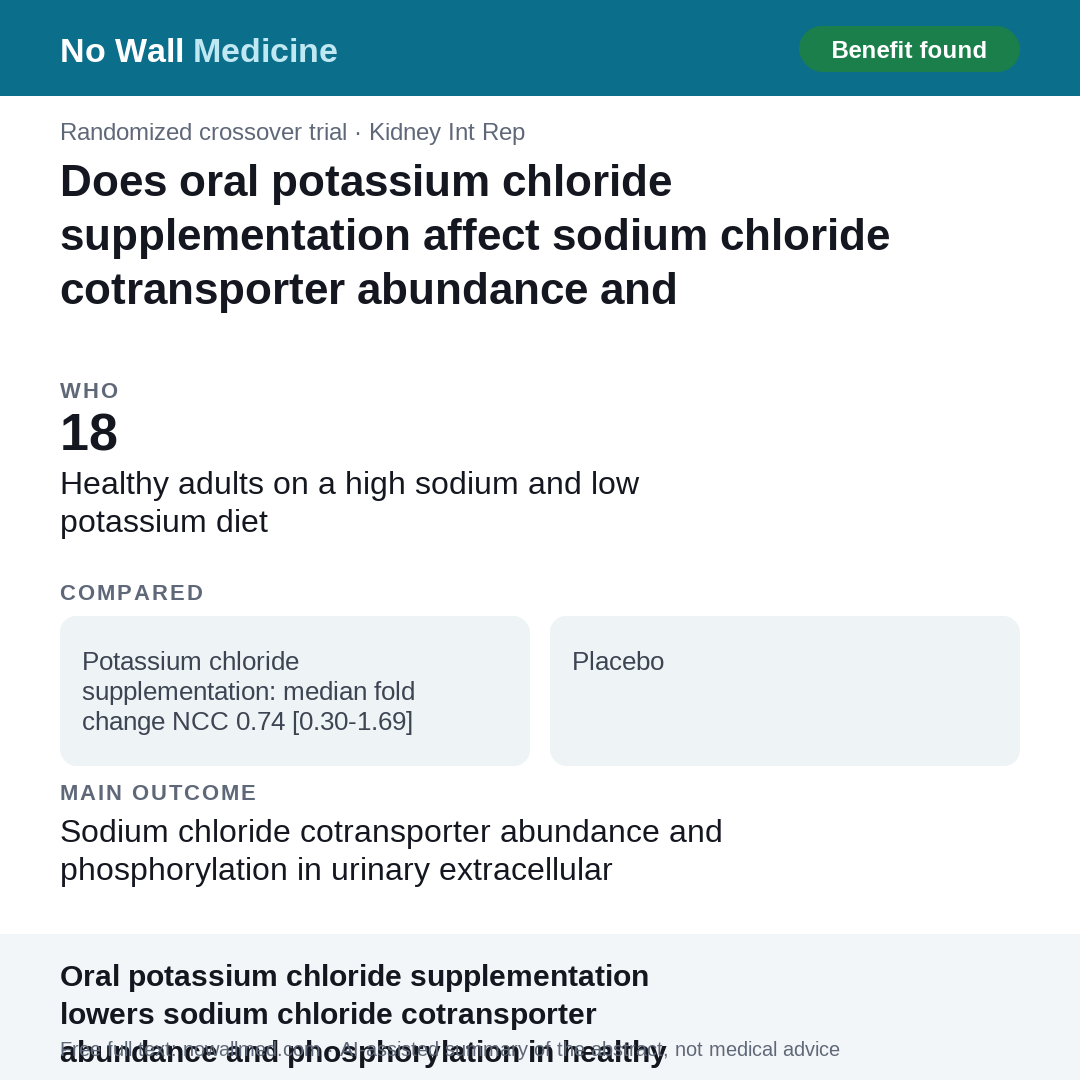
Clinical question: Does oral potassium chloride supplementation affect sodium chloride cotransporter abundance and phosphorylation?
Key points
- The study looked at 18 healthy adults on a high sodium and low potassium diet who received either potassium chloride or a placebo.
- Potassium chloride supplementation was associated with lower urinary extracellular vesicle levels of the sodium chloride cotransporter (median fold change 0.74) and its phosphorylated form (fold change 0.81).
- Supplementation was also associated with higher plasma potassium and higher 24-hour urine excretion of potassium, chloride, and aldosterone.
Headline and key points written with AI from the paper’s abstract, with every number checked against it. Read the paper before relying on them.
Was this summary helpful?
Cite this article
Wu A, Wolley MJ, Mayr HL, et al. Randomized Trial on the Effect of Oral Potassium Chloride Supplementation on the Thiazide-Sensitive Sodium Chloride Cotransporter in Healthy Adults. Kidney Int Rep. 2023. doi:10.1016/j.ekir.2023.03.011
Spotted a mistake? Suggest a correction