Rapid Cycle Deliberate Practice shortened time to defibrillation and epinephrine administration
Rapid cycle deliberate practice approach on resuscitation training: A systematic review
Systematic review and meta-analysisBenefit found
Is rapid cycle deliberate practice effective compared to traditional instruction for resuscitation training?
Who
Participants in simulated resuscitation training studies
Compared
Rapid cycle deliberate practice
Traditional instruction or other learning
Main outcome
Time to chest compressions, defibrillation, and epinephrine administration
Bottom line: Rapid cycle deliberate practice may improve time to defibrillation and epinephrine administration in resuscitation training.
Limitation: Very low certainty of evidence due to risk of bias, inconsistency, indirectness, and imprecision.
Resusc Plus · 2024-05-06Download image
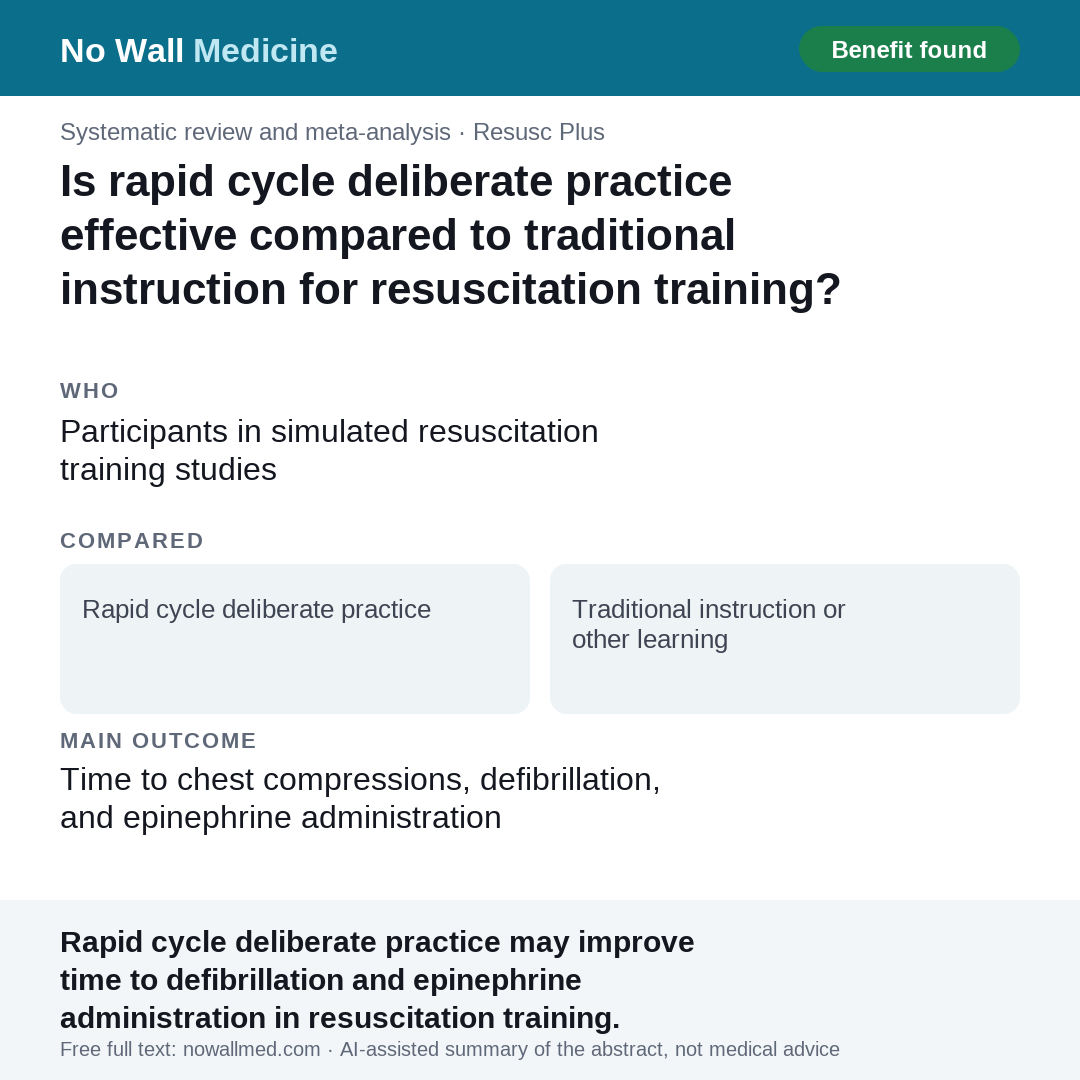
Clinical question: Is rapid cycle deliberate practice effective compared to traditional instruction for resuscitation training?
Why it matters: Effectiveness of Rapid Cycle Deliberate Practice on resuscitation training outcomes was unknown
Key points
- Nine studies with simulated resuscitation training compared Rapid Cycle Deliberate Practice to traditional instruction.
- Rapid Cycle Deliberate Practice had significantly shorter time to defibrillation and epinephrine administration.
- Overall certainty of evidence was very low due to risk of bias and other limitations.
Limitation the authors note: Overall certainty of evidence was very low due to risk of bias, inconsistency, indirectness, and imprecision
Headline and key points written with AI from the paper’s abstract, with every number checked against it. Read the paper before relying on them.
Was this summary helpful?
Cite this article
Abelairas-Gómez C, Cortegiani A, Sawyer T, Greif R, Donoghue A, International Liaison Committee on Resuscitation (ILCOR) Education. Rapid cycle deliberate practice approach on resuscitation training: A systematic review. Resusc Plus. 2024. doi:10.1016/j.resplu.2024.100648
Spotted a mistake? Suggest a correction
Top studies every Monday
The week’s key trials and guidelines in your specialties, plus any topics you follow. By email, free.
Get the weekly digest