New three-question tool identifies low-quality meta-analyses in plastic surgery research
Rapid Identification of Low-quality Meta-analyses in Plastic Surgery Using the Meta-analysis Critique (MAC) Tool
Observational studyBenefit found
Can the Meta-analysis Critique tool quickly appraise plastic surgery meta-analysis quality?
Who
283
Plastic surgery meta-analyses published between 2011 and 2023 · MEDLINE and EMBASE databases
Compared
100.00%Research question assessment
96.23%Statistical analysis appropriateness assessment
98.97%Risk of bias assessment
Main outcome
Specificity of the Meta-analysis Critique tool compared to AMSTAR 2
Bottom line: The Meta-analysis Critique tool provides high specificity for quickly screening the quality of plastic surgery meta-analyses.
Limitation: Not intended as a confirmatory quality assessment instrument and requires further validation in other specialties.
Aesthet Surg J · 2026-07-31Download image
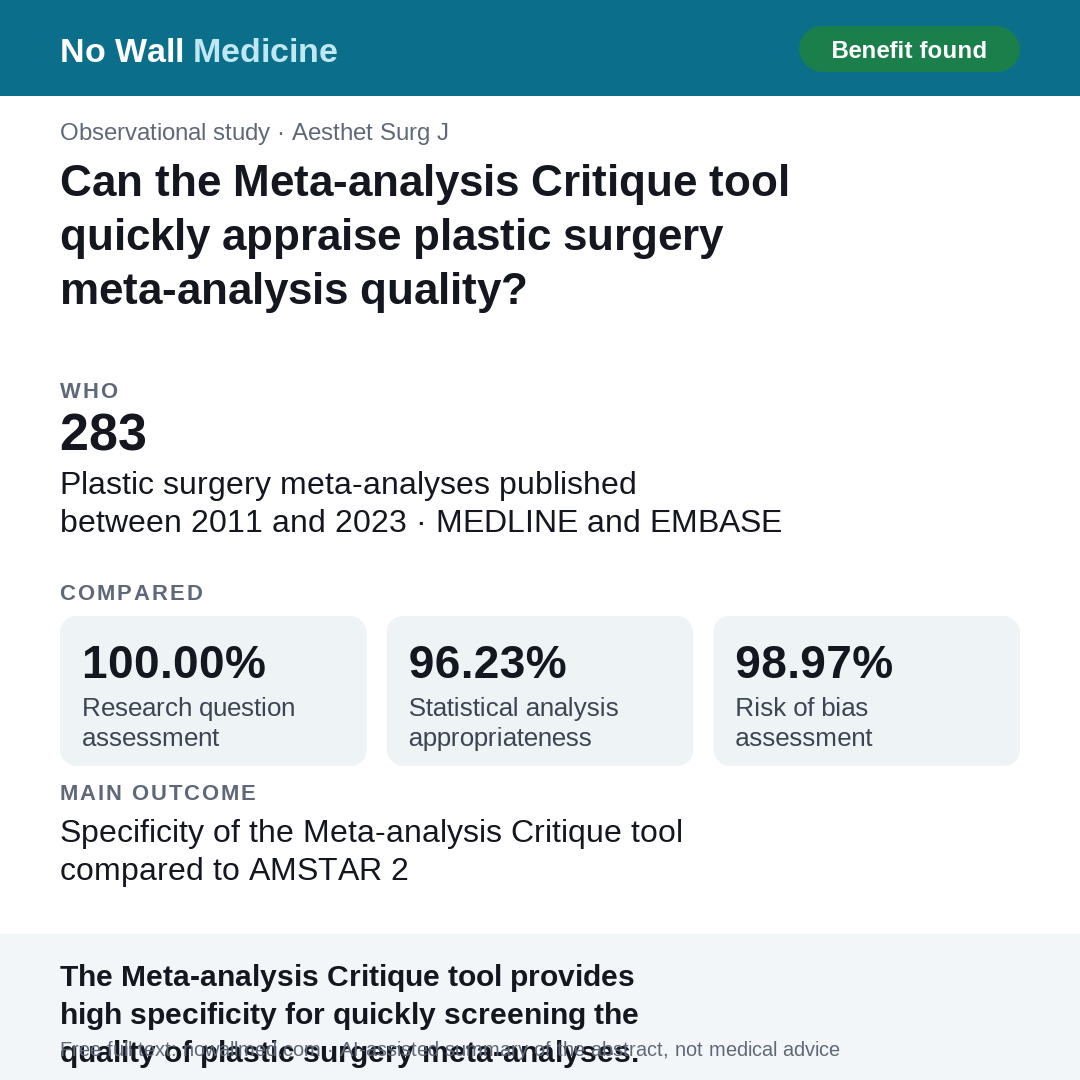
Clinical question: Can the Meta-analysis Critique tool quickly appraise plastic surgery meta-analysis quality?
Why it matters: Existing tools for assessing the quality of meta-analyses, which are collections of multiple studies, are often difficult for clinicians to use and time-consuming.
Key points
- Researchers analyzed 283 plastic surgery meta-analyses published between 2011 and 2023 using the AMSTAR 2 gold standard and a new three-question screening instrument called the Meta-analysis Critique (MAC) Tool.
- The MAC Tool showed high specificity for assessing the research question (100.00%, CI: 90.97%-100.00%), statistical analysis appropriateness (96.23%, CI: 87.02%-99.54%), and risk of bias (98.97%, CI: 94.39-99.97%).
- While the number of meta-analyses increased from 68 (24%) in the first half of the decade to 215 (76%) in the second half, the proportion of high-quality studies did not improve.
Limitation the authors note: The authors state that future studies are needed to validate this tool and determine its broader reliability in other medical specialties.
Headline and key points written with AI from the paper’s abstract, with every number checked against it. Read the paper before relying on them.
Cite this article
Leveille CF, Lewandowski N, Tsang QK, Churchill IF, Zhu XM, Gallo L. Rapid Identification of Low-quality Meta-analyses in Plastic Surgery Using the Meta-analysis Critique (MAC) Tool. Aesthet Surg J. 2026. doi:10.1093/asj/sjag162
Spotted a mistake? Suggest a correction