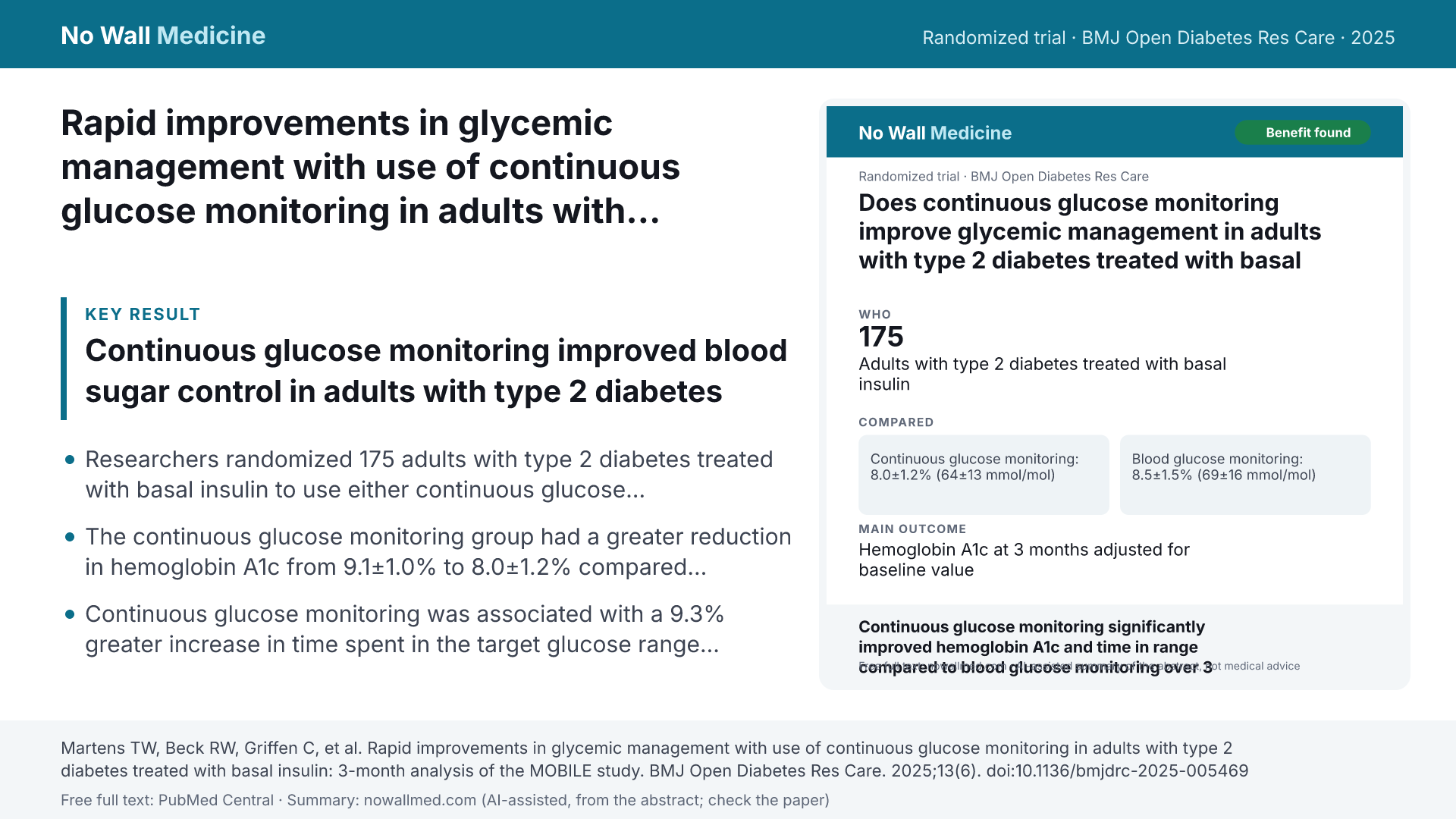
Continuous glucose monitoring improved blood sugar control in adults with type 2 diabetes
Rapid improvements in glycemic management with use of continuous glucose monitoring in adults with type 2 diabetes treated with basal insulin: 3-month analysis of the MOBILE study
Randomized trialBenefit found
Does continuous glucose monitoring improve glycemic management in adults with type 2 diabetes treated with basal insulin?
Who
175
Adults with type 2 diabetes treated with basal insulin
Compared
Continuous glucose monitoring: 8.0±1.2% (64±13 mmol/mol)
Blood glucose monitoring: 8.5±1.5% (69±16 mmol/mol)
Main outcome
Hemoglobin A1c at 3 months adjusted for baseline value
Result: -0.6% (95% CI -0.9% to -0.3%)
Bottom line: Continuous glucose monitoring significantly improved hemoglobin A1c and time in range compared to blood glucose monitoring over 3 months.
BMJ Open Diabetes Res Care · 2025-11-04Download image
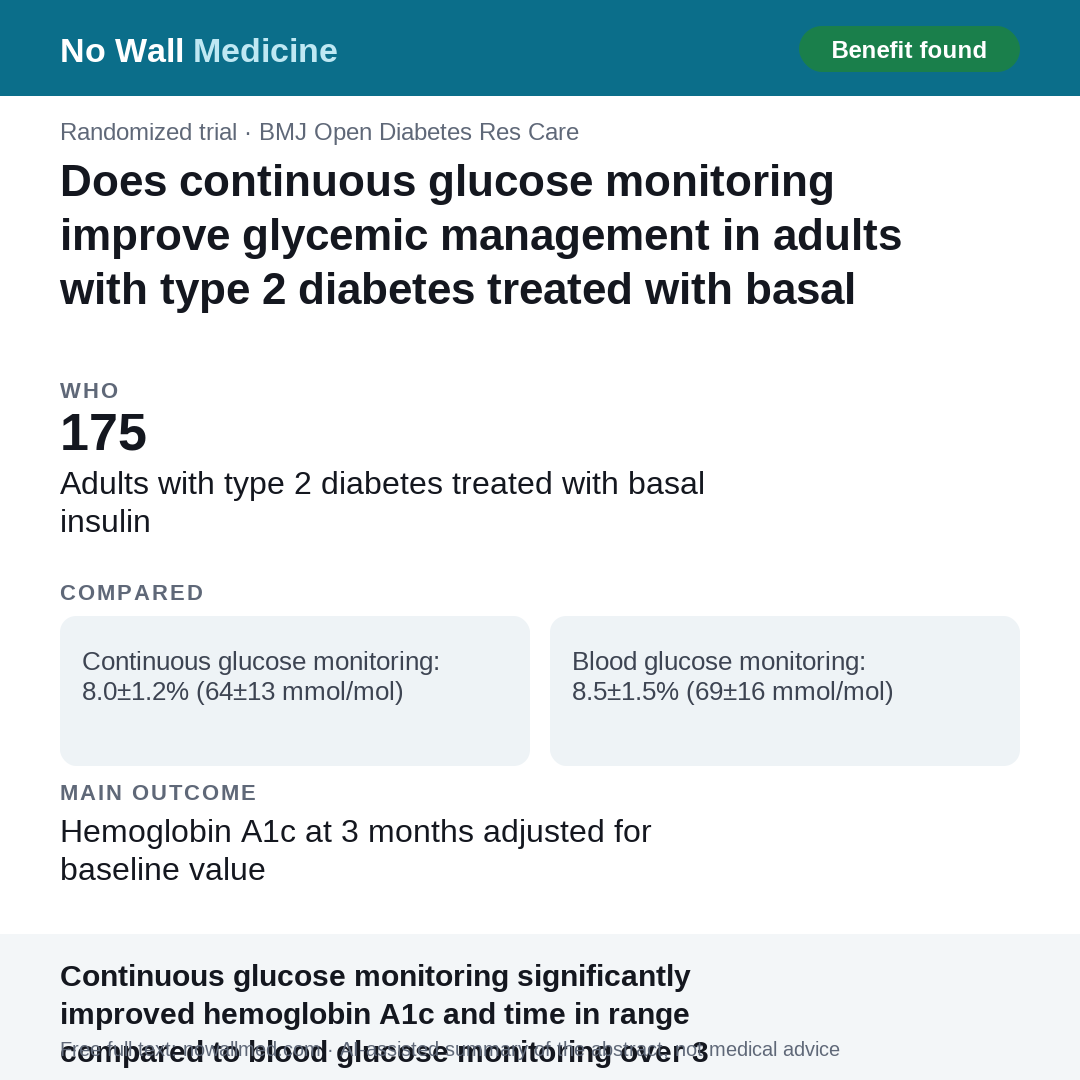
Clinical question: Does continuous glucose monitoring improve glycemic management in adults with type 2 diabetes treated with basal insulin?
Key points
- Researchers randomized 175 adults with type 2 diabetes treated with basal insulin to use either continuous glucose monitoring or blood glucose monitoring for 3 months.
- The continuous glucose monitoring group had a greater reduction in hemoglobin A1c from 9.1±1.0% to 8.0±1.2% compared to 9.0±0.9% to 8.5±1.5% in the blood glucose monitoring group.
- Continuous glucose monitoring was associated with a 9.3% greater increase in time spent in the target glucose range of 70-180 mg/dL and a lower weekly rate of low blood sugar events.
Headline and key points written with AI from the paper’s abstract, with every number checked against it. Read the paper before relying on them.
Was this summary helpful?
Abstract
Introduction
This analysis investigated whether use of real-time continuous glucose monitoring (CGM) compared with blood glucose monitoring (BGM) results in rapidly improved glycemic management in adults with type 2 diabetes (T2D) treated with basal insulin. Research design and methods
Using data from the MOBILE study where adults (n=175) with T2D treated with basal insulin without prandial insulin were randomized (2:1) to either CGM (n=116) or BGM (n=59), the treatment effect on glycemic management was determined over 3 months. The main outcome was a between-group difference in hemoglobin A1c (HbA1c) at 3 months adjusted for baseline value. Other outcomes included changes in CGM-derived glucose metrics and hypoglycemic events. Results
After 3 months, there was a greater reduction from baseline in mean HbA1c in the CGM group compared with the BGM group, from 9.1±1.0% (76±11 mmol/mol) to 8.0±1.2% (64±13 mmol/mol) in the CGM group and from 9.0±0.9% (75±10 mmol/mol) to 8.5±1.5% (69±16 mmol/mol) in the BGM group (adjusted difference, -0.6% (95% CI -0.9% to -0.3%); -6.6 mmol/mol (95% CI -10.2 to -2.9), p<0.001). Mean time spent in range 70-180 mg/dL (3.9-10.0 mmol/L) increased significantly more in the CGM group than the BGM group (adjusted difference, +9.3% (95% CI 2.1% to 16.4%), p<0.001). There also was a greater reduction in mean time >250 mg/dL (>13.9 mmol/L) with CGM (adjusted difference, -5.8% (95% CI -10.4% to -1.2%), p<0.001) without an increase in time <70 mg/dL (<3.9 mmol/L). Mean weekly hypoglycemic event rate was lower with CGM than BGM (adjusted difference, -0.2 events per week (95% CI -0.4 to -0.1), p<0.001). Further, in the CGM group, significant improvements in CGM metrics were observed during the first 7 days of CGM use. Conclusions
In adults with basal insulin-treated T2D, use of CGM compared with BGM resulted in rapidly improved glycemic management, with a substantial reduction in HbA1c over 3 months. Trial registration number
NCT03566693.
Abstract reproduced under the article’s CC BY NC licence.
Subject terms
Headline, design, result, key points, caveat and citation as plain text.
Cite this article
Martens TW, Beck RW, Griffen C, et al. Rapid improvements in glycemic management with use of continuous glucose monitoring in adults with type 2 diabetes treated with basal insulin: 3-month analysis of the MOBILE study. BMJ Open Diabetes Res Care. 2025. doi:10.1136/bmjdrc-2025-005469
Spotted a mistake? Suggest a correction