Rapid phenotypic tests show high accuracy for detecting antibiotic resistance directly from blood cultures
Rapid phenotypic testing for detection of carbapenemase- or extended-spectrum ß-lactamase-producing Enterobacterales directly from blood cultures: a systematic review and meta-analysis
Systematic review and meta-analysisBenefit found
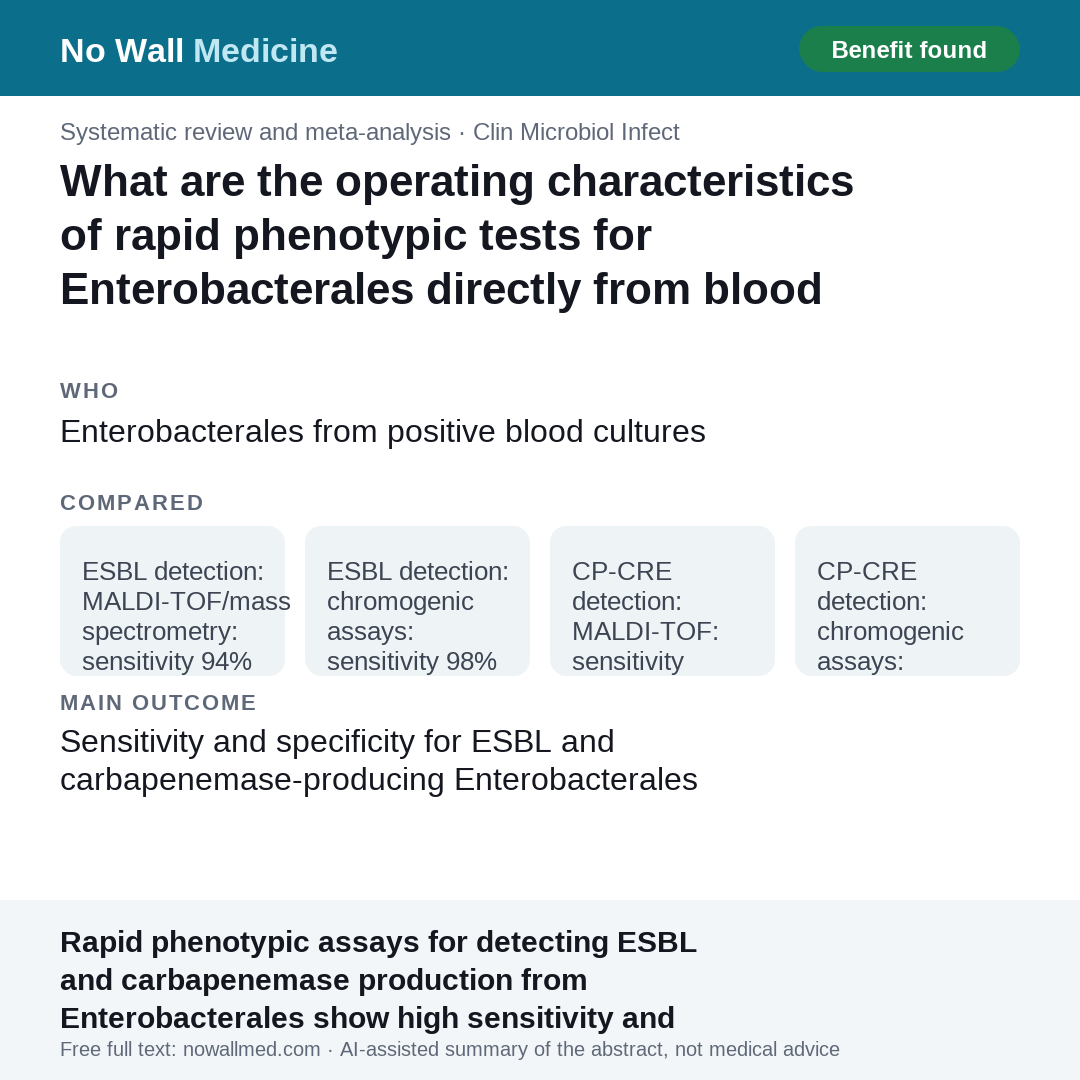
What are the operating characteristics of rapid phenotypic tests for Enterobacterales directly from blood cultures?
Who
Enterobacterales from positive blood cultures
Compared
ESBL detection: MALDI-TOF/mass spectrometry: sensitivity 94% (95% CI 93-99%) and specificity 97% (95% CI 95-100%)
ESBL detection: chromogenic assays: sensitivity 98% (95% CI 92-100%) and specificity 100% (95% CI 96-100%)
CP-CRE detection: MALDI-TOF: sensitivity 100% (95% CI 99-100%) and specificity 100% (95% CI 100-100%)
CP-CRE detection: chromogenic assays: sensitivity 96% (95% CI 77-99%) and specificity 100% (95% CI 81-100%)
Main outcome
Sensitivity and specificity for ESBL and carbapenemase-producing Enterobacterales detection
Bottom line: Rapid phenotypic assays for detecting ESBL and carbapenemase production from Enterobacterales show high sensitivity and specificity.
Limitation: clinical studies are limited
Clin Microbiol Infect · 2023-09-16Download image
Clinical question: What are the operating characteristics of rapid phenotypic tests for Enterobacterales directly from blood cultures?
Why it matters: It is unknown how well rapid phenotypic tests perform when applied directly to positive blood cultures rather than pure bacterial colonies.
Key points
- Researchers performed a meta-analysis of studies using mass spectrometry, chromogenic, or immunogenic assays to detect antibiotic resistance in Enterobacterales bacteria from blood cultures.
- For extended-spectrum beta-lactamase detection, mass spectrometry had 94% sensitivity and 97% specificity, while chromogenic assays had 98% sensitivity and 100% specificity.
- For carbapenemase-producing Enterobacterales detection, mass spectrometry showed 100% sensitivity and 100% specificity, while chromogenic assays showed 96% sensitivity and 100% specificity.
Limitation the authors note: Clinical studies are limited.
Headline and key points written with AI from the paper’s abstract, with every number checked against it. Read the paper before relying on them.
Was this summary helpful?
Subject terms
Cite this article
Del Corpo O, Senécal J, Hsu JM, Lawandi A, Lee TC. Rapid phenotypic testing for detection of carbapenemase- or extended-spectrum ß-lactamase-producing Enterobacterales directly from blood cultures: a systematic review and meta-analysis. Clin Microbiol Infect. 2023. doi:10.1016/j.cmi.2023.09.007
Spotted a mistake? Suggest a correction
Top studies every Monday
The week’s key trials and guidelines in your specialties, plus any topics you follow. By email, free.
Get the weekly digest