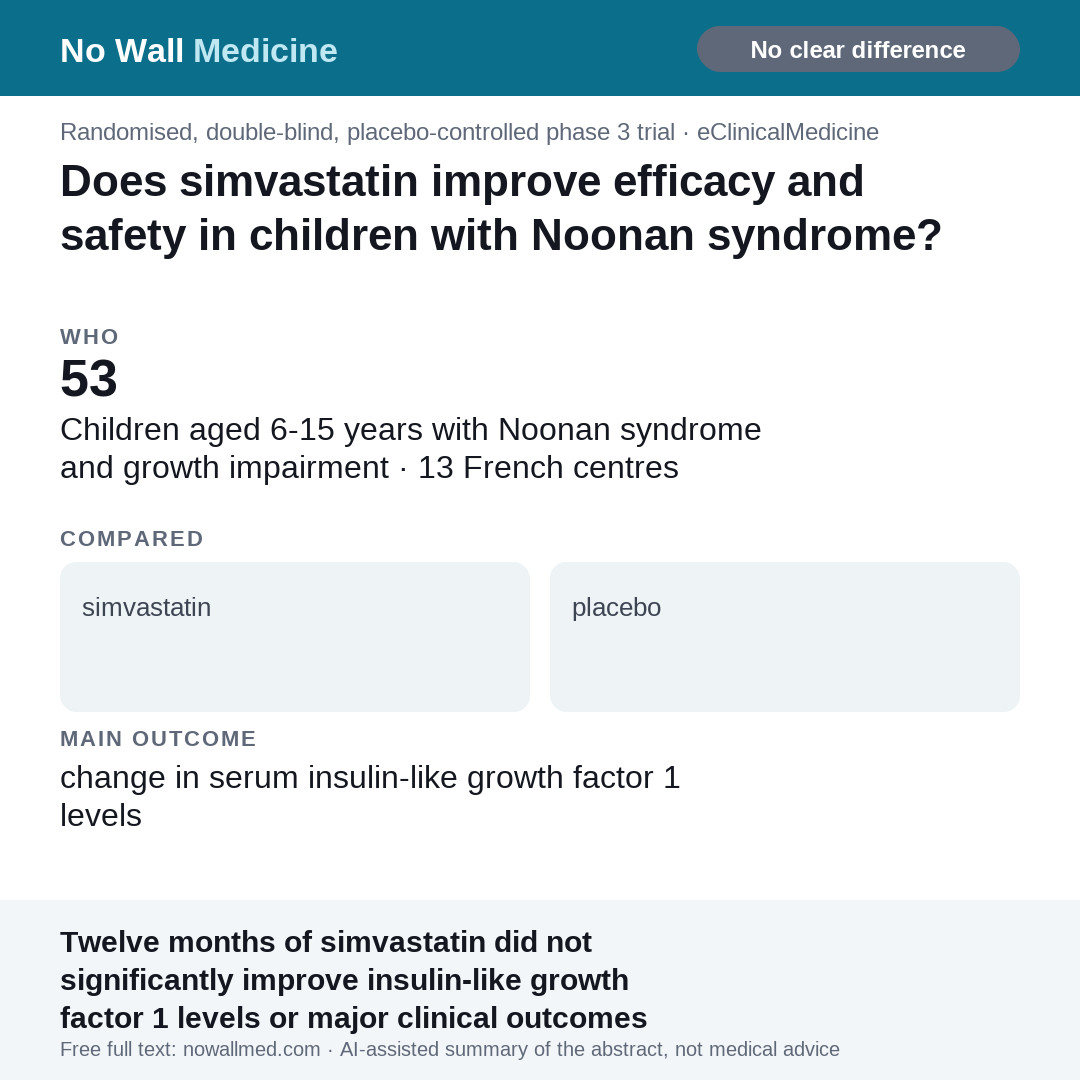
Simvastatin did not significantly improve growth or insulin-like growth factor 1 in children with Noonan syndrome
RAS/MAPK pathway modulation with simvastatin in children with Noonan syndrome: a multicentre, randomised, double-blind, placebo-controlled phase 3 trial
Edouard T, Capri Y, Verloes A, Amouroux C, Bournez M, Bretones P, et al
Clinical question: Does simvastatin improve efficacy and safety in children with Noonan syndrome?
Why it matters: No randomized controlled trials have evaluated the efficacy and safety of statin therapy in children with Noonan syndrome.
Key points
Researchers studied 53 children aged 6 to 15 years with Noonan syndrome, comparing daily simvastatin to a placebo over 12 months.
Simvastatin did not significantly improve insulin-like growth factor 1 levels, height, growth velocity, bone density, or behavioral outcomes compared to placebo.
Simvastatin was associated with borderline significant changes in a bone metabolism biomarker and a heart function parameter, but these did not lead to clinical improvements.
Limitation the authors note: The authors state that the borderline significant findings in secondary outcomes require confirmation in adequately powered studies.
Headline and key points written with AI from the paper’s abstract, with every number checked against it. Read the paper before relying on them.
Exploring outcomes and insights from joint agency response investigations for children with learning disabilities who die unexpectedly: an observational study
Prevalence, clinical characteristics and management of female genital mutilation in paediatric and adolescent patients: a retrospective cohort analysis from a clinic in Vienna, Austria
Evolution of the clinical profile and cardiac outcomes of multisystem inflammatory syndrome in children (MIS-C) across three COVID-19 waves in Central Kerala: a cross-sectional study