Atrial pacing did not improve exercise capacity in patients with heart failure and slow heart rates
Rate-Adaptive Atrial Pacing for Heart Failure With Preserved Ejection Fraction: The RAPID-HF Randomized Clinical Trial
Single-center, double-blind, randomized, crossover trialNo clear difference
Does rate-adaptive atrial pacing improve exercise performance in patients with heart failure with preserved ejection fraction?
Who
29
Patients with symptomatic heart failure with preserved ejection fraction and chronotropic incompetence · Tertiary referral center, Rochester, Minnesota
Compared
No pacing: 10.4 [SD, 2.9] mL/kg/min
Atrial rate responsive pacing: 10.7 [SD, 2.6] mL/kg/min
Main outcome
Oxygen consumption at anaerobic threshold
Result: absolute difference, 0.3 [95% CI, -0.5 to 1.0] mL/kg/min
Bottom line: Atrial pacing increased exercise heart rate but did not improve oxygen consumption or exercise capacity in these patients.
JAMA · 2023-03-06Download image
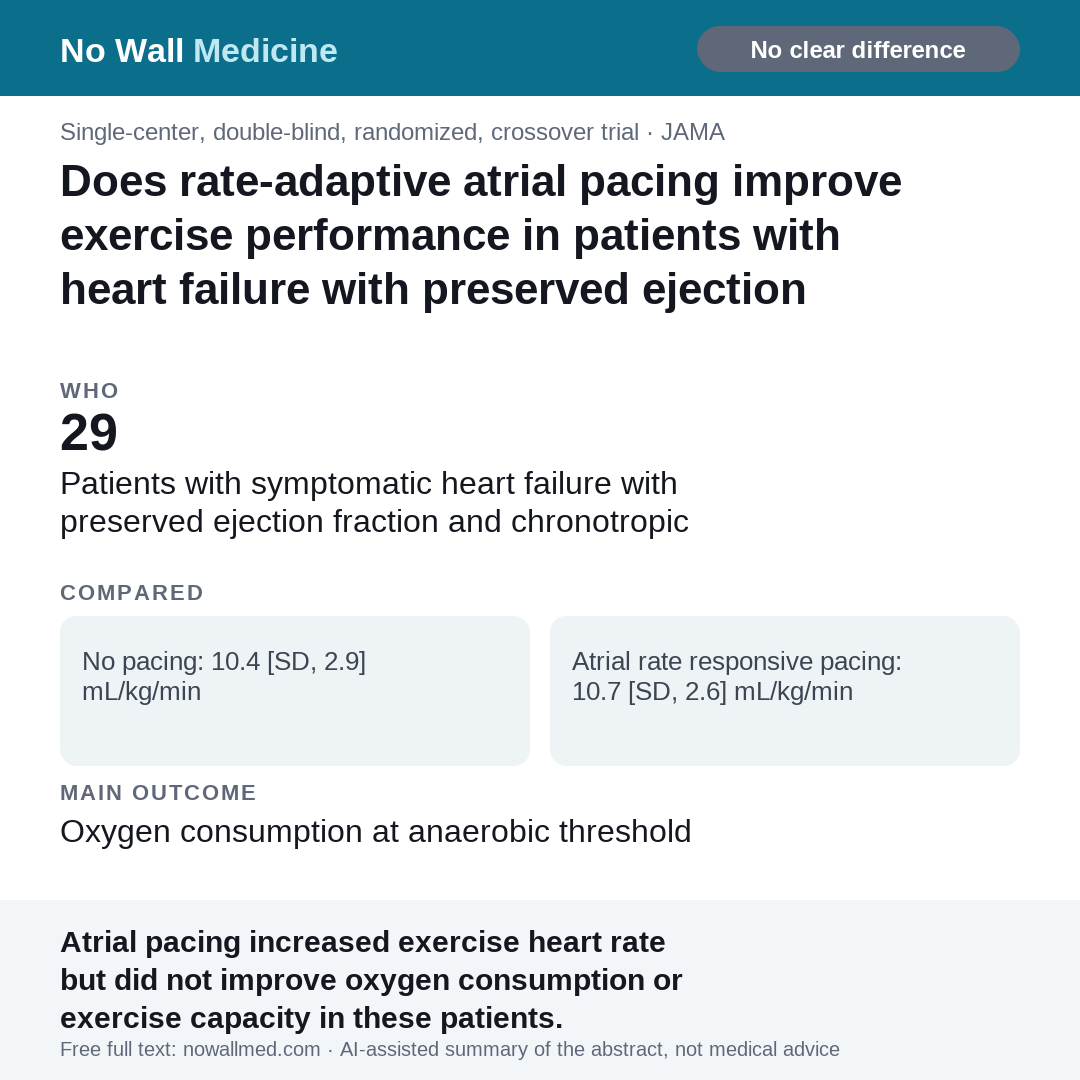
Clinical question: Does rate-adaptive atrial pacing improve exercise performance in patients with heart failure with preserved ejection fraction?
Why it matters: It was unknown if restoring heart rate during exercise through atrial pacing would be beneficial for patients with heart failure and impaired aerobic capacity.
Key points
- Researchers studied 29 patients with heart failure and chronotropic incompetence, which is the inability to increase heart rate during exercise, using a randomized crossover trial.
- While pacing increased heart rate during low-level and peak exercise, it did not significantly change oxygen consumption at the anaerobic threshold, peak oxygen consumption, or health status scores.
- Atrial pacing was associated with a decrease in stroke volume of -24 mL [95% CI, -43 to -5] and device-related adverse events in 6 of 29 participants (21%).
Headline and key points written with AI from the paper’s abstract, with every number checked against it. Read the paper before relying on them.
Topics
Cite this article
Reddy YNV, Koepp KE, Carter R, Win S, Jain CC, Olson TP. Rate-Adaptive Atrial Pacing for Heart Failure With Preserved Ejection Fraction: The RAPID-HF Randomized Clinical Trial. JAMA. 2023. doi:10.1001/jama.2023.0675
Spotted a mistake? Suggest a correction