Artificial intelligence assistance increased anatomical coverage during nose and throat examinations in a randomized trial
Real-time AI-assisted quality control during nasopharyngolaryngoscopy: a randomized controlled trial
Prospective, double-centre, randomized controlled trialBenefit found
Does real-time AI-assisted quality control improve anatomical coverage during nasopharyngolaryngoscopy?
Who
318
Patients undergoing nasopharyngolaryngoscopy examination · Two centres
Compared
93.08%ENDOVISTA-ENT-assisted
83.50%Conventional
Main outcome
Coverage of predefined anatomical sites
Bottom line: Real-time AI-assisted quality control significantly improves anatomical coverage during nasopharyngolaryngoscopy without increasing examination time.
NPJ Digit Med · 2026-04-16Download image
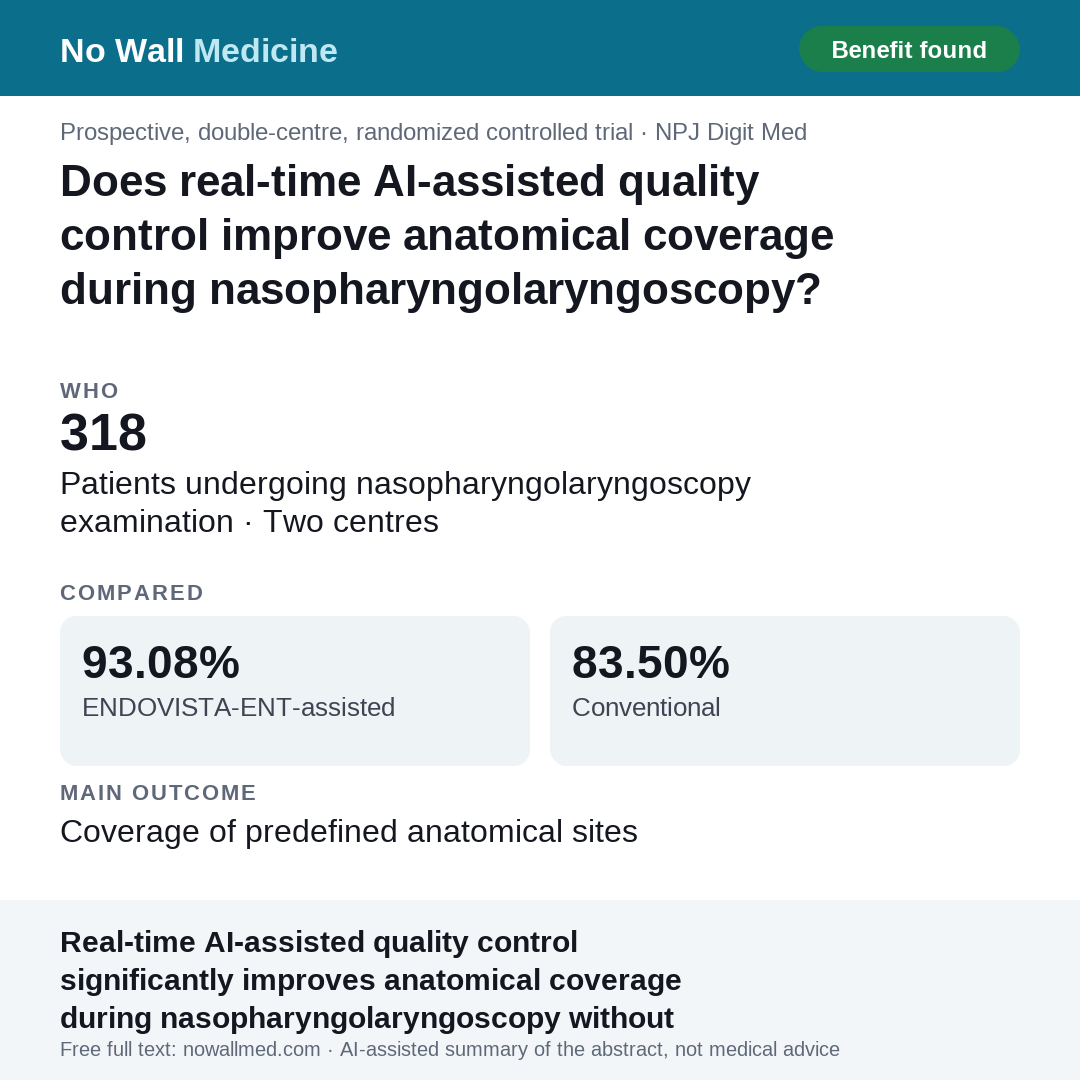
Clinical question: Does real-time AI-assisted quality control improve anatomical coverage during nasopharyngolaryngoscopy?
Why it matters: Incomplete examinations during nasopharyngolaryngoscopy may contribute to missed findings in clinical practice.
In absolute numbers
ENDOVISTA-ENT-assisted: 93.08% · Conventional: 83.5% → a difference of 9.6 percentage points, so about 11 people would need the treatment for 1 more to benefit (number needed to treat) over the trial’s follow-up.
Worked out by us from the two group results above, not reported by the authors. Check the paper for the exact outcome and timing.
Key points
- Researchers conducted a randomized controlled trial with 318 patients to compare conventional nasopharyngolaryngoscopy with an artificial intelligence-assisted system.
- The artificial intelligence system achieved a mean anatomical coverage of 93.08% compared to 83.50% for conventional examinations (P < 0.0001).
- The improvement in coverage occurred without significantly increasing the time required for the examination.
Headline and key points written with AI from the paper’s abstract, with every number checked against it. Read the paper before relying on them.
Cite this article
Li Y, Ye B, Li Y, Fan C, Chen W, Shuai Y. Real-time AI-assisted quality control during nasopharyngolaryngoscopy: a randomized controlled trial. NPJ Digit Med. 2026. doi:10.1038/s41746-026-02643-0
Spotted a mistake? Suggest a correction