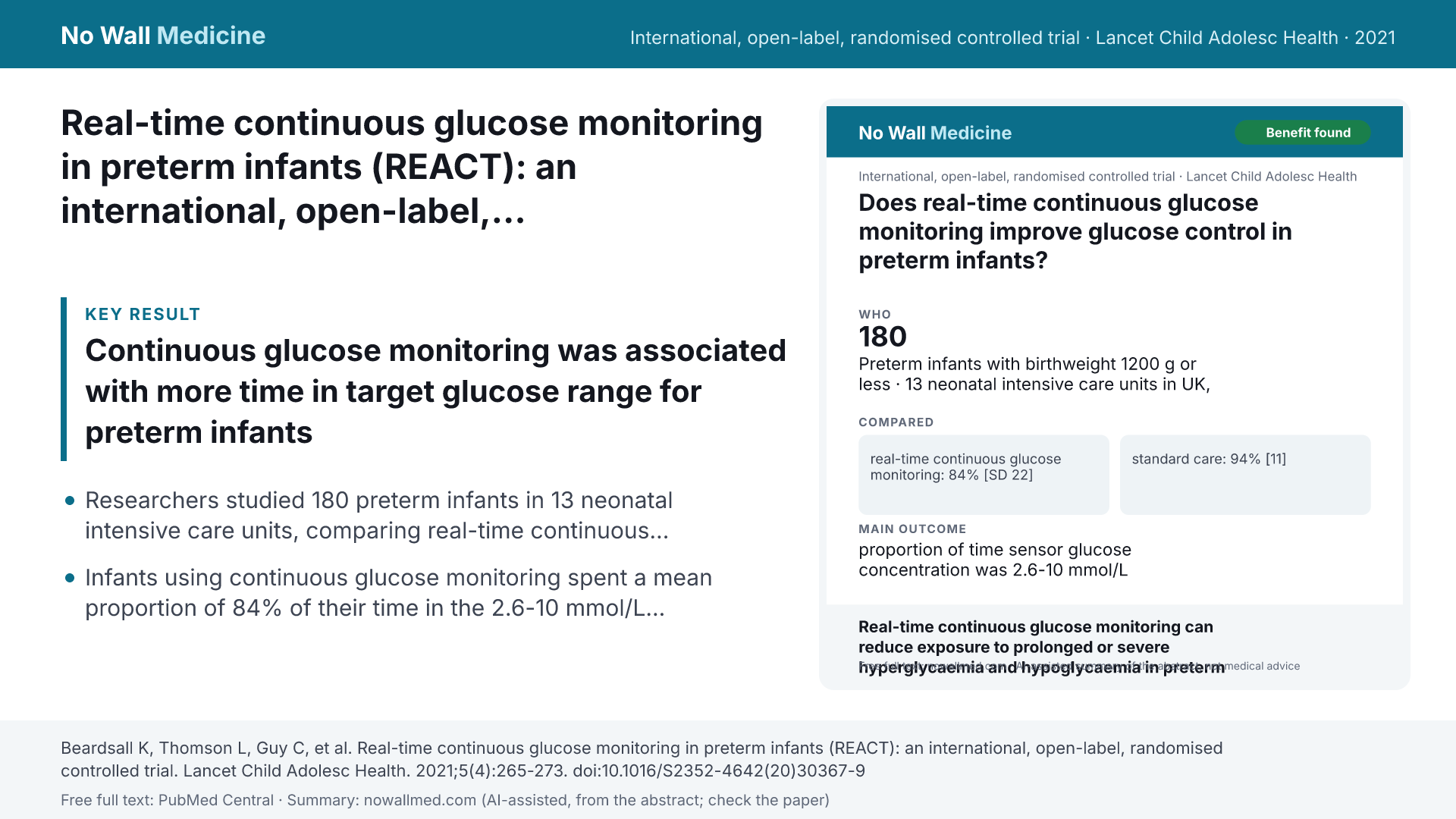
Continuous glucose monitoring was associated with more time in target glucose range for preterm infants
Real-time continuous glucose monitoring in preterm infants (REACT): an international, open-label, randomised controlled trial
International, open-label, randomised controlled trialBenefit found
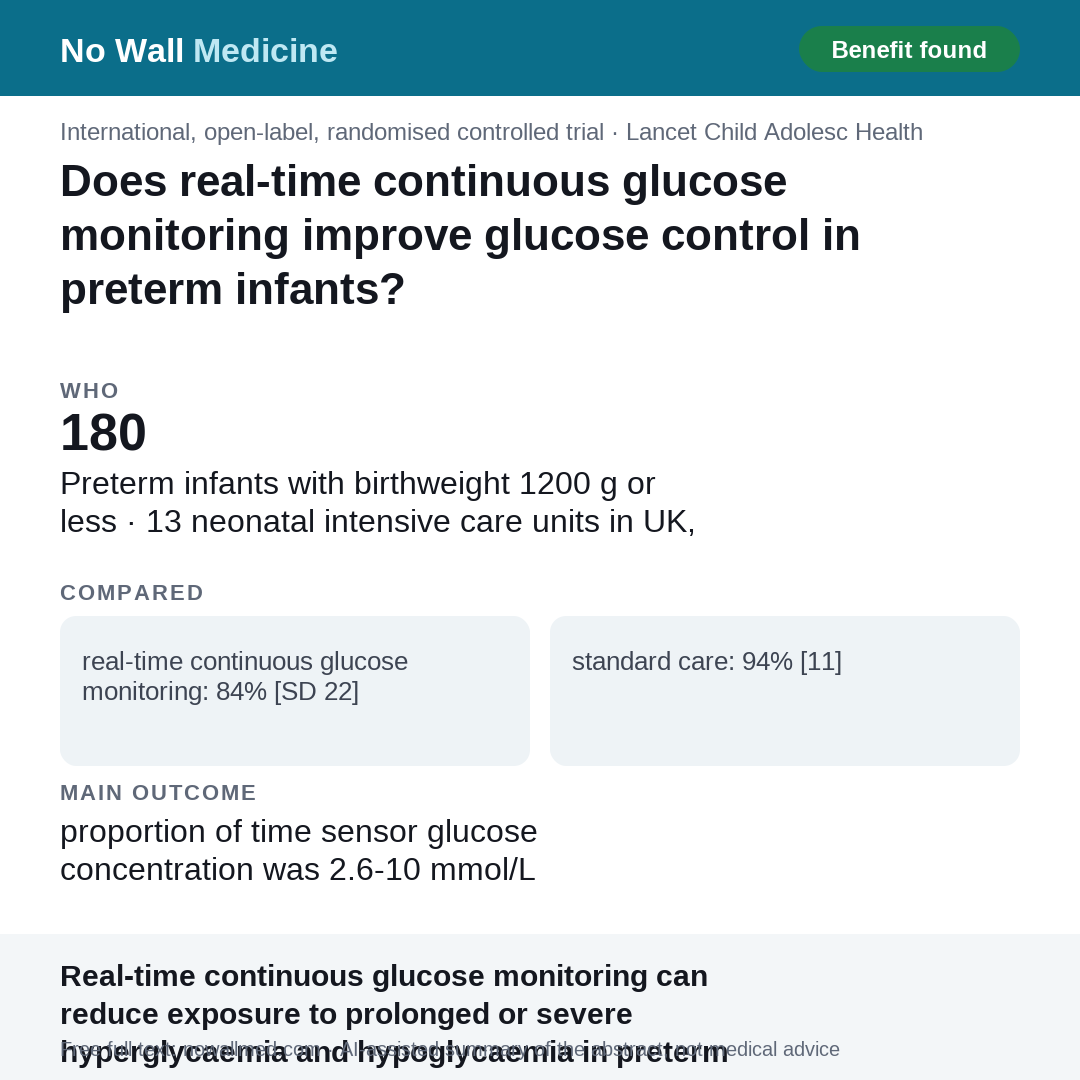
Does real-time continuous glucose monitoring improve glucose control in preterm infants?
Who
180
Preterm infants with birthweight 1200 g or less · 13 neonatal intensive care units in UK, Spain, and Netherlands
Compared
real-time continuous glucose monitoring: 84% [SD 22]
standard care: 94% [11]
Main outcome
proportion of time sensor glucose concentration was 2.6-10 mmol/L
Result: adjusted mean difference 8.9% (95% CI 3.4-14.4)
Bottom line: Real-time continuous glucose monitoring can reduce exposure to prolonged or severe hyperglycaemia and hypoglycaemia in preterm infants.
Funded by: National Institute for Health Research Efficacy and Mechanisms Evaluation Programme
Lancet Child Adolesc Health · 2021-02-10Download image
Clinical question: Does real-time continuous glucose monitoring improve glucose control in preterm infants?
Why it matters: It is unknown if continuous glucose monitoring, which tracks blood sugar levels in real-time, is effective or safe for preterm infants in intensive care.
Key points
- Researchers studied 180 preterm infants in 13 neonatal intensive care units, comparing real-time continuous glucose monitoring to standard care.
- Infants using continuous glucose monitoring spent a mean proportion of 84% of their time in the 2.6-10 mmol/L target range compared to 94% in standard care.
- More infants in the standard care group experienced glucose levels below 2.6 mmol/L for over 1 hour than those in the continuous glucose monitoring group.
Headline and key points written with AI from the paper’s abstract, with every number checked against it. Read the paper before relying on them.
Was this summary helpful?
Abstract
Background
Hyperglycaemia and hypoglycaemia are common in preterm infants and have been associated with increased risk of mortality and morbidity. Interventions to reduce risk associated with these exposures are particularly challenging due to the infrequent measurement of blood glucose concentrations, with the potential of causing more harm instead of improving outcomes for these infants. Continuous glucose monitoring (CGM) is widely used in adults and children with diabetes to improve glucose control, but has not been approved for use in neonates. The REACT trial aimed to evaluate the efficacy and safety of CGM in preterm infants requiring intensive care. Methods
This international, open-label, randomised controlled trial was done in 13 neonatal intensive care units in the UK, Spain, and the Netherlands. Infants were included if they were within 24 h of birth, had a birthweight of 1200 g or less, had a gestational age up to 33 weeks plus 6 days, and had parental written informed consent. Infants were randomly assigned (1:1) to real-time CGM or standard care (with masked CGM for comparison) using a central web randomisation system, stratified by recruiting centre and gestational age (<26 or ≥26 weeks). The primary efficacy outcome was the proportion of time sensor glucose concentration was 2·6-10 mmol/L for the first week of life. Safety outcomes related to hypoglycaemia (glucose concentrations <2·6 mmol/L) in the first 7 days of life. All outcomes were assessed on the basis of intention to treat in the full analysis set with available data. The study is registered with the International Standard Randomised Control Trials Registry, ISRCTN12793535. Findings
Between July 4, 2016, and Jan 27, 2019, 182 infants were enrolled, 180 of whom were randomly assigned (85 to real-time CGM, 95 to standard care). 70 infants in the real-time CGM intervention group and 85 in the standard care group had CGM data and were included in the primary analysis. Compared with infants in the standard care group, infants managed using CGM had more time in the 2·6-10 mmol/L glucose concentration target range (mean proportion of time 84% [SD 22] vs 94% [11]; adjusted mean difference 8·9% [95% CI 3·4-14·4]), equivalent to 13 h (95% CI 5-21). More infants in the standard care group were exposed to at least one episode of sensor glucose concentration of less than 2·6 mmol/L for more than 1 h than those in the intervention group (13 [15%] of 85 vs four [6%] of 70). There were no serious adverse events related to the use of the device or episodes of infection. Interpretation
Real-time CGM can reduce exposure to prolonged or severe hyperglycaemia and hypoglycaemia. Further studies using CGM are required to determine optimal glucose targets, strategies to obtain them, and the potential effect on long-term health outcomes. Funding
National Institute for Health Research Efficacy and Mechanisms Evaluation Programme.
Abstract reproduced under the article’s CC BY licence.
Subject terms
Cite this article
Beardsall K, Thomson L, Guy C, et al. Real-time continuous glucose monitoring in preterm infants (REACT): an international, open-label, randomised controlled trial. Lancet Child Adolesc Health. 2021. doi:10.1016/S2352-4642(20)30367-9
Spotted a mistake? Suggest a correction