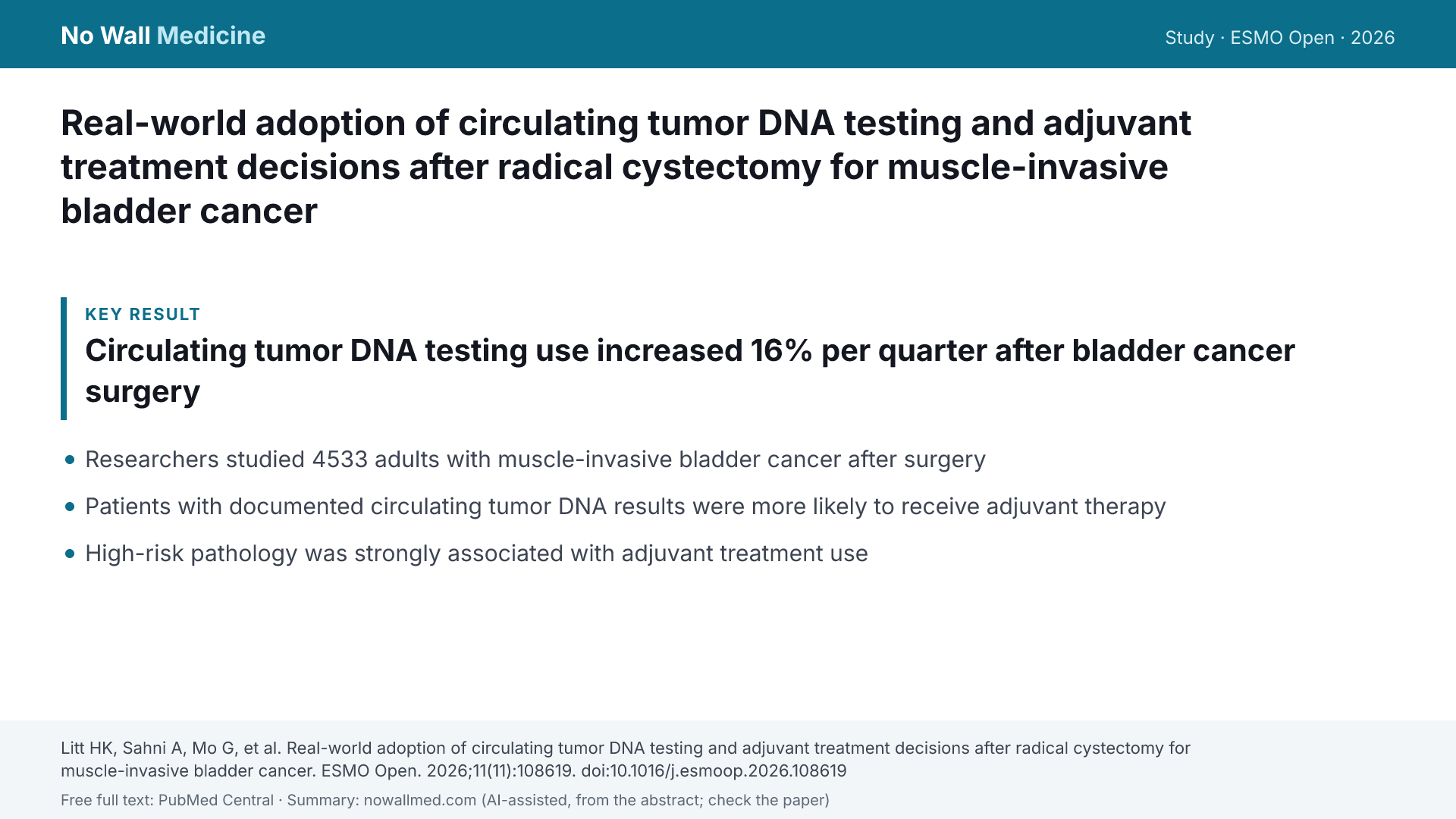
Circulating tumor DNA testing use increased 16% per quarter after bladder cancer surgery
Real-world adoption of circulating tumor DNA testing and adjuvant treatment decisions after radical cystectomy for muscle-invasive bladder cancer
Why it matters: Doctors have had little data on how circulating tumor DNA testing affects treatment decisions after bladder cancer surgery
Key points
- Researchers studied 4533 adults with muscle-invasive bladder cancer after surgery.
- Patients with documented circulating tumor DNA results were more likely to receive adjuvant therapy.
- High-risk pathology was strongly associated with adjuvant treatment use.
Limitation the authors note: Precision was limited in the association between detectable circulating tumor DNA and adjuvant treatment use
Study type: Observational study: it can show a link, but not prove that one thing causes another.
Headline and key points written with AI from the paper’s abstract, with every number checked against it. Read the paper before relying on them.
Was this summary helpful?
Headline, design, result, key points, caveat and citation as plain text.
Cite this article
Litt HK, Sahni A, Mo G, et al. Real-world adoption of circulating tumor DNA testing and adjuvant treatment decisions after radical cystectomy for muscle-invasive bladder cancer. ESMO Open. 2026;11(11):108619. doi:10.1016/j.esmoop.2026.108619
Spotted a mistake? Suggest a correction