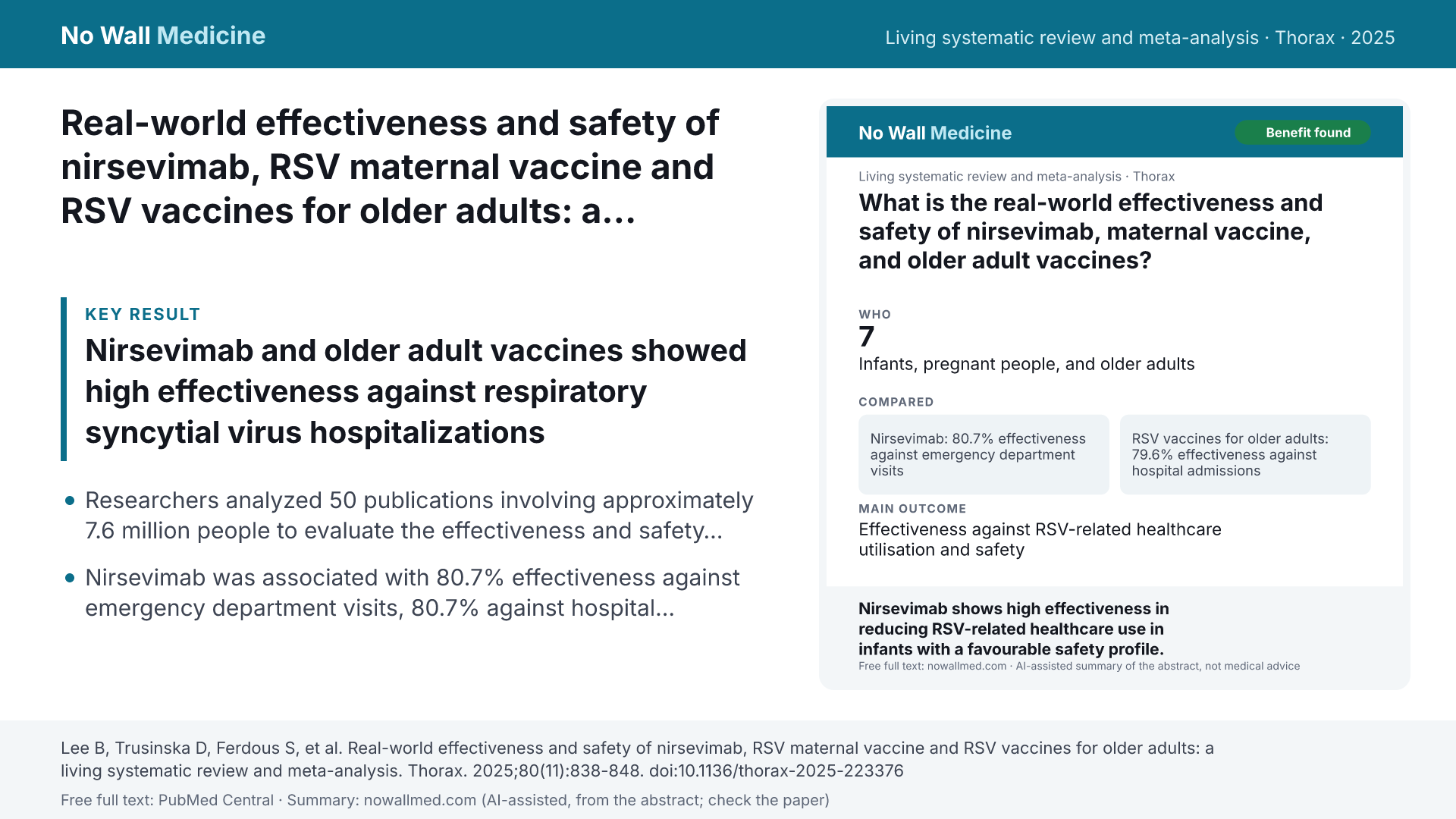
Nirsevimab and older adult vaccines showed high effectiveness against respiratory syncytial virus hospitalizations
Real-world effectiveness and safety of nirsevimab, RSV maternal vaccine and RSV vaccines for older adults: a living systematic review and meta-analysis
Living systematic review and meta-analysisBenefit found
What is the real-world effectiveness and safety of nirsevimab, maternal vaccine, and older adult vaccines?
Who
7
Infants, pregnant people, and older adults
Compared
Nirsevimab: 80.7% effectiveness against emergency department visits
RSV vaccines for older adults: 79.6% effectiveness against hospital admissions
Main outcome
Effectiveness against RSV-related healthcare utilisation and safety
Result: nirsevimab effectiveness against hospital admissions 80.7% (95% CI: 76.1% to 85.2%)
Bottom line: Nirsevimab shows high effectiveness in reducing RSV-related healthcare use in infants with a favourable safety profile.
Limitation: More evidence is needed for evaluating RSV vaccines in pregnant people and older adults.
Thorax · 2025-10-15Download image
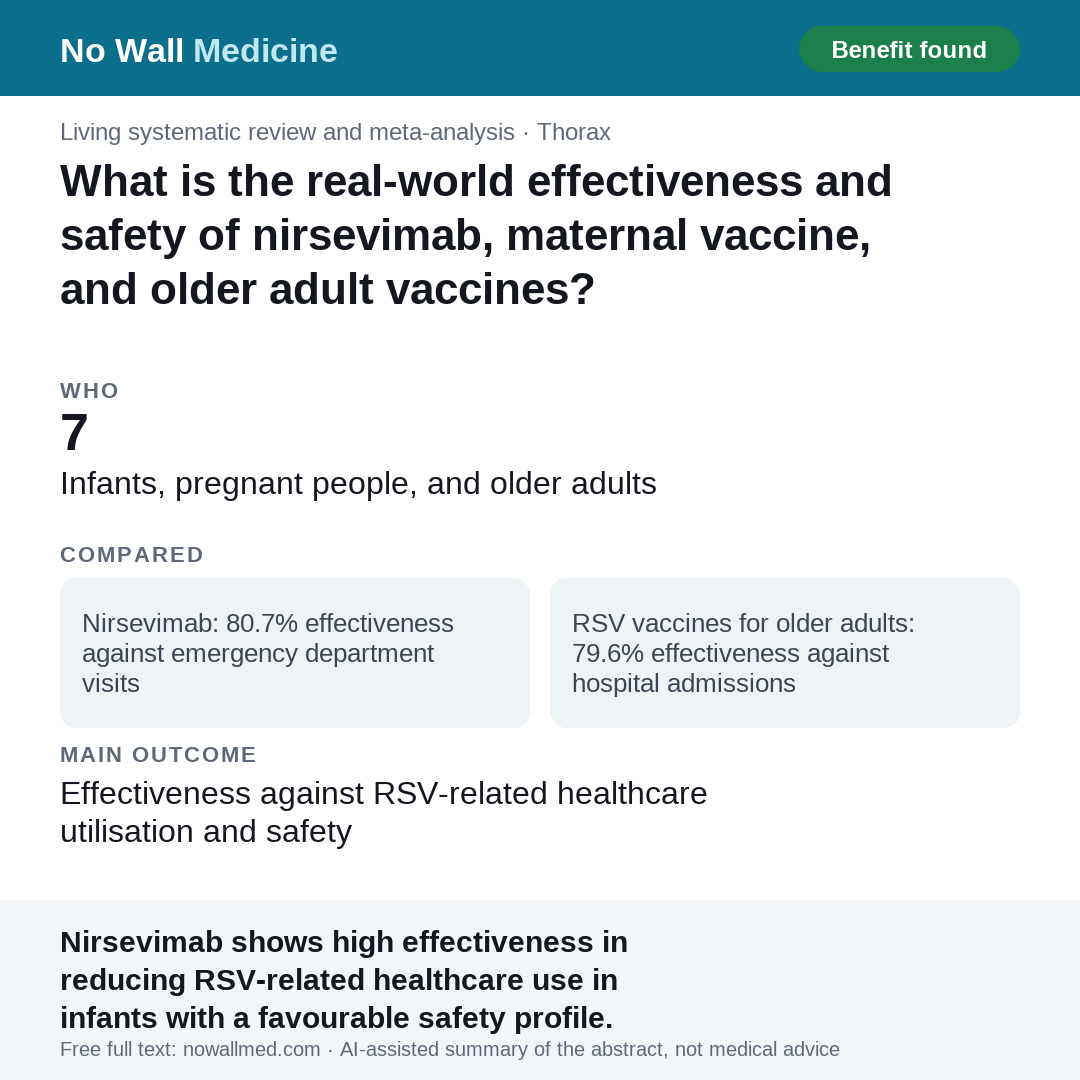
Clinical question: What is the real-world effectiveness and safety of nirsevimab, maternal vaccine, and older adult vaccines?
Why it matters: Clinical trials for these respiratory syncytial virus preventions had restrictive inclusion criteria, small sample sizes, and short follow-up periods.
Key points
- Researchers analyzed 50 publications involving approximately 7.6 million people to evaluate the effectiveness and safety of nirsevimab, maternal vaccines, and vaccines for older adults.
- Nirsevimab was associated with 80.7% effectiveness against emergency department visits, 80.7% against hospital admissions, and 75.6% against intensive care unit admissions.
- RSV vaccines for older adults were associated with 79.6% effectiveness against hospital admissions, and fewer than 10 cases of Guillain-Barré syndrome per million doses were reported.
Limitation the authors note: Evidence was limited for the RSV maternal vaccine.
Headline and key points written with AI from the paper’s abstract, with every number checked against it. Read the paper before relying on them.
Was this summary helpful?
Abstract
Background
The long-acting monoclonal antibody nirsevimab and respiratory syncytial virus (RSV) vaccines became available for prevention of severe RSV-associated disease in 2023. While clinical trials showed good efficacy and safety, their restrictive inclusion criteria, small sample sizes and short follow-up limit generalisability. We aimed to summarise real-world evidence on the effectiveness and safety of nirsevimab, RSV maternal vaccine and RSV vaccines for older adults. Methods
A living systematic review and meta-analysis, with 5 monthly updated searches in three databases was performed. Eligible studies were published from 1 December 2022 to 10 March 2025. Meta-analyses for the effectiveness of nirsevimab and RSV vaccines were carried out using random-effects model. Safety data were summarised narratively. Results
A total of 50 publications, covering approximately 7.6 million people, were included. Nirsevimab showed 80.7% effectiveness (95% CI: 75.7% to 85.7%; seven studies) against RSV-related emergency department visits, 80.7% (95% CI: 76.1% to 85.2%; 17 studies) against hospital admissions and 75.6% (95% CI: 63.3% to 87.9%; eight studies) against intensive care unit admissions. The effectiveness of RSV vaccines for older adults against RSV-related hospital admissions was 79.6% (95% CI: 73.8% to 85.3; three studies). No effectiveness data were available for RSV maternal vaccine. No severe adverse events were reported for nirsevimab, while RSV vaccines in older adults had fewer than 10 Guillain-Barré syndrome cases per million doses. No severe adverse events were reported for RSV maternal vaccine, although evidence was limited. Conclusions
Our review demonstrated high effectiveness of nirsevimab in reducing RSV-related healthcare utilisation in infants and a favourable safety profile. More evidence is needed for evaluating RSV vaccines in pregnant people and older adults. Prospero registration number
CRD42025643585.
Abstract reproduced under the article’s CC BY NC licence.
Subject terms
Cite this article
Lee B, Trusinska D, Ferdous S, et al. Real-world effectiveness and safety of nirsevimab, RSV maternal vaccine and RSV vaccines for older adults: a living systematic review and meta-analysis. Thorax. 2025. doi:10.1136/thorax-2025-223376
Spotted a mistake? Suggest a correction