Standardized management of chronic obstructive pulmonary disease is being tested in a large Chinese hospital trial
Real-world effectiveness study of guideline-directed COPD STANDARDized management in patients with chronic obstructive pulmonary disease: a cluster randomised trial design
Cluster randomized pragmatic trialUnclear result
Does guideline-directed standardized management prevent moderate-to-severe exacerbations in patients with chronic obstructive pulmonary disease?
Who
3456
Stable patients with chronic obstructive pulmonary disease · 99 secondary hospitals in China
Compared
standardized management
usual care
Main outcome
moderate-to-severe exacerbation
Bottom line: This ongoing trial aims to assess if standardized management improves exacerbation prevention in chronic obstructive pulmonary disease.
Limitation: The study is currently being performed between 2023 and 2027.
BMJ Open Respir Res · 2025-07-07Download image
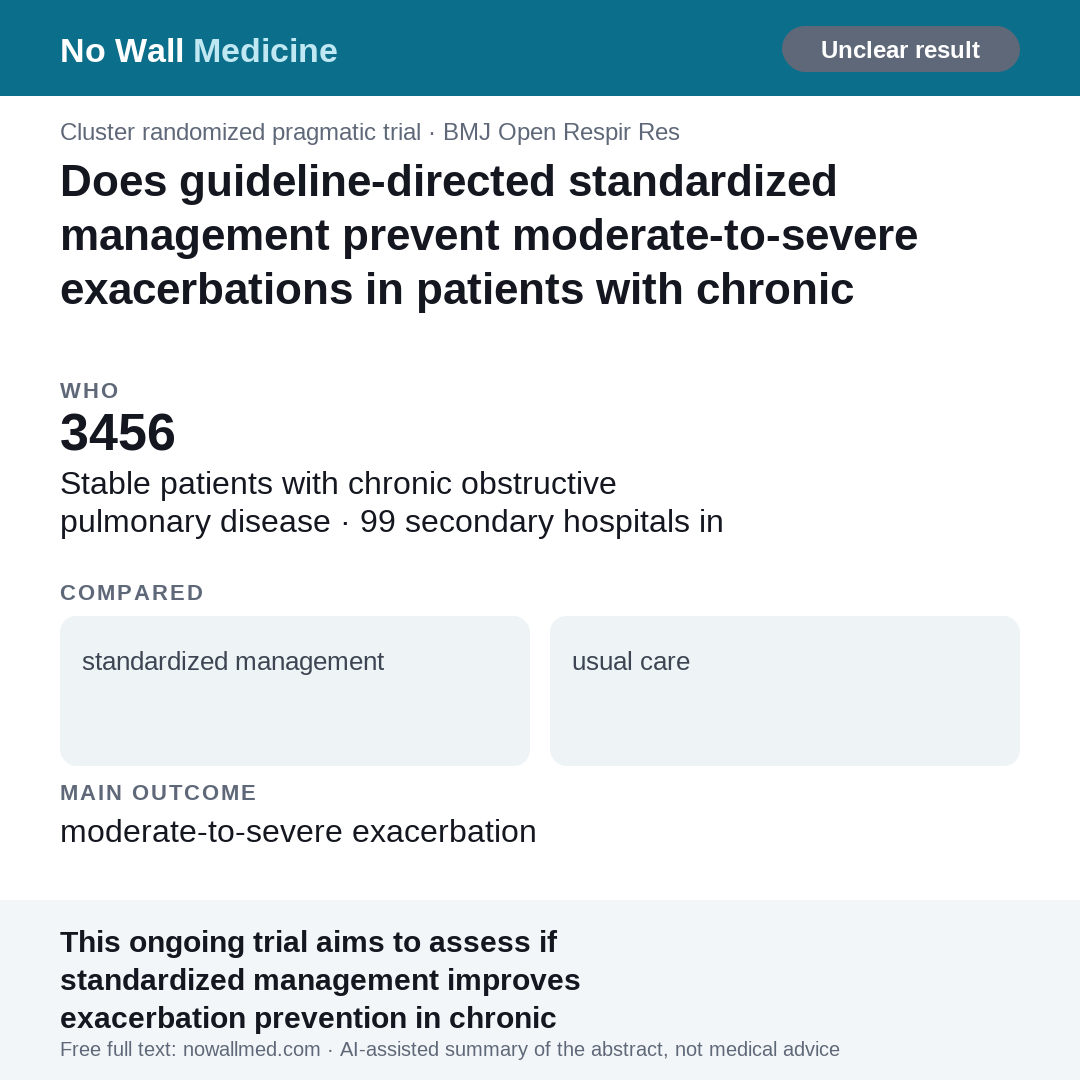
Clinical question: Does guideline-directed standardized management prevent moderate-to-severe exacerbations in patients with chronic obstructive pulmonary disease?
Why it matters: Existing guidelines for managing chronic obstructive pulmonary disease are not fully implemented in clinical settings, and evidence regarding real-world effectiveness is limited.
Key points
- Researchers are conducting a cluster randomized trial involving 3456 stable patients with chronic obstructive pulmonary disease across 99 hospitals in China.
- The study compares an integrated five-component intervention, including inhaled therapy and education, against routine care to assess effectiveness in preventing moderate-to-severe exacerbations.
- Secondary outcomes being measured include hospital admission, mortality, health status, and self-management of the disease.
Headline and key points written with AI from the paper’s abstract, with every number checked against it. Read the paper before relying on them.
Abstract
Introduction
Chronic obstructive pulmonary disease (COPD) affects the ageing population worldwide. Exacerbations worsen health status and increase health resource use. Existing guidelines recommend disease management, but they are not fully implemented in a clinical setting. Evidence regarding best practice and real-world effectiveness is limited. Methods and analysis
A nationwide multicentre clinical effectiveness trial is being performed between 2023 and 2027, involving 99 secondary hospitals in urban and rural areas in China. It is an open-label, adjudicator and assessor-blinded, parallel group, cluster randomised pragmatic trial. Hospitals are randomly allocated to standardised management (SM) or usual care. A total number of 3456 stable patients with COPD who are symptomatic (individuals in the Global Initiative for Chronic Obstructive Lung Disease (GOLD) Group B) or have exacerbation risk (individuals with one moderate exacerbation history in Group A and individuals in Group E) using GOLD 2023 ABE classification will be enrolled. In the SM group, an integrated intervention comprising five components will be delivered using a physician and nurse model. These are: (1) long-term inhaled maintenance therapy, (2) periodic inhaler technique assessment and symptom monitoring, (3) annual pulmonary function testing, (4) COPD education session and (5) health behaviour adoption (smoking cessation, vaccination, pulmonary rehabilitation). In the control group, patients will receive routine care. The primary goal is to assess the real-world effectiveness of guideline-directed disease management on exacerbation prevention, with moderate-to-severe exacerbation as the primary outcome and hospital admission, mortality, health status and COPD self-management as secondary outcomes. It is the first pragmatic trial undertaken of this form in a developing country. It is anticipated that it will provide a feasible and effective COPD management model that can inform guidelines and be rolled out into secondary and primary care, with modification, to ensure standardised COPD care nationwide. Trial registration number
NCT04664491.
Abstract reproduced under the article’s CC BY NC licence.
Topics
Cite this article
Dong F, Su R, Ren Y, Huang K, Li W, Yang L. Real-world effectiveness study of guideline-directed COPD STANDARDized management in patients with chronic obstructive pulmonary disease: a cluster randomised trial design. BMJ Open Respir Res. 2025. doi:10.1136/bmjresp-2024-002768
Spotted a mistake? Suggest a correction